Understanding Power Transmission Financing
Search
Please fill the input to search
The group of authors who donated their expertise (and time!) to this book came together for a simple and collective intent: to address the critical deficit of transmission capacity in Sub-Saharan Africa. It is stated that roughly half the population of Sub-Saharan Africa (or 600 million people) lack reliable access to electricity. The lack of electricity access is particularly stark at a time when the global number of persons without access to electricity is falling.
While there is no adequate information on the breakdown between generation, transmission, and distribution, historically investment in generation has been roughly four times higher than transmission and distribution combined. Furthermore, the distribution sector has also attracted more investment than transmission, leaving this segment of the African energy market as the most impacted by a lack of both public and private investment.
The critical nature of transmission infrastructure to the overall function of an energy market cannot be overstated. As generation expands, transmission is needed to bring electricity to the demand centres. Additional transmission capacity (including cross-border) can also provide access to large power generation sources and connect them to unserved demand. Transmission across national borders, often referred to as interconnection, enables economies of scale that bring down the cost of power and allow for greater efficiency in matching production with consumption.
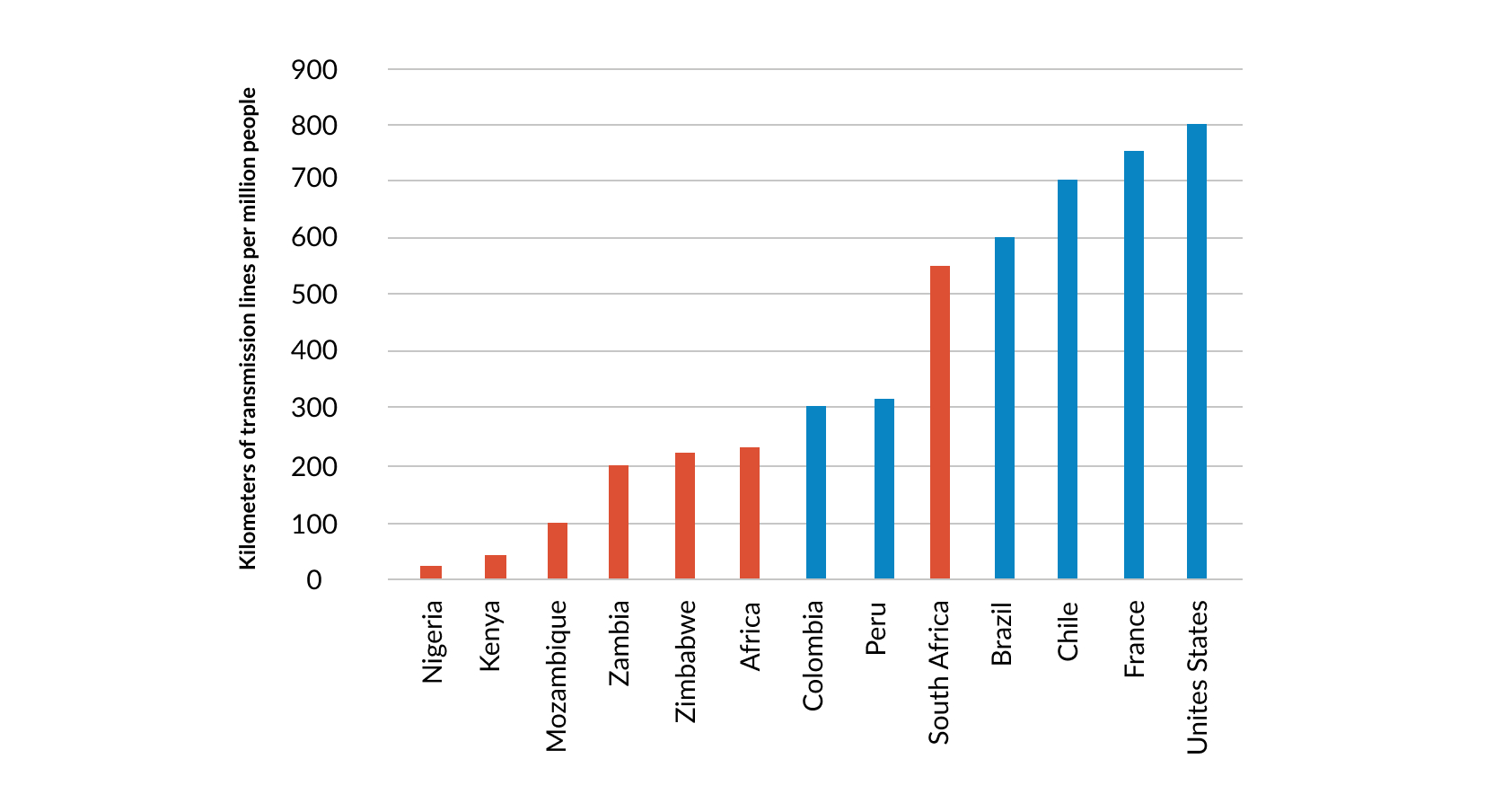
Current estimates place the total investment requirements for the period 2014-2040 at $80-$140 billion, which equates to $3.2–$5.4 billion per year. Of the 38 Sub-Saharan African countries, 9 have no transmission lines above 100 kilovolts (kV). The scale of the transmission deficit is also significant when one considers that the combined length of transmission in the 38 Sub-Saharan African countries is about 112,196 km, less than the length of the domestic transmission network of Brazil. The following Figure 1.1 helps further illustrate the transmission deficit in Sub-Saharan Africa as compared to energy markets around the world.
At a time when the world is coming together to address the threat of climate change, it is also important to note that transmission infrastructure is essential to the transition towards a less carbon-intensive power market. Without it, many grid-connected utility-scale renewable energy projects cannot be implemented. More importantly, developing and maintaining highly optimised transmission systems that can manage the intermittent nature of renewable energy helps to reduce technical losses and avoid the need to build additional generation or storage capacity.
The critical lack of development of transmission infrastructure in Sub-Saharan Africa, despite the increased investment in other segments of the power value chain, naturally leads to two important questions: How did the situation become so dire? and how can we overcome the transmission deficit to widen the access to energy? The first question demands an intense inquiry into economics, politics, sociology and geography that is beyond the capacity of the authors of this handbook. The second question, however, can be answered constructively and is the focus of this book.
Virtually all development of transmission infrastructure in Sub-Saharan Africa remains within the responsibility of fully or partially state-owned utilities. One reason is that it is difficult to prioritise and justify transmission projects when transmission costs are not clear and transparently allocated within the sector. As a result, the utilities that currently manage transmission infrastructure often require public subsidies to counter operating losses that arise when costs are not properly allocated and recouped. These subsidies usually take the form of direct budget support from the government. The effect is that state-owned utilities are not incentivised or able to invest in new projects.
This vicious circle of generating losses and failing to invest in new infrastructure is not inevitable. There are numerous examples around the world where energy markets have been able to overcome this transmission deficit through a combination of concerted regulatory reform and partnership with the private sector. This book presents these examples as case studies distributed throughout the chapters. The common narrative across the experiences from other markets is as follows: if the existing market actors (government, utility, regulator) can bring clarity and predictability to the transmission sector, the private sector can deploy its expertise and capital to overcome the infrastructure gap.
It is important to note at the outset of this book that the primary constraint on private investment is not the lack of the availability of capital (see chapter 2. Financing Structures and Capital Sources). The key constraint is, rather, the ability to access that funding through market regulations and project structures that provide the predictable operating conditions and revenue that are fundamental to any commercial investment. This book is intended to outline how public officials can satisfy these expectations from the private sector through a general description of transmission sector regulation, planning and operation, and a detailed explanation of the structures for private investment in the transmission sector.
As previously noted, the existing transmission gap in Sub-Saharan Africa is driven in large part by the inability to fund new infrastructure through public budgets or finance public infrastructure due to a history of operating losses. Thus, the first motivating factor for using private capital to fund transmission infrastructure is to mobilise finance over and above what the public sector may be able to provide. The private sector is not, however, simply a source of capital. It is also a partner in project management, cost control and risk mitigation. With the appropriate set of incentives, the private sector can be an extremely efficient implementation model for transmission projects at a low cost and on schedule. Successful private transmission projects have been implemented in India, Latin America, the Philippines, United Kingdom, and elsewhere. Brazil alone has financed over 50,000 km of transmission lines through private investments.
Inviting private investment in the transmission sector can also bring innovation through the utilisation of state-of-the-art technologies which are transforming the energy landscape. For example, smart grid technologie introduce new capabilities and provide opportunities for more efficiency, as well as new services (energy management, distributed generation, internet and telecoms).
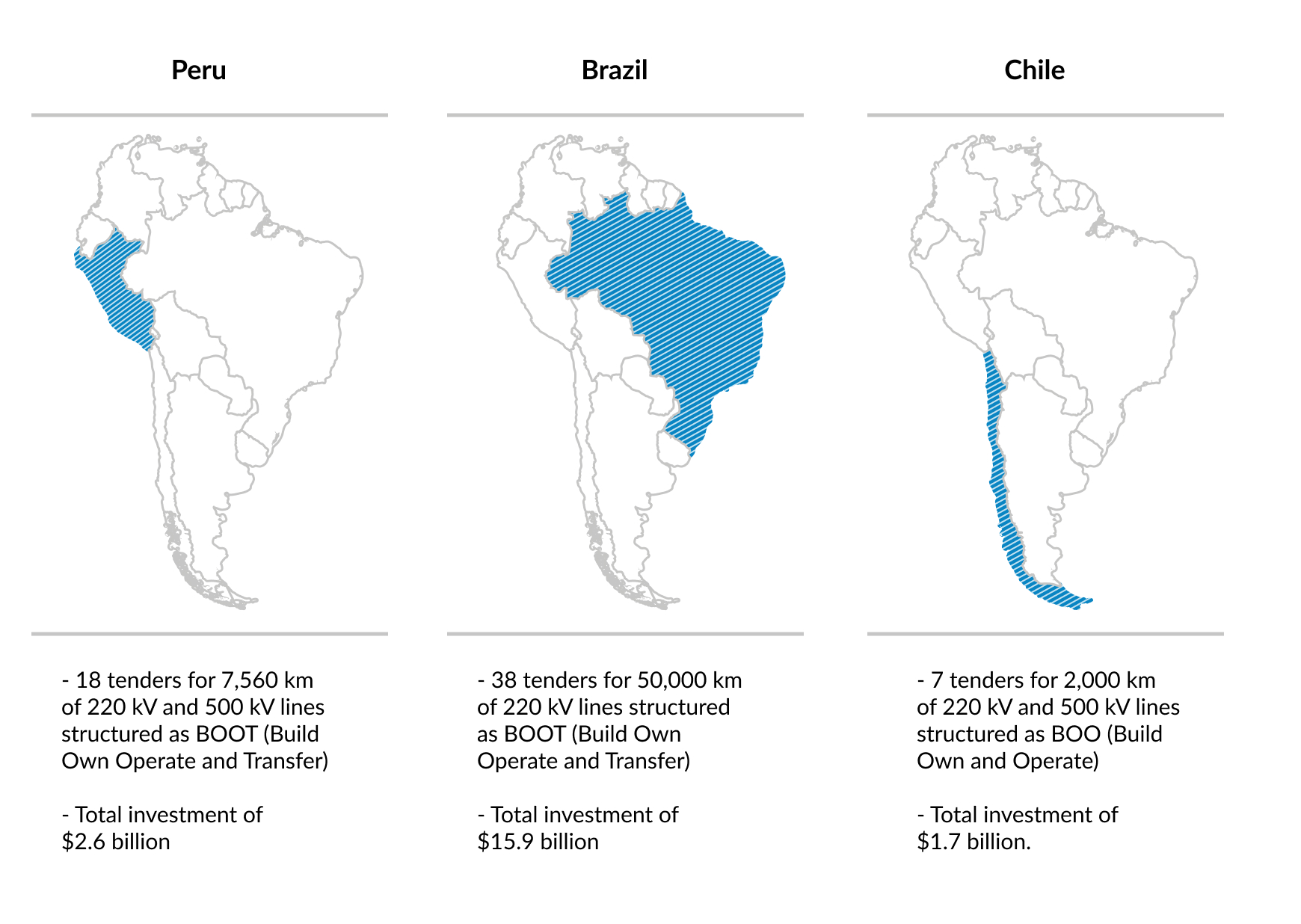
While private investment is not as widespread in transmission as in power generation, there is substantial experience worldwide. In addition to well-functioning power markets in OECD countries (e.g., United Kingdom), private transmission has become common in the last twenty years across Latin America and in countries such as India, Kazakhstan, and the Philippines. Just in the period 2000-2015, multiple projects materialised in Latin America as summarised in Figure 1.2.
Similarly, India has developed more than 500 km of 400kV and 765kV lines through private investment. Kazakhstan has a privately owned and financed transmission system, and the Philippines privatised their existing transmission system through a 25-year concession in 2009.
Sub-Saharan Africa was able to leverage the experience from other markets to adopt new business models and avoid legacy infrastructure (for example, deploying wireless data/voice systems rather than installing landlines). In the same way, the African energy market can learn from the recent experience in peer markets around the world to move past the traditional focus of publicly financed transmission infrastructure and instead foster a dynamic market place that is driven by private investment.
This handbook would benefit all stakeholders involved in the power sector and more specifically in the development of transmission infrastructure. The book is intentionally designed to benefit all levels of readers:
Beginner: The book provides an overview of the fundamental regulatory structure of transmission markets, the planning and procurement of transmission systems and the core principles of contracting and finance that are required to attract private investment. The intent is that with this essential background information in mind, the detailed explanation of private investment models will be easier to understand.
Utility/Regulator: The observations and guidance in this handbook are presented from the perspective of a public official in an utility or a regulator. Specifically, the assumption is that such an official has already recognised the need to bring private-sector investment into the market. Further, the book assumes that the official is considering the required adjustments to the existing regulatory framework and the specific obligations in any partnership with a private-sector investor to develop transmission infrastructure.
Procuring Agency/Negotiator: Perhaps the greatest value that we can convey in this book is the collective experience of the authors in planning, procuring and negotiating transmission projects. As a result, the book contains significant detail on the structuring of private transmission projects, the allocation of risks and obligations within those structures, and related considerations around financing and regulatory compliance.
In addition to the public sector readers described above, this handbook should also be helpful to other sector participants including the transmission companies, transmission system operators, regulators, investors, and financial institutions as it presents a diverse set of considerations that those parties must address in their role in the development of private transmission projects.
The knowledge and guidance presented in this book are not intended to represent the opinion of any one author. As emphasised throughout this book, the development of transmission infrastructure through a partnership between the public and private sector requires close collaboration between stakeholders and the application of expertise from many disciplines. To hold to this guiding principle, the development of this handbook also brought together a diverse group of stakeholders and experts. Our group of authors, who each contributed their time on a pro-bono basis, includes contributors from governments, development banks, investment funds, project developers, universities and leading international law firms. Equally important is that our group includes engineers, economists, lawyers and regulators who collectively have over 200 years of experience in the energy sector. Our sincere hope is that the collective wisdom and dedication of this group demonstrates how important it is to make progress in addressing the infrastructure gap in Sub-Saharan Africa and that our contribution will make a meaningful impact on that effort.
The unique conditions for the preparation of this handbook are notable
since they differ from the rest of the Understanding series. As with previous books, this handbook was produced using
the
The authors would like to thank our Book Sprint facilitator Barbara Rühling for her ability to adapt the Book Sprint process to a virtual format and for her patient guidance throughout the hours of staring at our confused faces on a computer screen. The authors would also like to thank Henrik van Leeuwen and Lennart Wolfert for turning our rushed scribbles into beautiful and meaningful illustrations. The tireless work of Book Sprints’ remote staff Raewyn Whyte and Christine Davis (proofreaders), and Agathe Baëz (book design), should also be recognised. It is also important to recognise the considerable planning and development that went into the conceptualisation of this handbook before the drafting process. In particular, our deepest appreciation goes to Elizabeth Clinch (International Program Specialist, CLDP) for the original research at the outset of the concept development and for her tireless work to bring our group together in a virtual space. The authors would also like to recognise the following individuals and institutions that helped focus dialogue to build a consensus around the need for a handbook focused on transmission financing: Jennifer Baldwin (Power Africa); Megan Taylor (Power Africa); and Kenyon Weaver (Commercial Law Development Program). The authors would also like to thank the generous funding and logistics support from the United States Agency for International Development’s Power Africa programme and the African Legal Support Facility.
To continue the tradition of open-source knowledge sharing that is at the core of the Understanding series, both as a standalone reference guide and as a jumping-off point for further discussion and scholarship, the book is published under the Creative Commons Attribution-NonCommercial-ShareAlike 4.0 International License (CC BY NO SA). In selecting this publication license, the authors welcome anyone to copy, excerpt, rework, translate and/or re-use the text for any non-commercial purpose without seeking permission from the authors, so long as the resulting work is also issued under a Creative Commons License. The handbook is initially published in English with translated editions soon to follow. The handbook is available in electronic format at http://cldp.doc.gov/Understanding as well as in print format. Many of the contributing authors are also committed to working within their institutions to adapt this handbook for use as the basis for training courses and technical assistance initiatives.
This handbook is the fifth in the Understanding series published by Power Africa. The first handbook,
Gas and LNG Options
|
Reason Abajuo Legal Counsel African Legal Support Facility |
Samson O. Masebinu Development Assistance Specialist: Energy Finance USAID/Power Africa (South Africa) |
|
Mohamed Rali Badissy Professor of Law Penn State Dickinson Law (USA) |
Subha Nagarajan Managing Director Global Capital Advisory (USA) |
|
Christopher Flavin Business Development Director Gridworks (UK) |
Gadi Taj Ndahumba African Legal Support Facility |
|
Jay Govender Projects and Energy Sector Head Cliffe Dekker Hofmeyr Inc. |
Kaushik Ray Partner Trinity International LLP (UK) |
|
Ryan Ketchum Partner Hunton Andrews Kurth LLP (UK) |
Stratos Tavoulareas Energy Advisor and Visiting Scholar George Washington University (USA) |
|
Julius Kwame Kpekpena Chief Operating Officer Millennium Development Authority (Ghana) |
Omar Vajeth Principal Corporate Relations Officer African Development Bank |
|
Mohammed Loraoui Attorney Advisor (International) U.S. Department of Commerce (USA) |
The business models used to finance transmission infrastructure are heavily impacted by sources of funding for the sector. Before introducing the different business models, it is necessary to understand the various external funding options and their criteria, which this chapter explores.
In the next chapter 3. Common Funding Structures in the African Market, we discuss the status quo of transmission infrastructure financing in the African continent — the public sector structures generally used to finance these types of projects at present. We then look to business models involving the private sector in chapters 4. Introduction to Private Funding Structures, 5. Independent Power Transmission (IPT) Projects, 6. Whole-of-grid concessions, and 7. Other Private Funding Structures.
Transmission projects will go through a detailed planning phase before a source of financing and a business model are selected. Chapter 9. Planning and Project Preparation explains this process.
The risks highlighted in chapter 11. Common Risks must also be considered as these will impact sources of funding as well as business models. The funding decision will have implications for the introduction of the private sector or continued reliance on public sector funding, and together these will inform the business model selected.
Below we set out the broad principles of financing that have been or could be applied to the funding of existing and future transmission infrastructure projects.
Many businesses, especially large businesses in capital intensive industries, raise debt funding on the strength of their balance sheets, the stability of their revenues, and their ability to service their debts. They do not grant security over any part of their assets to lenders or bondholders, and they agree with each lender that they will not grant security over their assets to any other or future lenders. This type of financing — financing that does not involve the grant of security over a company’s assets — is referred to as corporate finance.
When considering corporate finance in the context of funding transmission infrastructure, the relevant entity procuring funding has historically been the national transmission company of the country. The financial health and liquidity of this entity’s balance sheet (assets and cash flows) will determine its borrowing capacity (which can be enhanced with government support). If the credit of the national transmission company does not allow it to raise debt, additional support from the government’s balance sheet will be required to secure external debt.
In a project finance context, the funding is secured against the viability of a specific project. In this option, a project company is created for financing, constructing and potentially operating the transmission assets and is financed with a mix of equity and debt. In typical project finance funding structures, the project company also retains ownership of the transmission asset. A lender considers the revenue generated by the transmission project as the primary, and often singular, source of loan repayment. The projected cash flows after meeting operating expenses must be sufficient to service debt in terms of capital repayment and interest. The cash flows available after debt service should also provide a reasonable return on equity.
The predictability, sufficiency and certainty of cash flows will determine the project company’s borrowing capacity to finance the project. If the project underperforms and the borrower defaults on the loan as a result, the lender will have the right to enforce its security on the project company’s assets. If liquidating the project company’s assets is insufficient to recover the balance of loan owed due to default, the lender will have no recourse to the owner(s) of the project company for further compensation: the sponsor's liability is limited to the investment it has made via its equity contributions. Therefore, the key to project finance is the underlying revenue stream generated by the asset in question (e.g., annuity, use of system or wheeling charges for a transmission infrastructure project).
If the transmission asset is not linked to a dedicated generation facility or a large industrial consumer, and there is uncertainty as to how well-utilised the transmission infrastructure will be, lenders will expect a payment regime similar to a fixed capacity payment or fixed availability payment. Such payments are not vulnerable to changes in the amount of power flows on the transmission line.
In the context of transmission infrastructure, an entity’s borrowing capacity via corporate finance is limited by its existing balance sheet, including how much existing debt it has (and the state of its revenues and assets). Any existing balance sheet constraints will limit the borrowing capacity of transmission utilities to fund transmission infrastructure using corporate finance structures. The state utility may have the opportunity to borrow further with government support. Project finance structures, however, do not look at the transmission company’s borrowing capacity because the debt capital raised is treated as off-balance-sheet financing.
Under corporate finance, since repayment is divorced from a transmission asset’s underlying economic value or performance, repayment risk will be a function of a borrower’s existing level of leverage compared to the financial or market value of its total assets to determine its liquidity. A healthy balance sheet will attract a lower cost of financing (more efficient pricing). As the credit quality of an entity decreases, the cost of funding increases due to higher risk perception.
Under the project finance option, since repayment is secured via project revenue, lenders will focus on mitigating all risks to those cash flows. Project finance transactions tend to be highly structured and complex, with emphasis placed on appropriate contractual allocation of risks that impact the underlying revenue stream. This adds to the time and cost of pulling together the number of stakeholders and related documentation. The pricing of the project is influenced by the perceived risk of the cash flows, the credit quality of the source of those cash flows, and if needed, the enhancement of these cash flows.
Transmission networks require ongoing investment. Ongoing investment requires continuous capital injections in the business in the form of new projects or upgrades of existing assets. As a general rule, state-owned transmission utilities, whole-of-grid concessionaires, or privatised utilities will typically find it more practical to raise debt financing using corporate financing techniques. In contrast, a project company established to implement an independent power transmission (IPT) project will use project finance to allow for higher debt to equity ratios, longer tenor, and limited recourse for the shareholders in the project company. Given these factors, IPTs are likely to be financed using project finance techniques.
The sources of capital for a transmission project will depend upon the outcome of the planning, risks related to the project, and a government’s and state utility’s balance sheets and the ability to raise finance. In chapter 3. Common Funding Structures in the African Market, the existing model of government balance sheet financing for these assets is discussed in more detail, and in later chapters, we discuss some private sector finance models. Below, we set out the typical capital sources — government budgetary allocation, debt, and equity — and indicative terms used in most funding models.
In the context of its annual budget, a government may choose to allocate a certain amount of the fiscal budget to the development of the country’s transmission infrastructure. When an allocation is made, the specific method of application of these funds is likely to vary from one government to another depending on the country’s laws and conventions for public procurement of infrastructure. In some jurisdictions, the funds will be managed and applied directly by the Ministry of Energy (or equivalent); in others, they may be channelled via a department of public works or the state-owned entity licensed to construct and maintain transmission infrastructure. Nonetheless, the source of these funds will invariably come directly from the government’s accounts or “balance sheet” as shown below, and thus the government’s ability to finance transmission infrastructure through a budgetary allocation will depend on the country’s priorities and fiscal constraints. Ultimately, the decision as to whether to use this model will depend on the government’s balance sheet (i.e. availability of cash) and its expenditure priorities (based on its current policies) given a country’s wider infrastructure investment needs.

In practice, financing transmission infrastructure through budgetary allocations is difficult and has become increasingly rare. The size of the investment puts significant pressure on a government’s budget and its available cash. The allocation can be structured in a way as to accumulate yearly until reaching the required amount, but depending on the size of the investment, the desired amount may take many years to be collected. Furthermore, in addition to slowing down the development of the power grid, this approach requires significant fiscal discipline as the government needs to set aside the funds each year and resist the temptation to use them when a crisis or economic downturn arises.
Transmission infrastructure necessitates long-term funding, given the relatively high capital expenditure required for identification, development and construction. Given constraints in local commercial banking markets, public financial institutions are an important source of debt financing for transmission infrastructure.
The stakeholders and financial products described below cover both public and private sector debt financings — their application in real-world scenarios is dealt with in later chapters.
Multilateral development banks (MDBs) and donor-backed funds can lend directly to governments on concessional or grant terms for identified projects which follow the MDB procurement guidelines, and can also be lenders for the financing of independent power transmission projects in the private sector.
Examples of MDBs, which provide concessional finance, include the African Development Bank, European Investment Bank, and the World Bank Group. Concessional in this context means that the terms of the loan are likely to include low or subsidised interest rates, extended grace periods, and long amortisation schedules that can extend beyond 30 years. Typically these loans are provided to the government via the Ministry of Finance, and on-lent to the transmission utility. These loans are accounted for on the government’s balance sheet, typically as both an asset and a liability. The transmission company will own the asset, but repayment, if required, will be secured from the government's balance sheet. MDB and donor concessional money may be used to settle contractor invoices directly, but the government remains the obligor.
Transmission projects funded through MDB concessional funds can in some instances take longer to secure the funding and the necessary contractors. This is often the case where the government or the utility does not have the necessary capacity to manage the high degree of coordination, planning, and adherence to MDB procurement guidelines for such projects. In addition, MDBs have country and sector limits (often called “funding envelopes”) that are available to countries for this type of financing support which get revised based on the country’s capacity for debt and the requirements of the ministries. When the funding envelopes may be nearing their limits, countries will have to prioritise the infrastructure projects they want to support. Bilateral donor agencies can be another source of grant or heavily subsidised financing which can provide sector viability gap funding or support to an individual transaction.
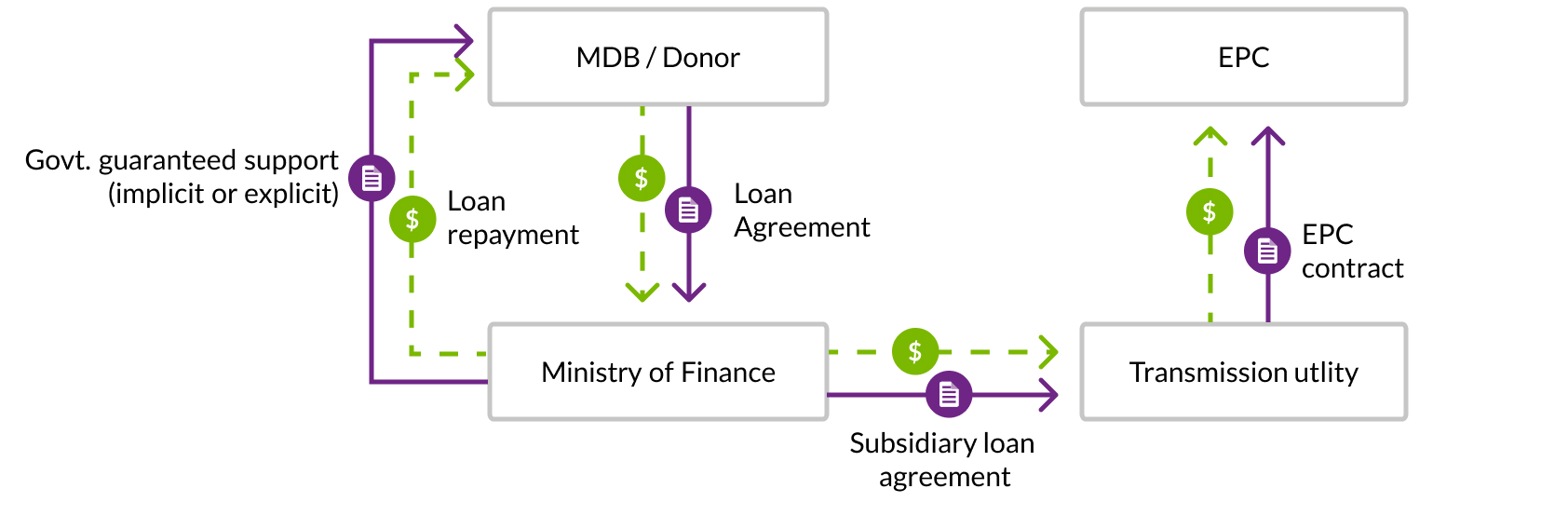
Private sector MDB funding
The same MDBs have “private sector windows”, i.e., funding available for private sector projects, such as IPTs. These are loans granted on commercial terms rather than concessional terms, and for tenors up to 18-20 years. Importantly, private sector MDB loans are not captured on the government’s balance sheet, unless a government guarantee or financial backstop helps secure repayment. The structures under which MDBs participate in IPTs are set out further in chapter 5. Independent Power Transmission (IPT) Projects.
Export Credit Agencies (ECA) are institutions that are publicly owned financing agencies that help finance national exports by providing direct loans, guarantees, or insurance to overseas buyers, including entities such as transmission companies. ECA finance can be used in the public sector, in government balance sheet financing, and project finance involving IPT structures.
Examples of active ECAs in Sub-Saharan Africa include the Export Credit Insurance Corporation of South Africa, US Export-Import Bank, UK Export Finance, BPIfrance, SERV from Switzerland, Euler Hermes from Germany, and the Export-Import Bank of China. Some of these agencies can provide local currency solutions in certain jurisdictions, but for the most part, provide USD and Euro denominated loans.
To ensure financing discipline and promotion of fair and transparent trade practices, financial terms and conditions follow guidelines set by the OECD, called the OECD Arrangement on Officially Supported Export Credits guidelines. Eligible financing is typically up to 85% of the relevant export contract, with some allowances to cover a portion of local on-shore costs, but the expectation is that the government (or borrower) covers the 15% balance, usually in the form of a down payment in cash. Financing terms include longer tenors than commercial banks can competitively price or sometimes provide to borrowers in certain jurisdictions (up to 12 years for corporate finance and 14 years for project finance loans), but the cost of funds is generally more expensive than concessional borrowing. For transmission infrastructure associated with a renewable energy generation project, the OECD Arrangement allows project finance loans up to 18 years, on an exceptional basis.
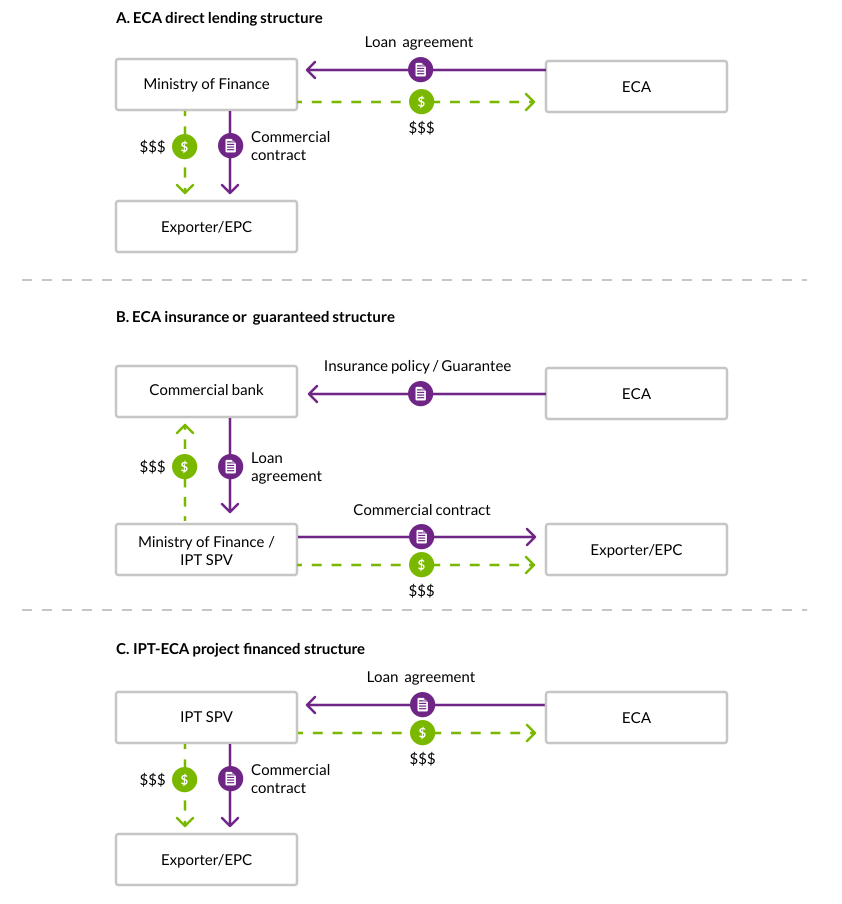
In the context of transmission infrastructure, ECAs can provide (1) corporate finance loans, underwriting the sovereign’s capacity to repay the loan, lending directly to Ministries of Finance, which helps to reduce the cost of financing, and (2) project or corporate finance loans to IPT special purpose vehicles (SPVs) or private companies, respectively.
Depending on the ECA, they can either lend directly or insure/guarantee (between 95-100%) a commercial bank that will provide funding, which will be reflected in the commercial bank’s lower cost of funds to the project.
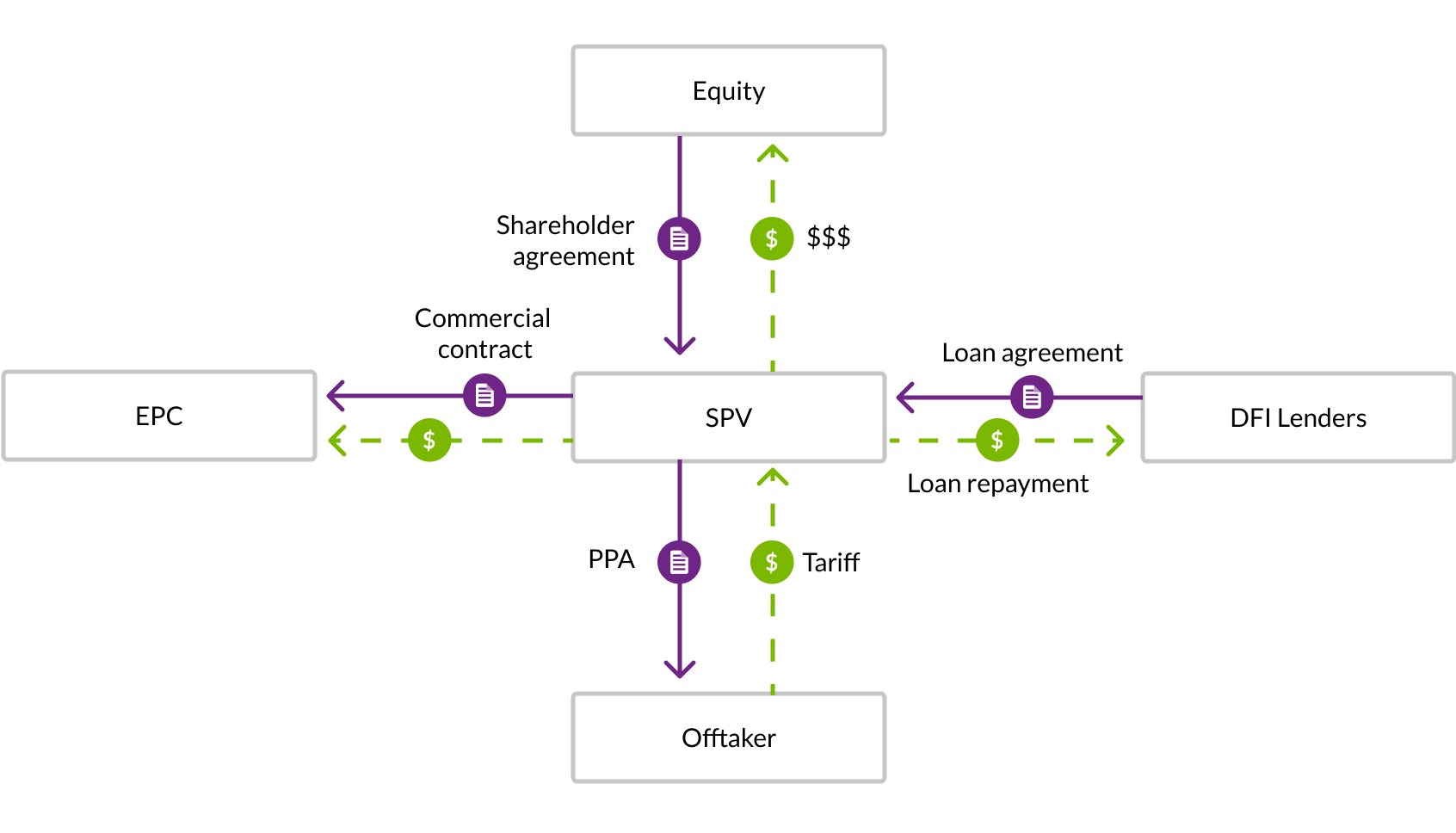
Development Financial Institutions (DFIs) which include MDBs, are usually majority-owned by national governments and source their capital from national or international development funds, or benefit from government guarantees. This ensures their creditworthiness, which enables them to raise large amounts of capital from international capital markets and provide financing on very competitive terms. DFIs can provide up to 15 to 20 years, long tenor competitive commercial lending to projects with some degree of private ownership. Some examples of DFIs active in Sub-Saharan Africa include the Development Bank of South Africa, Development Finance Corporation from the US, the CDC group from the UK, Proparco from France, and FMO from the Netherlands.
Some DFIs can provide loans to state-owned utilities which demonstrate independent governance, depending on that utility’s balance sheet and ownership of assets. All DFIs can provide commercial project finance debt to a project company, which can be used in IPT transactions. The diagram below shows a DFI-funded project finance structure.
In addition to lending, some DFIs such as the AfDB and the WBG can
offer a guarantee and insurance products to help credit enhance a
project structure by covering off certain credit or political risks.
Guarantees include partial credit guarantees (PCGs) and partial risk guarantees (PRGs) to cover commercial lenders and investors against the risk of a
possible government failure to meet contractual obligations to a
project. Please see the
Some DFIs provide political risk insurance (PRI) to mitigate and manage risks arising from the adverse action, or inactions, of governments that go against contractual obligations. PRI can also be used to backstop termination support under a government guarantee or other forms of government undertakings if the government is unable to pay as per its contractual obligation.
Green/climate-backed financing
There are many clean technologies and climate change donor-backed funds which can provide grant funding to support grid modernisation and transmission lines, if the infrastructure can be linked to projects and initiatives which promote and advance sustainable development and encourage the development of a more sustainable economy, for example, renewable energy generation. Given the emphasis that many countries are placing on decarbonisation to support countries on their journey to a green energy transition, it is expected that the EU and other publicly backed institutions will make more grants or highly concessional finance available to support these activities.
The advantage of these resources is that they provide subsidised financing, which, when combined with more commercial sources of funds, can help blend the cost of capital to reduce financing costs for transmission infrastructure.
Transmission is the enabling infrastructure for renewables, and, as such, it should be credited with greenhouse gas reductions and be eligible for green financing. In addition, the strength of the existing transmission and grid networks will determine how much greenfield renewable energy generation a country can support. Many emerging countries with mandates to significantly scale up renewable energy generation will need to simultaneously invest in upgrading and expanding their transmission network to support greater renewable energy penetration. While this is still an evolving field, greenhouse gas reduction calculation methodologies have been considered by numerous organisations and both governments and developers should monitor progress to identify potentially attractive financing options.
In addition to DFIs, commercial banks provide debt financing to transmission infrastructure projects. Commercial banks are privately owned banks that participate and provide funding to a range of projects, including transmission projects. Commercial banks more typically lend to projects that have creditworthy cash flows or cash flows that are enhanced with cover via DFIs or ECAs.
Typically, commercial banks are financial institutions that are regulated by central banks and other international banking regulations which impact the level of liquidity, risk thresholds and pricing.
Blended finance
Providing hybrid private sector/donor funding for IPTs, for example, can significantly boost the availability of funding to the sector. The provision of grant funding for a project is unlikely to impact returns for investors positively or negatively since funding models for this asset class are typically fixed or capped. The impact of such funding would be to increase the number of projects which can be undertaken.
In IPT and other project finance structures, lenders generally require project owners to invest an amount of equity in exchange for shares in the project company, usually for at least 20-30% of the total project cost. This form of long-term capital earns dividends over the life of the project which are paid from the remainder of cash flows after operating expenses and debt service obligations have been met. The capital structure and cash waterfall are intentionally aligned so that equity owners are incentivised to ensure that the transmission assets are constructed and perform as contractually specified, to generate and collect the forecasted revenue. Equity providers for transmission infrastructure include:
In some instances, state-owned transmission companies or energy utilities also invest capital (or some other form of consideration) into a project company and acquire equity interest.
The purpose of this chapter is to introduce some private sector business models which have been applied to finance transmission infrastructure in other parts of the world. More detailed information on the different funding structures will be provided in the following chapters which dive into the details of each model. This chapter aims to provide tools to ensure that well-informed decisions can be made. More specifically, we will look at key considerations in determining whether these business models are, or could be, applicable in a particular country or market.
Which model is more suitable for a country or a specific project depends on many factors which are country and project-specific. A detailed assessment is recommended to identify all the relevant considerations and provide the advantages and disadvantages of the various options, so the government can make the best decision. Nevertheless, whilst private sector involvement in the transmission sector can take many forms, this book will discuss:
The two most applicable structures to the African context based on the current state of its electricity supply industry are the IPT and the whole-of-grid concession. For this reason, more details will be provided on these two models than on privatisation, merchant lines, and industrial demand-driven models.
An obstacle to privately financed transmission infrastructure is often the perception that the national power company or transmission system operator (TSO) will lose control over the sector. On the contrary, in many cases, the private investor builds the transmission project and turns over the operation of the assets to the TSO immediately upon completion of construction and project acceptance. In other cases, the private investor only owns and operates physical transmission assets without managing the electrical system and coordinating generation dispatch and power flows.
Another important consideration is that ownership and control do not have to be held under the same organisation. Who owns the transmission infrastructure may vary depending on whether it is an IPT or a whole-of-grid concession. It is also possible to find variations within the same model. For example, an IPT may be entitled to own the infrastructure which it constructs on a long-term basis, but it may also be a condition of the project documents or a condition of the relevant licensing regime that ownership of the assets is transferred to the state-owned utility or another state-owned entity at the end of a fixed period.
Furthermore, operation and maintenance can be separate as maintenance of the transmission assets (under the project) can be carried out by the private investor or a maintenance contractor or even be subcontracted to the national transmission company.
Depending on the objectives of the government, it is, therefore, possible to calibrate the degree of control retained in respect of the transmission asset as well as define the ownership of the asset during and after the duration of the core agreement.
Although there are many advantages to private funding, the nature of the financing will also carry constraints and requirements. When choosing a private funding model for financing transmission infrastructure, a government must be aware that it will require efforts in negotiating a complex commercial transaction often driven by well-established market standards. This is especially true when it comes to project finance which is typically the method of financing for IPTs.
Risk allocation is the key component of project financing and by extension may determine the success or failure of the privately-funded transmission project. While there is a natural tendency to attempt to shift risks to other parties, it is wise to keep in mind the golden rule of risk management: Each risk should be allocated to the party that is in the best position to first control/reduce it and then manage it. Imposing risks on the private investor, even though it is not in the best position to manage them, will typically result in a more expensive or even unbankable project. Allocating the risks to the party which is in the best position to manage them will help to de-risk and reduce the overall cost of the project and the final tariffs.
There may be concerns that the legal/regulatory framework may not be ready for some forms of private investments. Although this may be a genuine challenge, it is not an insurmountable obstacle. It is usually possible to put some of these models in place within existing frameworks. If legal change is required, the project could be structured to address the lack of laws/regulations (regulation by contract) and can be used as a testing ground to learn from and ensure that the laws/regulations which are finally approved are the right ones for the country.
As is the case with all power projects, transmission projects have many risks, some unique to transmission and others similar to all power projects. The most challenging risks in private transmission projects are: 1) land acquisition (“rights-of-way”) and 2) securing the revenue stream.
While each country and project have their own uniqueness which needs to be taken into account, some important lessons learned have emerged from the numerous transmission projects that have been implemented so far:
We would further note that countries that have successfully delivered IPPs may well choose to replicate some parts of the documentation structure of IPP models into the transmission sector. This may inform, for example, how the risk allocation between the government and the private sector is documented. In countries where political risks are taken by the government by way of a put/call options agreement (PCOA) for example, this documentation method may be replicated in the transmission sector. In other countries, political risks are dealt with in an “implementation agreement” or “concession agreement” and government officials may be more comfortable with both the nomenclature and risk allocation set out in these documents, as negotiated in the IPP space.
While it is important to be efficient and not “reinvent the wheel”, it is also crucial to take a fresh look at how risks are allocated as there may be particular differences in the risk allocation agreed in that country on the generation side that does not apply to the transmission side, due to the specific nature of a particular project.
The private developer/investor can be responsible for some or all of the project preparation, design, financing, construction and operation of the project. Depending on how and when the project developer will come on board, it may have substantial project preparation activities to complete. This depends on the procurement approach to select the developer/investor (competitive bidding or sole source).
Financing will typically be provided by other organisations too, including equity and debt. The financial institutions will carry out due diligence of the project including review of the various contracts, as well as assessment of the risks and project “bankability”, ahead of financial closure. At financial closure, the lenders will commit to the project and their funds will be drawn down to fund construction.
The government may have a substantial role to play in the transaction, especially if the project is not commercially viable. The risk allocation matrix in fact should determine the role of each project stakeholder including the government. In an IPT, the investor and the government may enter into a Government Services Agreement (GSA) which supplements the agreement between the investor and the offtaker.
Often, the Multilateral Development Banks have a substantial role to play. In the case of a financially unsustainable power sector, the government might work closely with the MDB to develop a roadmap to power sector sustainability. This roadmap could be developed in parallel with the project but it should include specific milestones which should be monitored and may be linked to the project agreements. Also, the MDBs may provide:
Last but not least, bilateral organisations and donor agencies could play a catalytic role too. They may help with technical assistance in project planning activities, but also they may provide grants or concessional lending because the projects fulfil an important role in the country’s economy. Also, they may provide funding to close the viability gap (e.g., similar to KfW’s GETFiT programme). In this way, scarce grant funding can be used in a targeted way to unlock larger sums of private sector investment. Private sector procurement and management practices can also benefit projects which may otherwise have been solely donor-led or implemented by transmission utilities with capacity shortages or governance shortfalls.
Providing hybrid private sector/donor funding for IPTs, for example, can significantly boost the availability of funding to the sector. The provision of grant funding for a project may not have a positive or negative impact on investor returns since funding models for this asset class are typically fixed or capped. The impact of viability gap funding like this would simply increase the envelope available to multiply the number of projects which can be undertaken.
The purpose of this chapter is to set out, in a non-exhaustive fashion, some of the common methods of funding transmission infrastructure that are currently used on the African continent and to highlight some of their features.
Most of these funding methods are public-sector led. However, they are akin to corporate finance structures as the financing is based on the strength of the government or state-owned utility balance sheets and not on the viability of the cash flows from the transmission projects specifically. These methods include government borrowing/ECA financing and state-owned utility borrowing. Of these methods, government borrowing and ECA solutions (which also require a government guarantee) are by far the most common funding structures utilised.
The most common private sector-led funding method used for transmission projects on the continent is the wrapping up of the financing of the transmission project into a related IPP project. This method, discussed in this chapter as the generation-linked transmission model, is the closest to project financing for transmission projects on the continent. As will be discussed in detail in this chapter, the cost of the transmission project is included as part of the construction costs of the IPP project. Since the IPP project is funded using a project financing structure, the costs of the transmission project are typically recouped from the cash flows of the IPP project.
From one country to another, the names of ministries are likely to vary and their functions can be separated differently among fewer or more ministries (e.g., the functions of the Ministry of Finance in one country may be shared between the Ministry of Economic Planning and the Ministry of Finance in some other countries). For this chapter, the Ministry of Finance (MoF) refers to the ministry (or ministries) responsible for raising and collecting both foreign and domestic revenues, managing the budget process and cash resources, setting fiscal policies and forecasting government revenues. The MoF is also responsible for borrowing on behalf of the government and managing the purse strings, which sometimes requires limiting the spending by which ministries try to deliver on their respective policy goals.
In a funding structure using government borrowing, the MoF effectively serves as the borrower on behalf of the government. The borrowed funds will be used for the procurement of the transmission infrastructure and the government accounts will reflect a new debt. Once the funds are borrowed, the government can choose to either procure the transmission line itself or, in turn, lend the borrowed funds to the transmission utility which will procure the transmission infrastructure and repay the government from its revenue (diagram below). Even for the latter scenario, the government remains responsible for the entirety of the debt and will have to pay its lenders even if the transmission utility fails to repay the government.
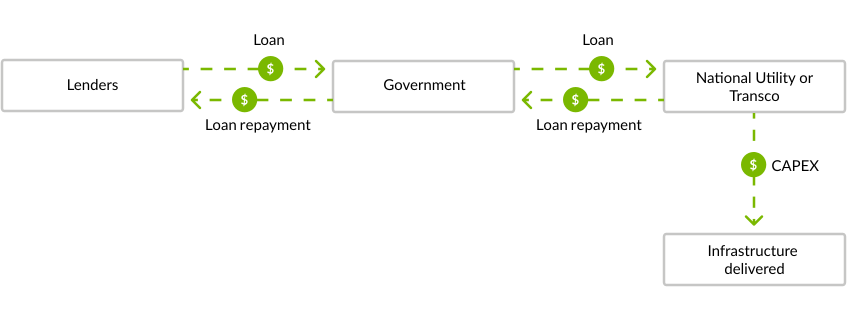
On the African continent, the government is most likely to access financing for transmission infrastructure via concessional borrowing or ECA financing. The borrowed funds are used to procure and pay an EPC contractor to construct the specified transmission infrastructure. As explained in the funding chapter 2. Financing Structures and Capital Sources, MDBs and ECAs can lend to a government via the Ministry of Finance to fund capital expenditure costs. The Lake Turkana Transmission Line case study described below illustrates the use of concessional borrowing and ECA financing for the construction of a transmission line.
Case Study — The Loiyangalani–Suswa High Voltage Power Line (“Lake Turkana Transmission Line”)
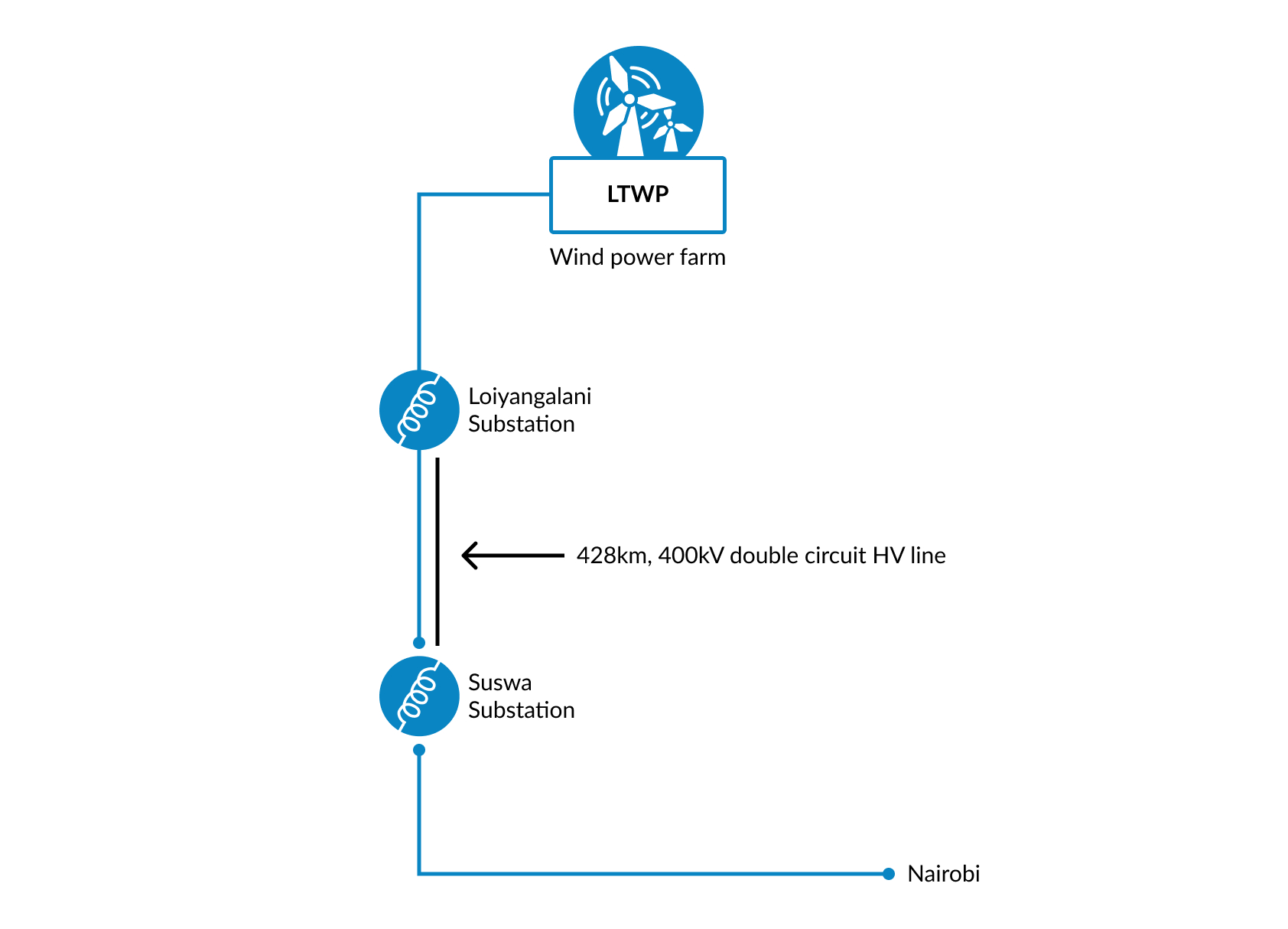
The Lake Turkana Transmission Line starts at the 310 MW Lake Turkana Wind Power plant in Marsabit County, Kenya, and runs south for approximately 428 km to the KETRACO substation in Suswa, Narok county, approximately 100 km west of Nairobi. In 2010, the Spanish government offered to finance the construction of the double circuit line. This included a concessional loan (for 30 years, with a low interest rate) of €55m and a commercial credit in an equal amount offered by the Spanish ECA (with commercial lending sitting behind it).
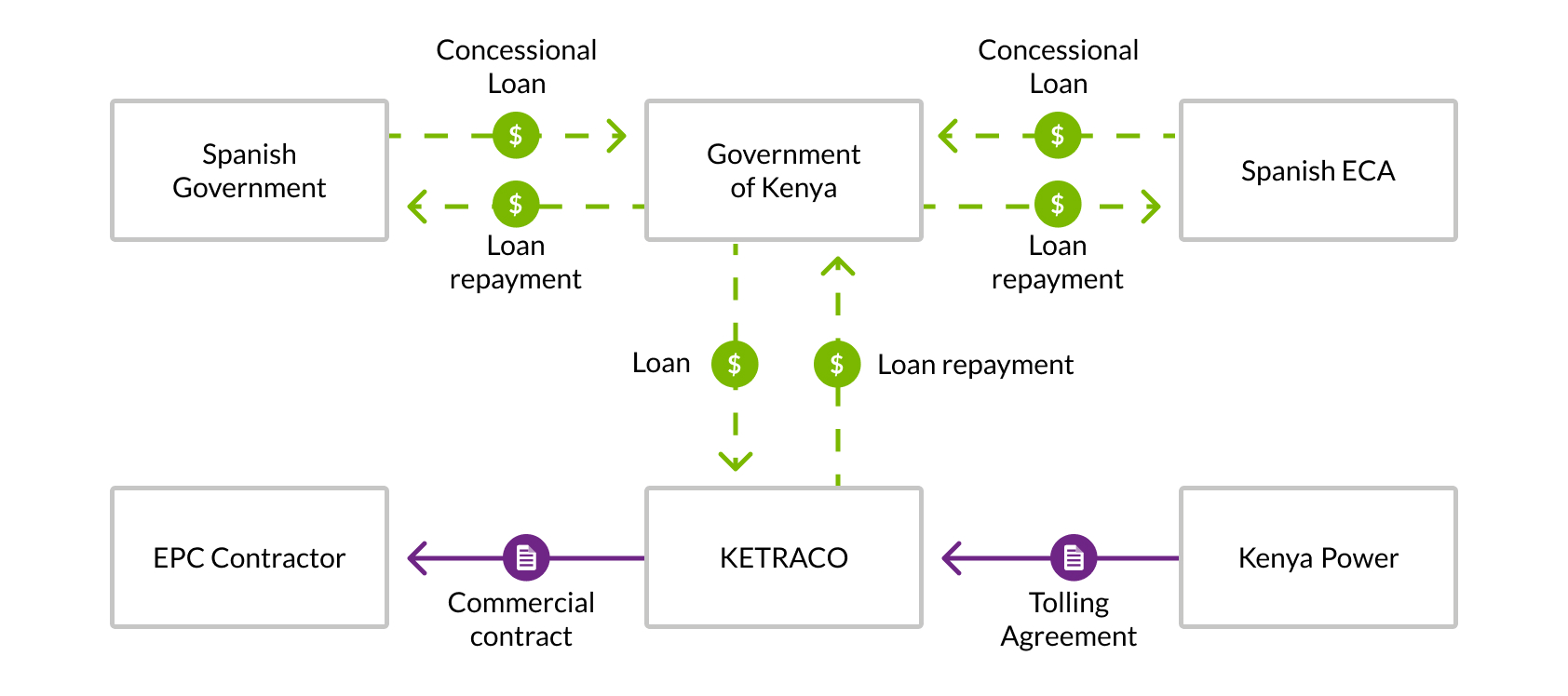
The Kenya Electricity Transmission Company (KETRACO), created in 2008, agreed to partly fund the line and substation by way of a tolling agreement with Kenya Power. With a large dedicated generation project attached, the potential for future generation projects alongside the transmission line corridor (an area with geothermal power potential) and the possibility for the line to interconnect with the Kenya-Ethiopia interconnector, the economic case for the project was clear.
Interface risk and cost overrun
The initial Spanish EPC contractor who was awarded the contract to construct the transmission line faced many implementation challenges, including a protracted wayleave and land acquisition process for which KETRACO was responsible, which delayed construction works. The initial Spanish EPC contractor subsequently filed for bankruptcy. The transmission line was eventually completed by a consortium of Chinese firms and officially commissioned in July 2019, behind schedule with a $96M cost over run ultimately financed from the government's balance sheet. The Lake Turkana Power Plant had already been commissioned in September 2018, earning deemed energy payments while waiting for the power plant’s connection to the grid to deliver energy to the wider Kenyan grid via the newly constructed line.
Given the Lake Turkana Wind Power project was an IPP and fully developed by the private sector, it raised an interesting discussion of “project on project” risk, with the two projects entirely interdependent but financed by separate means, and the former through commercial sources with the latter via sovereign borrowing. The risk allocation between the various stakeholders was heavily negotiated, with the Government of Kenya (GoK) bearing the responsibility for the timely delivery of the transmission line. The AfDB provided a €20 million PRG to backstop GoK’s completion risk on the transmission line, providing comfort to the Lake Turkana Wind Power lenders that deemed energy payment obligations would be met in the event the transmission line commissioning was delayed.
The Lake Turkana cost overruns highlight the magnitude of the interface risk for interdependent projects. For this reason, transmission lines are often wrapped in the financing and scope of a generation project. Further in this chapter, we discuss generation-linked transmission projects for which it was decided to finance and construct the transmission asset via the same project to significantly reduce the interface risk.
The financing of transmission infrastructure from government borrowing is an attractive method of funding as it can produce favourable terms (e.g., low-interest rate, long repayment period, etc.) provided the government can afford the debt. This type of loan is not extended based on the transmission utility's ability to secure the necessary income to repay the loan but on the government’s fiscal ability to collect sufficient revenue to service and repay the debt. It, therefore, provides more flexibility and allows the government to rely on its full fiscal revenue for the development of the power sector.
Nonetheless, this method of funding requires careful management of the impact of the borrowing on the country’s debt sustainability efforts. Hence, the transmission project will have to compete with other projects as it will ultimately affect the country’s ability to borrow for other sectors of its economy. Moreover, the government will have to ensure that the transmission infrastructure will ultimately improve the viability of the sector as a series of uneconomical transmission financing can easily drain the government’s finances and have long-lasting repercussions on the overall economy. Furthermore, government balance sheet funding may be restricted by other international geopolitical factors as most government borrowing in SSA is provided by other governments, government agencies and MDBs.
Countries with energy sectors that can independently recover their investment and operating costs have state-owned utilities that require minimal government subsidies or interventions to stay financially solvent. There are only a handful of state-owned power utilities in SSA that are sufficiently creditworthy to allow them to borrow from external sources. The repayment of the loan is not necessarily linked to the performance of the underlying asset that has been constructed but secured against other sources of income or revenue generated by the state-owned utility. The state-owned utility borrowing can be from ECAs and DFIs or the capital market.
An ECA and some DFIs can lend directly to the state-owned utility to fund the capital expenditure (CAPEX) requirements of a specified transmission infrastructure project, securing repayment against the utility’s balance sheet. Whereas the DFI will be agnostic on sourcing, as described above, the ECA will finance and disburse against invoices for a specified EPC scope of work which shows equipment and services from the ECA country.
Further, a creditworthy power utility responsible for transmission assets may choose to raise a corporate bond from capital markets for general-purpose borrowing, and then use a portion of those proceeds for investment in new, or the rehabilitation of existing, transmission infrastructure. An example of state-owned utility capital market borrowing is provided in the following case study.
Case Study — Caprivi Link InterConnector
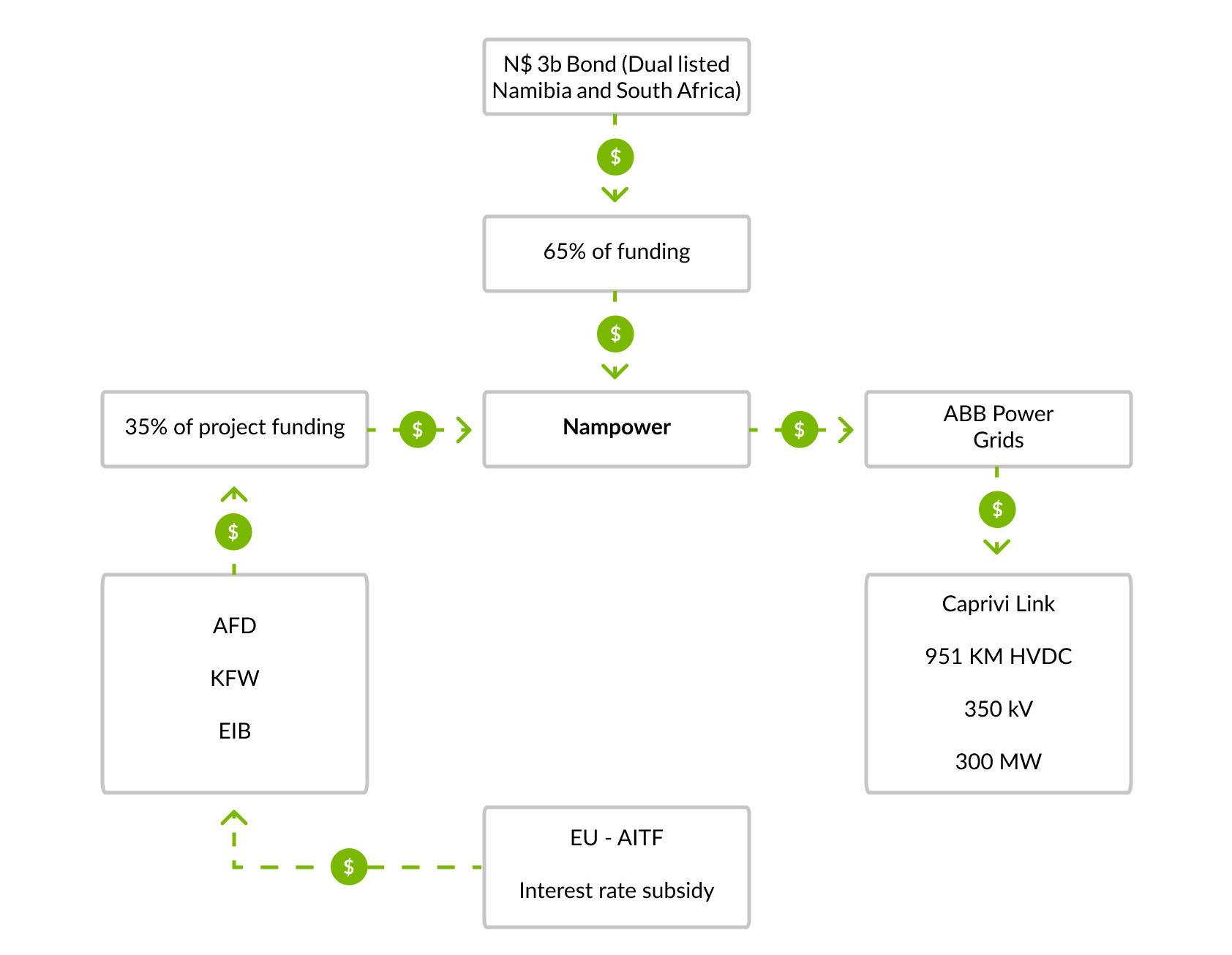
NamPower, Namibia’s national power utility, is responsible for generation, transmission and energy trading, reporting up to the Ministry of Mines and Energy. Its favourable and independent financial credit rating has allowed it to raise financing from the capital markets for its long-term projects.
In 2007, NamPower successfully dual-listed a $3B Namibian dollar-denominated long-term debt issue on both the Namibian and South African stock exchanges to fund the Caprivi Link Interconnector connecting Namibia to the Zambian and Zimbabwean electricity networks by 2009. Notable features at the time included a 300MW bipolar scheme, upgradeable to 600MW, and comprising a 951 km 350kV high voltage direct current (HVDC) bipolar line, along with numerous substations. This represented the first cross-border debt-raising transaction completed in Southern African capital markets, to finance a cross-border interconnection in line with the Southern African Power Pool (SAPP) with the objective to interconnect all Southern African Development Community (SADC) countries.
Government-supported financing is the most common approach to financing transmission infrastructure projects in Africa. Government balance sheet financing supports infrastructure ownership and controls being retained by the government and/or the relevant transmission utility, thereby increasing the asset base of, and sources of revenue, for the country. In addition, the government or the transmission utility remains in full control of the technical designs, timelines and process in the development of the transmission infrastructure.
Where the transmission utility maintains ownership of the transmission infrastructure, it also bears the risk and responsibility for the proper management and maintenance of the infrastructure. This extends to:
This often results in significant reserves being required to meet the costs of such obligations.
Public sector-led funding structures will affect the balance sheets of both the government and the utility. Such funding structures also affect the extent of the government’s debt sustainability. Hence, these structures require significant fiscal discipline.
There are examples of transmission infrastructure that is built by an IPP developer as part of a generation project. Generation power projects tend to be located as close as possible to fuel sources (river, coal mine, solar radiation, etc.). However, especially for renewable projects, the fuel sources are often far from existing grid connections and may require the construction of additional transmission infrastructure including substations. When procuring a new generation project, the government or the transmission utility may therefore decide that the transmission infrastructure is to be built by the IPP as part of the broader generation project and handed over to the government. Depending on the developer’s appetite and the size of the transmission line asset, the IPP might be interested to accept to take on the construction (and potentially financing) of a transmission line that will connect its project to the grid. Nonetheless, since the transmission line is transferred to the utility at some point in the project, the transmission line is ultimately will be government-owned.
This kind of model is used to reduce the connection risk in IPP projects. This ‘connection risk’ is the risk that the IPP or power plant is producing (or able to produce) electricity but cannot deliver it to end users because of a lack of connectivity to a transmission line. This could manifest itself in the construction phase of the power generation project where the delay in the construction and completion of the transmission infrastructure in turn delays the achievement of an anticipated commercial operations date under the power generation project.
This model allows the IPP to be in control of the interface risk between the two projects — generation and transmission. If this risk is not managed in this way, the typical remedy to the IPP is the inclusion of “deemed energy” payments under the power purchase agreement. These are payments calculated based on the loss of revenue from the energy that would have been delivered but for the transmission line unavailability event. Where generation is in the private sector but transmission is in the public sector, there is an increased financial risk on the government to pay these “deemed energy” payments (e.g., see above Case Study — Lake Turkana Transmission Line) to the extent the government or transmission utility does not manage or deliver the transmission infrastructure or make it available for the IPP to use.
The extra equity investment and debt funding necessary for the supplemental transmission work can either be repaid via a cash payment by the transmission utility when the transmission infrastructure is handed over or can be compensated through a higher generation tariff which reflects the additional fixed cost incurred to connect the power project to the national grid. The transmission asset will typically be handed over to the transmission utility at the commercial operation date, even if the cost of the construction is repaid to the IPP through the electricity tariff under the PPA.
Some considerations that arise when transmission infrastructure is built and captive to the benefit of one beneficiary (closed access for other usages) but which is ultimately handed to the transmission utility to maintain via public funds, is whether the transmission line still serves the greater public good. This may still be the case if the captive line provides reliable electricity to industrial users, who have wider economic benefits for a country.
Case Study — Self-build funding model in the South African IPP programmes
The South African government, through its energy ministry, has undertaken the competitive procurement of many independent power producer (IPP) programmes across various technologies since 2010. One of the most lauded of these programmes is the Renewable Energy Independent Power Producer Procurement Programme (REIPPPP). Today REIPPPP is in its fifth round of procurement. As of the end of round 4 bidding, the South African power utility Eskom Holdings SOC Limited (Eskom) concluded PPAs for 92 renewable energy projects with a total capacity of 6327 MW. Grid connection and integration of the power generation facility to the national grid was a key feature of the REIPPPP.
Facing Eskom funding constraints and the short timelines required for grid connection, the REIPPPP was structured to allow bidders to elect to build the grid connection facilities on a "self-build" basis as part of their bid. The option was initially only made available for distribution facilities but in the second quarter of 2015, Eskom's transmission division introduced a self-build option to its customers, both electricity generators and consumers.
In this option, the customer can elect to design, procure, construct and commission the transmission assets. The customer undertakes the design, route selection and procuring of all authorisations, with consultation and the approval of Eskom, who ultimately ensures the transmission infrastructure aligns with existing grid technical specifications. After successful commissioning, the customer is obliged to transfer full ownership of the transmission assets and all environmental authorisations, wayleaves, approvals and permits to Eskom. Eskom states in its Transmission Development Plan published in January 2021 that the intention is to give customers greater control over risk factors affecting their network connection. However, it is important to note that transmission infrastructure expects that it is open access, meaning there could be the possibility of connecting other generation assets and other customers to the self-build transmission line after it is handed over to Eskom.
The self-build option has since also been expanded to allow customers to also build associated works (such as substations) that will be shared with other customers, based on an assessment by Eskom of the accompanying risks to the transmission system and other customers. Since this is purely a voluntary option, the option of Eskom constructing the generator or customer's network and paying a connection charge also remains available to bidders and customers alike.
What is important to note with this option is that the customer bears the risk and responsibility to finance the transmission infrastructure construction works, including the authorisations required and the wayleave acquisition (including compensation). These costs are recovered through the tariff over the term of the PPA, so IPPs need to consider these additional costs when bidding into the tender.
Due to the success of the self-build option, this approach has been adopted by the South African government in all subsequent IPP programmes.
This chapter will discuss the Independent Power Transmission (IPT) model, the scope of which involves the design, construction, and financing of a single transmission line or a set of transmission lines and/or associated transmission infrastructure such as substations. The IPT models described below assume transmission assets that are connected with the country’s wider electricity network rather than captive assets for the benefit of an industrial offtaker (which are discussed in chapter 7. Other Private Funding Structures). Although an IPT is typically used for the development of greenfield assets, we will also explore how the same concepts can be used for the refurbishment of existing transmission assets.
In emerging markets, IPTs are implemented under a long-term contract, generally between the state-owned transmission utility and a project company. The contract will typically define the economic payment model, and the roles and responsibilities for the new infrastructure, including ownership, construction, maintenance and financing responsibilities. These contracts can be structured as transmission service agreements (TSA) but may also take other forms such as lease or line concession agreements. In this chapter, the long-term contract will be referred to as a TSA although it might have another name in practice.
IPTs have a proven record in many countries across the world including Latin America and Asia. They are often described as a less disruptive intervention in the transmission sector than the other available private business models as they typically can be implemented with limited or no regulatory reform. The IPT model, therefore, has the potential to unlock many critical infrastructure projects in SSA and, if well structured, could help African transmission utilities quickly finance lines that have a direct and positive impact on their revenue.
There are a handful of different IPT business models which have successfully resulted in transmission infrastructure built, maintained and financed by private project companies. While very similar, in that the private party assumes construction and financing risk in all IPT models, they vary by degree of ownership and maintenance obligations which will normally change the terms of repayment and the risk allocation between the project company and the transmission utility. The return on investment expectations, as well as the cost of financing, will increase the more the project company bears risks that condition its repayment.
“Operations” — Line operation and maintenance or system operation
“Operations” in this chapter refer to specific maintenance activities required to ensure that a transmission line and other associated infrastructure are available to be used when specified. This is different from “System Operations'', which is carried out by the transmission utility/transmission system operator (TSO) on a whole network basis and involves system control and dispatch of generation facilities. Notwithstanding the IPT model used, system control and dispatch will be carried out by the transmission utility/TSO, not the project company. Hence, in this chapter, operations refer to “line operation & maintenance” only.
The TSA establishes the financial terms and period during which the project company is entitled to receive payment in exchange for ensuring the constructed transmission infrastructure is available to be operated by the transmission utility as specified. In most cases, the project company will not take demand risk (volume or price), or utilisation of transmission infrastructure risk, since the transmission utility will determine how, when, and by what means the grid is managed and electricity is dispatched. The simplest way of structuring TSA payments is as a fixed return on investment amortised over the term of the TSA, structured as a service charge with scheduled payment dates. This type of annuity (or unitary payment) very clearly defines the revenue stream by which investors and lenders can recover their respective capital injections, which should lower lenders’ cost of capital and investors’ return expectations. Also, when the transaction is structured appropriately, the annuity payment becomes the key criterion for selecting the winning bidder, assuming of course that competitive bidding is used.
The annuity payment will be sized to ensure the project company can recover expenses associated with capital expenditure, financing and operating and maintenance agreement (O&M) expenses related to constructing, financing and, if applicable, operating the transmission infrastructure. Depending on the IPT business model, there may be an element of payment variability associated with asset performance linked to O&M obligations. However, baseline payment will be sized to ensure ongoing debt servicing. Below are the most common IPT business models:
In most IPT models that have been successfully implemented to date in Latin America and Asia, the private ownership of transmission-related assets is transferred to the transmission utility at the end of the TSA term.
BOOTs used extensively in Latin America
38 projects implemented in Brazil (220kV lines for a total of 50,000 km) and 18 projects in Peru (220kV and 500kV lines for a total of 7,560 km) were BOOT.
There are some countries in SSA that have the regulatory environment or experience with IPPs to be able to implement IPT business models within existing legislation. For countries with a track record in IPPs, IPTs could be considered a logical next step in using private capital to develop and expand their electricity networks. Many of the same government stakeholders who are familiar with the process and requirements of an IPP are likely to have the capacity and relevant experience to enable IPTs, especially when generation and transmission are bundled under the same utility.
In many countries, a transmission licence will need to be granted to the project company, either by a regulator or other relevant authority. There may also be a legal prohibition on private companies owning and operating transmission infrastructure (e.g., due to concerns about the natural monopoly characteristic of transmission infrastructure). If there are legal prohibitions, then there may be ways to structure around this as described in the section below (Ownership of transmission assets). If this is not possible, then an IPT business model can only be implemented if the regulatory structure is amended to allow the granting of a licence or appropriate authorisations by the regulator or relevant authority.
A regulator will typically have a role in approving (and likely licencing) the project company to implement a specified IPT business model. Thereafter, the regulator is likely to be responsible for monitoring compliance with licence conditions, which could include identified KPIs under the TSA during the O&M phase. When the TSA includes a simplified payment model, which eliminates demand risk, the regulator will typically wish to understand and approve the payment model. Before a TSA is being agreed to, the regulator needs to understand the cost and benefit to the sector but will not need to review complex tariff methodologies periodically during the TSA as required with power generation projects.
There are three key phases of an IPT project:
See chapter 9. Planning and Project Preparation for a description of the planning process of transmission projects. Project selection is critical in determining which transmission infrastructure is suitable for an IPT. Some of the key criteria to examine include:
The economics of the relevant project will have to be analysed based on the available data on the sector’s financial viability and growth prospects, and a set of assumptions. Projects that deliver the following efficiencies are well suited for an IPT business model: (i) can be delivered faster with lower O&M costs by the private sector, and (ii) likely to improve the sector’s cash flows by increasing the network’s availability (e.g., by connecting new end users to power supply, thereby meeting unserved demand). These types of projects are generally identified during the power system planning phase.
An analysis of whether there are other funds in the budget at the national, ministerial, or utility level for the financing of the infrastructure should be completed. The government should also assess whether there are donor funds readily available to procure the project without it being an IPT — if this is the case, some efficiencies from the private sector’s ability to maintain and operate the asset at a lower cost may be lost. If some alternative funding sources are identified, the government should then decide whether the transmission infrastructure is the best use of these funds.
An IPT is unlikely to be a suitable solution for smaller projects. Typically, for projects less than US$50 million, given the expense required for project preparation and execution, an IPT may not be the most suitable method of financing. It should be noted, however, that a series of smaller projects can be aggregated into a portfolio and executed as part of a single IPT investment.
An assessment of the overall legal and regulatory regime will be key to identify any particular challenges with an identified project. Environment and social risks should also be considered early to avoid obstacles that might stifle the financing efforts at a later stage (e.g., the construction of a transmission line through a protected natural reserve). This is not to say that easy projects should be implemented through the IPT model, but it would be wise that the first IPT project does not have added complications, as implementing a privately financed transmission project is challenging enough in a country with no relevant experience.
The host country can decide to allocate a project to a developer at an early stage in the project’s development or to undertake a certain level of preparatory work first. Allowing the developer to take responsibility for early-stage preparation provides more flexibility and may result in more innovation and cost savings. It also relieves the government from raising funds for project preparation and requires less capacity and government resources, although external funding may be available for conducting feasibility studies by the government or by the private sector. On the negative side, the developer needs to be selected before the design and investment requirements are finalised.
Countries can also choose to carry out a certain level of preparatory work centrally before conducting an auction or tender process to attract a greater level of investor interest and procure the most cost-effective construction solution and lowest cost of financing. While effective, this approach requires more resources initially to manage the project preparation phase until the developer is selected. Further detail on choosing between these approaches can be found in the Understanding Power Project Procurement handbook.
Regardless of who will be responsible for each activity, the following workstreams need to be completed during the preparation stage:
The development phase will end when the project reaches “financial close,” i.e. when all conditions precedent to the disbursement of the debt required for the project have been met, and monies disbursed.
After a financial closure has been achieved, construction will begin. The project company will typically be responsible for managing the project activities required to complete the infrastructure, although in some instances there may be a third party acting as construction manager. Even in the case of a single contractor (EPC), an owner’s engineer will typically be retained to supervise all aspects of the project and advise the project developer/owner. Some financial institutions may employ their own engineers and legal advisors to monitor construction, in particular the environmental and social aspects. Lenders will typically disburse their loans to fund the construction of the assets during this phase, although in some cases the equity investor in the project company may decide to finance the construction phase and refinance once the asset is built and delivered.
Generally speaking in IPT models, the control and dispatch of power will be the responsibility of the transmission utility acting as TSO, given the interface with the wider network. It is possible, but rare, for the private sector project company to take operational control of a section of the transmission network. Maintenance of the asset, which may include some localised operational activities, may be the responsibility of the project company. The project company may decide to have its own staff or hire a contractor to undertake this maintenance. In some cases, maintenance will be the responsibility of the transmission utility, either under the terms of the TSA or because the project company contracts back to the transmission utility under a maintenance agreement. The role of the project company in this respect has an impact on investor risk and is likely to determine the most suitable payment model that is agreed between the project company and the transmission utility (or an alternative offtaker). The decision as to which party is responsible for the maintenance and/or localised operations is a function of the risk analysis and how the project fits into the overall system strategy of the government.
The roles of each relevant sector participant concerning an IPT are set out in the table below.
|
Sector Participant |
Role |
|---|---|

|
The project company will have at least one shareholder/equity sponsor. In the case where projects are allocated earlier in the process, the owner of the project company will probably also develop the project. The developer will then either fund the project company with sufficient equity to capitalise it in the long term at a financial close or it will bring in a new shareholder. As with the IPP sector, developers usually carry out work and fund early-stage activities “on risk” in consideration for earning development fees, which are typically paid at financial close. Among the other project development activities undertaken by the developer/equity sponsor, it will take responsibility for arranging debt finance for the project company. During the lifetime of the IPT investment, the developer/equity sponsor will manage the project company and be the key point of interface between the project company and the stakeholders. |
 |
Lenders will finance the project company with loans. They will typically be mandated during the development phase to review the contracts developed by the developer/equity investor and test their “bankability” ahead of financial close (see below). At the financial close the lenders will fund the project and their loans will be drawn down to fund construction. IPT lenders include MDBs, bilateral DFIs, ECAs, and donor agencies. To provide long-term lending, international commercial lenders will likely only be able to participate with some kind of political risk or credit insurance from an ECA or DFI. Some local funding may be available as part of an overall funding package. |
 |
The “offtaker” is the organisation responsible for paying the IPT under the Transmission Services Agreement. In most cases, this will be the transmission utility, but it could be a different organisation in some countries, such as a distribution company or another government entity. |

|
The transmission utility’s role in the sector is unlikely to change as a result of an IPT project. In most cases, the transmission utility will continue to be responsible for all transmission operations in the host country and it will control dispatch and system operations. Existing infrastructure owned by the transmission utility will interface with the IPT’s infrastructure. The terms of many IPT projects will involve the transfer of the assets of the IPT project company to the transmission utility at the end of the term of the TSA. |

|
The government’s role in an IPT project is typically to assume certain state risks to protect the project company from risks it is not best placed to manage. The agreement between the government and the project company may be reflected in the Government Service/Support Agreement (GSA), which needs to be agreed upon and signed by both parties. The government here could be one or more ministries (usually the Ministry of Finance and the Ministry of Energy, or their equivalents) and may also include a Ministry of Land. A PPP Unit or Presidential Delivery Unit may also be a relevant governmental stakeholder. The level of support provided by the government in this respect will have an impact on the availability and pricing of debt and equity finance available for the IPT project. See further discussions in chapters 2. Financing Structures and Capital Sources and 11. Common Risks for further analysis on the range of government support available during both construction and operations phases. |
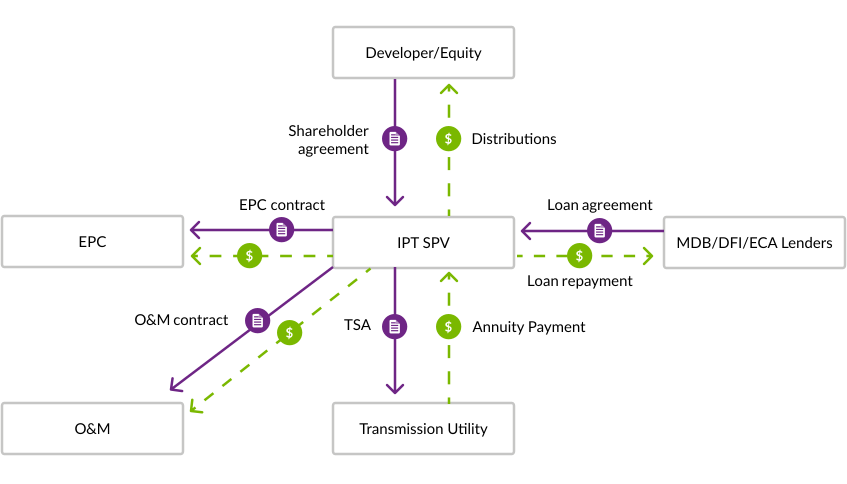
The risk matrix below summarises how key risks might be allocated to different stakeholders within a TSA. For a more detailed discussion and commentary on the individual risks, especially as they pertain to private investment in transmission infrastructure, please see chapter 11. Common Risks.
Please note that the table below is indicative and not meant to be exhaustive. The precise risk allocation between the parties on any particular transaction may be different to what is identified below as typical. Risk allocation is always subject to the fact pattern existing in relation to a particular transaction, investor appetite, and what risks a government is prepared and able to take on with respect to a particular transaction.
|
Risk |
Stakeholder bearing risk |
|
|---|---|---|

Govt/ Transmission utility |
IPT project company |
|
|
Financial risk |

|
|
|
Demand risk |
|
|
|
Credit risk |
|
|
|
Inflation |
|
|
|
Interest rates |
|
|
|
Foreign exchange rates |
|
|
|
Buy-out payment |
|
|
|
Land |
||
|
Pre-existing environmental conditions |
|
|
|
Pre-existing conditions in the title |
|
|
|
Land acquisition |
|
|
|
Technical risk |
||
|
Construction and commissioning of assets |
|
|
|
Scope changes before or during construction |
|
|
|
Interface between lines, substations, and generation facilities |
|
|
|
Technical risks related to the adoption of new technologies |
|
|
|
Operation, maintenance, technical performance |
|
|
|
KPIs, service levels |
|
|
|
Accidents, damage, theft |
|
|
|
Social and environmental risk |
||
|
Social and environmental impacts |
|
|
|
Occupational health and safety |
|
|
|
Resettlement |
|
|
|
Non-political force majeure events |
|
|
|
Political and Regulatory Risks |
||
|
Initial issuance of licenses, permits |
|
|
|
Renewals, modifications |
|
|
|
Changes in law |
|
|
|
Changes in tax |
|
|
|
Political force majeure events |
|
|
|
Disputes |
||
|
Resolution of disputes arising under contracts |
|
|
One of the main advantages that IPT business models bring is the ability for transmission utilities or host governments to expand transmission infrastructure using off-balance-sheet financing, via third-party investment and financing, freeing up financial resources for other purposes.
It is important to note that while asset ownership may lie with the project company for the duration of the TSA term, in practice, the key form of security relied upon by project lenders will be the revenue stream set out within the TSA. As indicated above, while a project company may be entitled to own the transmission infrastructure which it constructs permanently, the regulatory licensing regime or the TSA itself may dictate that the ownership of transmission infrastructure be transferred to the transmission utility at the end of the TSA term.
The TSA term is purposely defined for a long period (15 years plus) to spread the cost of long term transmission assets across many years and minimise the short term impact of servicing these payments on tariff structures. Payments are likely to follow a regular schedule over the term of the TSA.
As discussed earlier, simplified payment structures based on the availability and performance of the transmission infrastructure strip away demand risk based on utilisation (volume or end-user fees). This has the benefit of clearly defining a predictable revenue stream which represents a lower risk for investors and therefore attracts a lower cost of capital. Any variability to the revenue stream introduced via KPI metrics based on a split of risk allocation between the project company and the transmission utility (e.g., for commissioning or O&M responsibilities) may impact revenue risk but has the advantage of ensuring service quality, which should improve the operating performance and “availability” of the transmission infrastructure.
Whether additional credit support from a host government is required will be a function of the credit of the entity responsible for making scheduled payments. To the extent the paying entity, or offtaker, has a healthy balance sheet or the payment obligation is irrevocable and can be insured, there may be no need for a full sovereign guarantee to backstop ongoing or termination support. Minimising any sovereign contingent liability has the benefit of freeing up fiscal space.
If there are concerns about the offtaker’s ability to make timely scheduled payments, the following can be pursued to provide liquidity support:
Although ECA support (typically for an EPC contractor) offers a host government an off-balance sheet funding solution, the ECA still requires an implicit guarantee by requiring the MoF to be a borrower for their financing facility which can put pressure on the country’s debt capacity. In addition, the ECA requirement that the borrower provides a 15% contribution means there is still some amount of cash outlay expected from public resources, usually in the form of a down payment. While there could be alternative ways to finance the 15% contribution, this will take additional time and resources to structure, which can result in other inefficiencies.
While IPT financing may be more expensive than concessional loans or ECA financing benefitting from an implicit sovereign guarantee, it can attract a more diverse set of lenders and result in a lower cost for the project. As highlighted in the risk allocation matrix above, many types of lenders can provide cost-competitive financing to support IPT business models. As outlined in the contract structure diagram in Figure 5.1, the borrower will be the project company that enters into distinct construction and TSA contracts, and if applicable, an O&M services agreement. Depending on the amount of financing to be raised, the lender(s) can include MDBs, bilateral DFIs and ECAs who can provide long-term loans. Commercial lenders may be able to provide longer tenor loans with additional political and/or credit risk insurance from an ECA or MDB.
Aside from mitigating offtaker payment risk, there are a couple of other issues worth considering when choosing to implement IPTs which deserve special mention: land acquisition/right-of-way issues, and transmission infrastructure ownership.
Land acquisition is dealt with in chapter 10. Land Acquisition. To implement an IPT, the party that is best placed to manage this process is best decided on a case-by-case basis. However, the experience from around the world suggests that land acquisition/right-of-way risk, in most cases, is best handled by the government or a public sector entity. Even countries with very well-functioning power markets and numerous private transmission projects already being implemented (such as Brazil) have the government responsible for land acquisition.
In addition to ownership and local opposition, funding for acquiring the land and compensating the various stakeholders may be an obstacle too. Investors can play an important role, working with the government, to ensure that adequate funding is available and the compensation is fair and is done promptly. Land issues should be resolved before the agreement with the private investor is concluded.
This section has focused on implementing IPT business models for greenfield transmission infrastructure assets to raise financing that is off the government’s balance sheet. As outlined when defining IPT business models, the assumption is that the private sector will obtain a licence to own the transmission infrastructure for some time, after which the infrastructure is transferred to the transmission utility as set out in the TSA. This could be for a period of e.g. 20 or 30 years and is sized to allow the private sector developer to make a return on its investment.
This follows the example of how PPP business models have been applied to raise third-party financing to build other types of infrastructure, especially power generation assets. It is rooted in the philosophy that ownership of the asset runs concurrently with the project company’s right and ability to operate the relevant asset. It is typically also a lender requirement that the project company owns the asset for the long term, so that in a scenario where the project company has not been able to repay the debt it has incurred (e.g., because the transmission utility has failed to make payments to the IPT), lenders can recover their costs by selling the assets over which they have taken security. Lenders will always take some form of security (collateral) over the project company’s rights, title and interests — and having security over assets ensures that lenders have recourse to something of value, which they can sell (or at least have the right to do so) if things have gone wrong and the project is in default. Those rights are tied to the private ownership of the assets themselves.
In transmission infrastructure projects, where the operation of the relevant asset (e.g., the operation of a transmission line) may rest with the government utility, the same logic of ownership may not necessarily apply. In addition, unlike, for example, a generation asset such as a power plant, dismantling hundreds of kilometres of transmission infrastructure in a host country to sell to other parties (i.e., taking the ultimate step to enforce security to repay the debt) is likely to be less practical than for other types of assets. The analysis on ownership will therefore depend on the relevant transmission assets in question, who is operating it; and lender expectations. Security over revenue accounts associated with the predictable revenue stream and any credit-enhanced liquidity solutions and other contractual arrangements are arguably where lenders should focus their attention when structuring bankable solutions, rather than who owns the asset.
If this principle is accepted, there is room to argue that IPT business models do not need to rely on private ownership, in which case the refurbishment of existing transmission lines owned by the transmission utility could raise third-party financing along the same fundamentals outlined in previous sections of this chapter.
Case study — IPT: Peru
Peru is a country of 31 million people. Peak electricity demand is around 6200 MW and electricity production is nearly 50/50 hydro and thermal, even though renewables are increasing. 85% of the installed capacity is linked to the national power grid (SEIN) and 15% is in isolated systems. According to the World Bank in 2018, the length of the transmission lines was approximately 22,600 km. The majority of the demand is along the coast, as shown in Figure 5.2. Strengthening of the transmission capacity was a priority in the late 1990s and early 2000s when many transmission projects were implemented.
Reforms in the sector started in 1992, resulting in full deregulation and substantial privatisation. Eventually, there were 70 power generators, of which 65 rivately supplied 63% of the total energy. There are 14 transmission companies, all private, and 23 distribution companies of which 13 are private with 67% market share. Regulation of the power sector was well-designed and very effective in supporting a well-functioning power market.
Procurement of privately financed transmission projects started in 1998. The PPP process provided the framework for procuring transmission projects. Early on, it was decided that a BOOT model would be used and private investors would be selected through a competitive process. A well-balanced risk allocation matrix (among the investor, offtaker and government) provided the basis for de-risking these projects, leading to very competitive tariffs and substantial savings, as shown in Figure 5.3. The basis for bidding was an annuity, independent of demand and utilisation of the assets.
Eighteen tenders have now been completed leading to the implementation of a total of 7,560 km transmission lines (220kV and 500kV) and a total budget of $2.6 billion. All these projects were based on a BOOT model and were 30-year contracts.

An important conclusion that can be drawn from the Peruvian experience is that privately financed projects have been implemented at a fraction of the expected cost. The experience in other countries (e.g., Brazil and India) were similar. As an illustration of this, Figure 5.3 below shows that the winning bids in Peru provide significant savings to the electricity sector versus projected costs (an average of 36% lower).
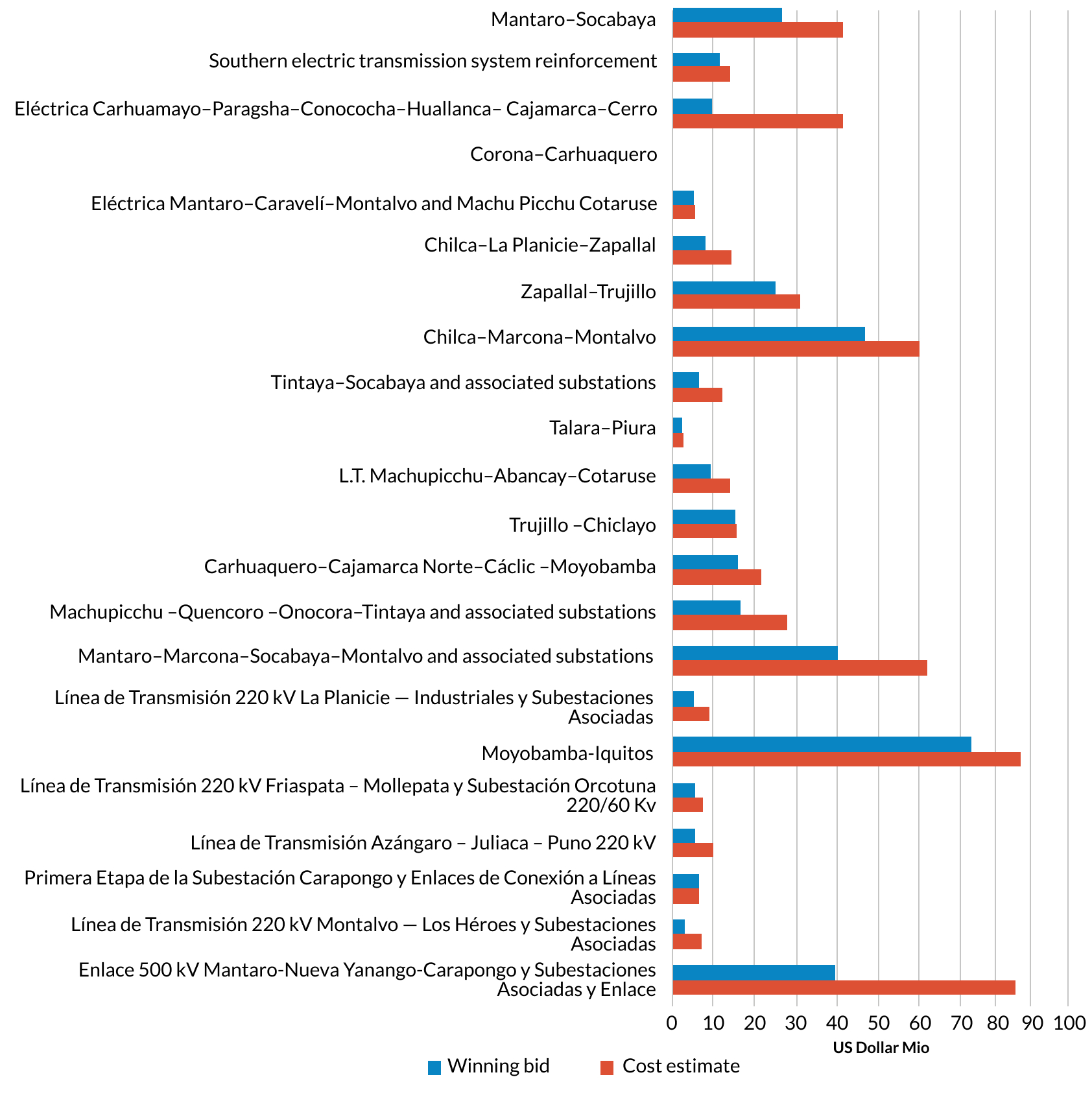
A case needs to be made on a project-by-project basis as to whether the benefits of an IPT in terms of availability of funding, flexibility of funding, and risk transfer to the private sector, mean that this is the most appropriate solution. The risks that the project company agrees to take will, to a large extent, determine the returns required by investors. An IPT will not always be the best solution and most countries will likely have a long list of projects that are more suitably funded with support from public funding sources.
However, experience in many countries demonstrates that when well structured and applied to the most appropriate projects, IPTs can create substantial value for the sector, improve the quality of power and enhance energy access. They can lead to efficiencies and lower costs for tariff payers.
Strategically, a host country’s decision to involve the private sector in the transmission subsector is a sensible way to improve power sector efficiency and reduce power supply costs. However, a necessary supplement to privately financed transmission should be a roadmap to power sector financial sustainability. IPTs can play an important role in making power sectors more efficient by unlocking critical projects that increase network ability to deliver power to areas of unmet demand and therefore increase sector cash flows. If correctly structured, they can also bring very material efficiencies, as illustrated by the experience of Peru described above.
Governments will consider a whole-of-grid concession when there is the expectation that a concessionaire can (1) better maintain and operate the existing transmission network to improve the overall availability and ultimately utilisation of transmission infrastructure and (2) invest in extending/upgrading the network to improve reliability and access to the power supply.
A whole-of-grid concession extends the right to develop, construct, operate, and maintain transmission infrastructure (the “concession”) to a private sector concessionaire, who in turn receives remuneration for the concession period. A concession can be a grant of rights or property, depending on the jurisdiction. Transmission assets are either leased or sold by a government or transmission utility to a private sector concessionaire to take over the role of the transmission utility via a concession agreement, a lease and assignment agreement, or a similar agreement.
Regardless of the contract form, the concessionaire may have to pay an upfront investment for the rights to maintain and operate the transmission infrastructure, although this is not always the case. The concessionaire would typically be compensated via payments it collects from its customers (generators, distribution companies, or industrial consumers that are directly connected to the transmission system).
The upfront payment owed by the concessionaire, and the form of this payment, is covered in further detail later in the chapter. The amount the concessionaire is required to earn in a year to cover its costs and earn a return on its investments (the annual revenue requirement) is calculated using performance-based rate making or cost of service regulation. In either ratemaking method, the revenue requirement is based on the regulated asset base (RAB) or rate base — a measure of the value of the assets which are used to perform a regulated service. In a whole-of-grid concession, the RAB would include all transmission infrastructure the concessionaire is expected to maintain, operate or expand to deliver services to a defined customer base (e.g., generators, bulk distributors, large industrial customers, etc.) in a defined geographic area. In exchange for delivering these services, the concessionaire earns and collects fees directly from those customers.
In principle, this methodology assumes that customers are paying a cost-reflective tariff that will ensure full recovery of the concessionaire’s investment in transmission assets, reducing the investor’s risk of investing in capital-intensive projects. If regulated tariffs are below what the concessionaire requires to recover its costs, then the transmission utility or other government entity will be required to compensate the concessionaire some other way. This is covered in greater detail later in the chapter.
There are two main ways a whole-of-grid concession may be structured:
The concessionaire, via a project company, is typically responsible for:
The rights conferred to the concessionaire must allow it to exert sufficient and unfettered control to manage its transmission network responsibilities without government or transmission utility interference. The government’s role is limited to an oversight role — i.e., an independent regulator that oversees tariff methodology and a planning role — set out in the concession itself. This “concession” right, depending on the jurisdiction (and asset), could be a grant of rights, land or property, or a combination of all three. However, title to the relevant land and properties may not always pass to the concessionaire as a result of the concession. What is more important is that the concessionaire retains the rights to control, maintain and operate the relevant asset — in this case, the entire national grid — and that these rights are granted in a manner that is legally valid, binding and enforceable (including with parliamentary or cabinet-level approval, where necessary).
In all cases, the transmission assets are transferred back to the transmission utility at the end of the concession.
Whole-of-grid concessions are suitable in jurisdictions that have an independent electricity regulator and have a regulatory framework that allows for third parties (such as a concessionaire) to hold a transmission licence that permits them to construct, operate and maintain transmission infrastructure. It is also important that the legislative framework permits private sector parties to own or operate strategic transmission assets. Changes to legislative and regulatory frameworks to permit whole-of-grid concessions where the existing regulatory regime does not permit investors to be concessionaires can be a complex, expensive, and time-consuming undertaking.
The allocation of risks in a whole-of-grid concession also plays a significant role in determining the success or failure of efforts to structure and award a concession. This is discussed in further detail later in the chapter.
Considering the ongoing investment required in the operation and maintenance of transmission infrastructure, it is not practical to establish a tariff from the outset that the concessionaire may charge customers for use of the transmission service for the entire term of the concession. To avoid renegotiating, restructuring, or early termination of a concession due to an insufficient or inadequate tariff, the tariff methodology the regulator intends to use should be clearly articulated in a set of tariff guidelines or the concession agreement. The two most common forms of regulation on which tariff methodologies are based are the cost-of-service approach and performance-based regulation. While these will not be covered in detail in this book, each has its advantages and disadvantages which need to be carefully considered.
The important principle is that the concessionaire’s annual revenue requirement should be sufficient to allow for a return on the RAB equal to the amount of the RAB times the weighted average cost of capital, operating and maintenance costs, taxes, and depreciation of existing assets.
The soundness and certainty of the RAB valuation and associated tariff methodology are critical to the success of implementing a whole-of-grid concession, given that the tariffs charged to customers for their use of the transmission infrastructure are the main source of revenue (and in some instances the only source of revenue) to the concessionaire.
A concessionaire’s revenue shortfall may sometimes be as a result of its failure to meet certain KPI set by the regulator. In this case, the government or the transmission utility would not be required to cover such a shortfall. However, if the shortfall is a result of the regulator’s failure to apply appropriate tariff guidelines, the government or the transmission utility will need to find an alternative way to compensate the concessionaire or face a potential termination of the concession. The compensation may take the form of a one-time payment or an ongoing subsidy to the concessionaire.
If there is a material unfavourable future change in the tariff methodology that does not adhere to the principles of full cost recovery plus a return on investment, this would be detrimental to the financial viability of the concessionaire. The government support agreement (discussed in further detail below) would typically address this risk.
In countries that do not have an established independent regulator, economic regulation can still be achieved through a government support agreement or concession agreement which includes an annexe that describes a regulatory methodology. The government support agreement (between the host country and the concessionaire) or the concession agreement (between the transmission utility and the concessionaire) will then govern the relationship between the asset owner and the service provider, and the relevant government counterparty will be responsible for monitoring the performance of the operator and for applying the regulatory methodology following the terms of the contract. This system is known as “Regulation by Contract.”
Case Study — Transmission Concession: Philippines
Source: Private Sector Participation in Electricity Transmission and Distribution/ Experiences from Brazil, Peru, The Philippines, and Turkey (World Bank, 2015), pages 6-9.
The Philippines is an example of a long-term (25-year) concession for existing transmission assets. The main goal was to raise capital for the sector and the Treasury. This goal was eventually satisfied even though it took longer than initially expected; privatisation of the transmission system attracted close to $4.2 billion in a concession deal that closed in 2007.
Initially (2001), the regulatory framework was established under a comprehensive restructuring and privatisation programme, known as the Electric Power Industry Reform Act (EPIRA). At the same time, the energy regulatory commission (ERC) was created. Performance-based regulation (PBR) formed the basic framework and a specific methodology for regulating the revenues of the transmission company was developed. A "revenue cap" approach was adopted for the transmission company.
While the essential regulatory elements were in place since 2003, it took a few years for the ERC to improve the rate-making methodology and impose the necessary discipline for setting the specific revenue cap levels. As a result, there were two unsuccessful attempts before the third successful one in December 2007. Bidders were very interested to invest in the Philippines mainly because of the following three factors: (1) there was promising growth prospect in the economy and the power sector; (2) there was a clear and steadily improving regulatory framework; and, (3) there was a vibrant domestic private sector which was interested to participate.
Eventually (in 2007), there were a sufficient number of eligible bidders, who were convinced of the quality of the regulatory framework and the integrity of the competitive process. The National Grid Corporation of Philippines (NGCP), a corporate vehicle of a group of local and international companies, won the concession.
Predictable Transmission Tariffs Set the Stage for Transmission Company Concession in the Philippines
“The efforts to attract investors to the Philippine transmission business were an essential part of the government's electricity reform programme stipulated under EPIRA in 2001. However, the efforts to complete the required auctions failed twice in 2003, and then again in February 2007. Regulatory uncertainty about the transmission company's revenue streams was the main concern voiced by investors, even though the transmission company had published the first set of essential guidelines on the subject. The failure of the first two bids can be attributed to the short track record of ERC and its PBR methodology. An additional source of uncertainty for bidders was the relatively short (three-year) duration of the first regulatory period set by the tariff guidelines. The period would end on December 31, 2005, after which the rates would be subject to revision.
For the second (2006-2010) and third (2011-2015) regulatory periods, the revenue cap methodology still applied. However, the regulatory uncertainty remained high in 2006, as the specific revenue cap levels were still debated. The continued uncertainty undermined the bidders' confidence, and the government finally decided to drop the third tender in February 2007 when only one bidder remained. At this point, the government preferred to announce a new auction rather than negotiate directly with the sole remaining bidder. The ERC used the opportunity to better prepare for the next auction. The regulatory asset base (RAB), a key component in the estimation of the maximum allowable revenue, was established and could be used by investors in preparing their bids. This set the tone for transparency and predictability of ERC's regulatory process.
The payment of the initial concession fee was made easier by requiring an upfront payment of only 25 per cent and the deferred payment of the balance under precise terms and conditions set before the final bid. In the new auction in December 2007, the successful bid by NGCP yielded $3.95 billion, well above the RAB level that was set around $3.0 to 3.2 billion.” (World Bank, 2015, p. 8)
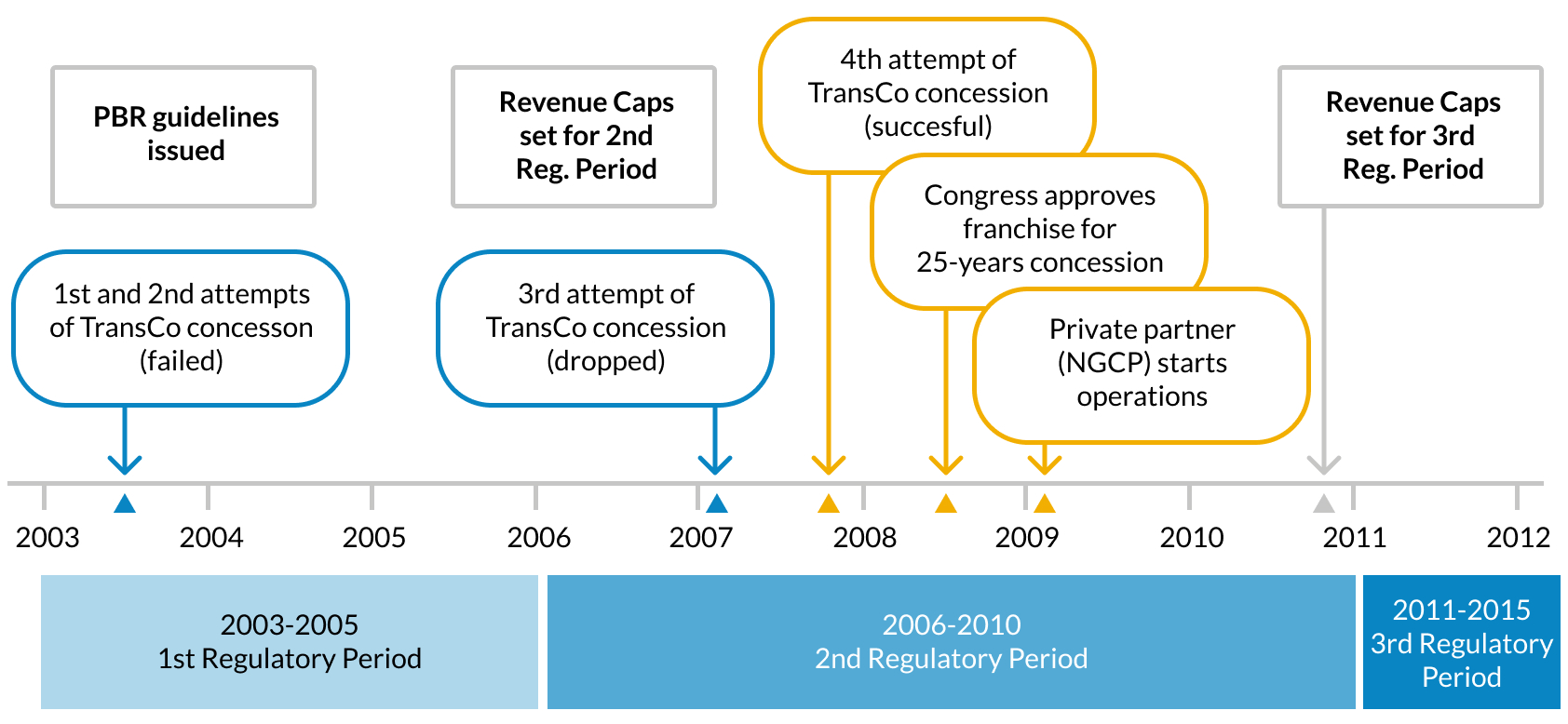
Host countries that seek to implement a whole-of-grid concession may procure them (1) by conducting an international competitive tender or (2) through direct negotiations. In both cases, the process would likely be subject to laws governing the procurement and/or public-private partnerships. MDBs and donors providing concessional financing often find it easier to support infrastructure projects that have been procured following a competitive tender process.
In a competitive tender, the qualification and evaluation criteria of the tender determine the selection of a concessionaire. Where a concession fee is required to be paid either upfront or periodically over the term of the concession agreement, the price offered for the concession fee will likely be a significant consideration in the award of the concession as well as the concessionaire’s return expectations.
For more information on how to procure projects in the power sector, see the Understanding Power Project Procurement handbook.
The implementation of a concession will impact the process of planning the development of the transmission system. Given the duration of a whole-of-grid concession and the concessionaire’s role in investing in network expansion, the concessionaire will likely become a key stakeholder in system planning. Under traditional cost of service regulation, a concessionaire may have a strong desire to obtain some form of commitment from a regulator that the regulator will include the capital costs associated with a future project in the rate base when the project is placed into service. Under performance-based rate-making, a concessionaire may be required to submit periodic business plans to the regulator which outline the new projects it intends to undertake. Those business plans are in turn used to establish the annual revenue requirements for the period that is covered by the business plan.
A concession agreement typically provides that the concessionaire will pay upfront or ongoing concession fees to the transmission utility. A concession fee provides a source of revenue to the transmission utility which it can use to fund its ongoing costs. A balance must be struck between how much the transmission utility needs to recover against the impact on transmission fees to the system: generally, higher concession fees will lead to higher transmission charges.
At the same time, it is important to recognise that the transmission utility may have ongoing liabilities which may not have been transferred to the concessionaire, for example, servicing a pre-existing debt. The transmission utility would need to earn revenues that are sufficient to enable it to pay for these liabilities as they come due. There may also be ongoing costs incurred by the transmission utility throughout the concession period, including administrative overhead to enable it to administer the concession agreement, maintain its ownership interest in the transmission system, and servicing debt repayment obligations.
There are different options that a transmission utility may choose to charge a concession fee to a concessionaire to extinguish or meet its ongoing liabilities, which are discussed in the Table 6.1.
|
Option |
Description |
|---|---|
|
Option 1 |
Under this option the concession fee would consist of:
The transmission utility would use the up-front payment to retire its debts and would use ongoing payments to fund the ongoing expenses for the term of the concession. The regulated asset base of the concession would initially be established as the amount of the up-front payment. That portion of the regulated asset base would depreciate at a specified rate designed to balance the competing interests of reducing the regulated asset base and reducing the depreciation charge recognised in each annual revenue requirement. |
|
Option 2 |
The concessionaire does not pay an upfront concession fee because the transmission utility retains its RAB, which would continue to depreciate following the regulatory concepts discussed in Option 1. The concessionaire will continue to collect revenue from the customer base, and remit via the concession fee that portion owed to the transmission utility to cover its debt obligations and ongoing administrative overheads. The concessionaire will start to earn a return on new investments made (including depreciation) for capital expenditure investments in upgrades or greenfield transmission network extensions. |
|
Option 3 |
The concessionaire does not pay an up-front concession fee to the transmission utility. The ongoing concession fee paid to the transmission utility will be sized to cover two distinct components:
|
Any number of permutations of these three options could be used to set the concession fee in a manner that aligns with the priorities of the host country and the ability of the concessionaire to raise debt and equity to fund any up-front and ongoing payment obligations. Option 1 would result in the highest upfront payment to the transmission utility (which would likely be paid to the government as a special dividend). In most cases, it would also result in higher use of system fees and therefore higher rates for consumers. Option 3 may, depending on how the debts of the transmission utility are structured, result in the lowest use of system fees and therefore the lowest rates for consumers. Option 2 can be tailored to achieve the desired blend of those two outcomes. Which option a government should pursue depends on its objectives.
Identifying and mapping stakeholders and their likely interests, concerns and objectives is an essential first step in determining groups of stakeholders that may support or oppose a whole-of-grid concession, with proper stakeholder engagement. To ensure successful implementation, it is important for the team responsible for structuring the concession to consider reasonable concerns and objectives of all affected stakeholders. These stakeholders include the host government (notably the ministries responsible for finance and electricity), the regulator, the transmission utility, generators, distribution companies, and consumers, along with potential lenders who have extended loans to the transmission utility. The most significant effects on those participants are mapped in the matrix that follows in Table 6.2.
|
Sector Participant |
Role |
|---|---|
|
|
The ministries involved in financing and executing new transmission implementation will now need to pay for and administer any subsidies, if required, to make the concessionaire whole. They will need to plan to raise the termination payment/ “buyout price” at the end of the term or upon the earlier termination of the concession. |

|
Regulators in SSA generally have significant experience regulating publicly-owned utilities, but limited experience regulating privately-owned utilities. A higher degree of oversight is required for privately-owned concessionaires, including regulatory methodology and KPIs, to ensure fairness and transparency. As private sector participation is introduced, both the independence of the regulator and the technical proficiency of the regulator become more important. |
|
|
The transmission utility will primarily be responsible for administering the concession agreement, maintaining its ownership interest in the transmission system, and servicing liabilities it retains. The concessionaire may be required to hire substantially all of the transmission utility’s employees as a concession condition. In all cases, employment considerations would also be influenced by local law requirements, impacting costs. |

|
Connection agreements and TSAs between generators, distribution companies, and industrial customers and the transmission utility will need to be transferred to the concessionaire. Consideration will be required regarding impact to generators, distribution companies, and industrial users, including liability for grid interruption and unavailability. If the transmission utility performs the role of a single-buyer and has entered into power purchase agreements in respect of independent power projects, those agreements should be reviewed to determine whether the implementation of the concession will trigger any defaults under existing PPAs. |
|
|
Development finance institutions that fund, or may be interested in funding, the development of new transmission infrastructure will be interested in exploring how they can continue to fund the development of new transmission infrastructure after the concession has been implemented. |
The participants in a concession and their contractual relationships are shown in Figure 6.2. The structure presented in Figure 6.2 assumes that the state-owned transmission utility does not act as a single buyer. If the state owned transmission utility does act as a single buyer then additional contracts will be necessary to separate rights and obligations related to transmission from rights and obligations related to supply.
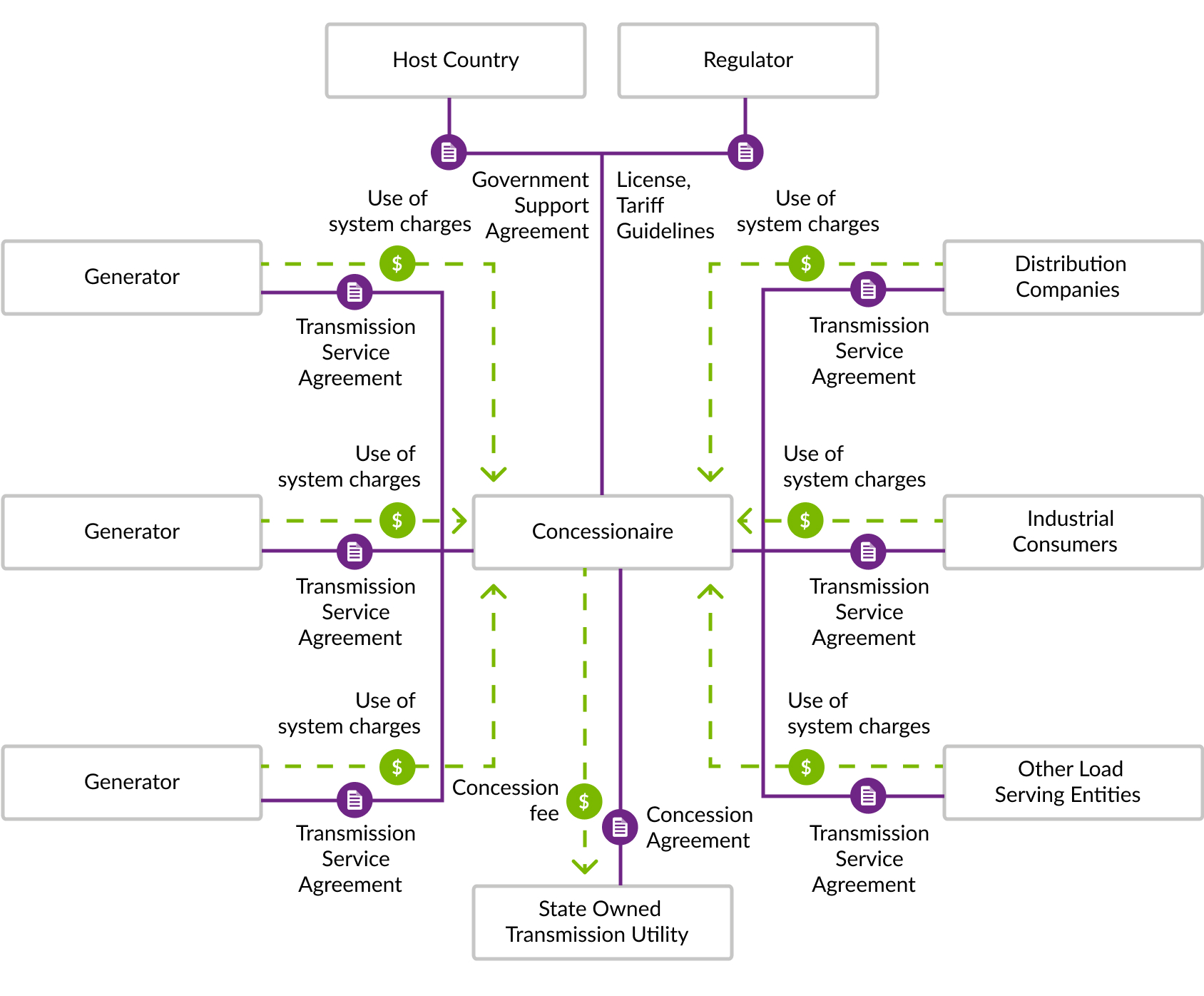
As the concessionaire constructs and installs new equipment and facilities and those facilities become part of the transmission system, legal title to the new equipment and facilities vests in the transmission utility so that the transmission utility remains the owner of the entire transmission system during the term of the concession. If, for example, the concessionaire needs to acquire additional rights-of-way, easements, ownership interests, or leasehold interests in land to expand the transmission system, the concession acquires those interests in the name of the transmission utility, and those interests become subject to the leasehold interest and access rights created by the concession without further action by the concessionaire or the transmission utility.
The concessionaire will be responsible for operating and maintaining the transmission system. If the legislative framework provides that the holder of a transmission license is responsible for dispatching generation and balancing the system, then the concessionaire will be responsible for those functions. If the legislative framework contemplates that those functions will be performed by a transmission system operator, then those functions will be performed by the entity that holds the license to act as the transmission system operator. Although the concessionaire may also hold the license to act as a transmission system operator, a different entity will perform those functions in markets that separate the transmission ownership and transmission system operator functions.
The concessionaire will recover its ongoing operations and maintenance costs from the use of system fees it charges for transmission. It will finance capital expenditures to upgrade and expand the transmission system with a combination of debt and equity. Equity will be contributed by the shareholders in the concessionaire or created by the retention of earnings by the concessionaire. The concessionaire will raise debt by borrowing from lenders or by issuing bonds or preferred shares. The concessionaire’s ability to raise capital in the form of equity, debt, and preferred shares is highly dependent on how the concessionaire is regulated.
In a typical whole-of-grid transmission concession, a state-owned utility that owns a transmission system (the “transmission company” or the “transmission utility”) grants a concession over all or a portion of its transmission network to the project company established to act as the holder of the concession (the “concessionaire”). At the same time, the ministry that is responsible for overseeing the electricity sector or the Independent Regulator that regulates the electricity sector, if one has been established, typically grants a transmission license to the concessionaire. In addition, the host country may enter into a government support agreement, implementation agreement, or similar agreement (a “government support agreement”) with the concessionaire to provide certain identified types of support to the transaction. We explore these three key documents below. We also take a look at a key concept for the financing of whole-of-grid concessions, and termination payments, below.
The concession agreement will typically provide that:
As far as a whole-of-grid concession is concerned, government support agreements will cover similar risks as in IPTs — although they may have additional and specific protections relating to any outstanding risks that fall to the government concerning an entire transmission system including, for example, pre-existing liabilities that relate to the transmission system assets before they are handed over under the concession.
The concession agreement and/or the relevant government support agreement will include a termination payment or “buy-out price”, which is payable at the end of the term of a concession or earlier, upon certain early termination events.
This payment amount, if paid at the end of a concession, may often be set to equal the regulated asset base as of the end of the last year of the concession. In scenarios other than the expiration of the term, the termination payment could be calculated by applying a multiplier to the regulated asset base.
In the case of early termination of the concession following (i) an event of default by the state-owned transmission utility under the concession agreement, (ii) an event of default by the host country under the government support agreement, or (iii) the occurrence of a prolonged political force majeure event, the multiplier may be greater than 1 in order to provide an incentive for the host country and the transmission utility to perform their obligations under the project agreements. Similarly, in the case of early termination of the concession following an event of default by the concessionaire, the multiplier may be less than 1 in order to provide an incentive for the concessionaire to perform its obligations under the project agreements. The incentives created by a multiplier other than 1 should not be viewed as, or sized in terms of, a penalty, which could be unenforceable under the laws of many host countries.
Termination payments can be sizeable, as the amount of the termination payment is directly correlated with the amount of investments made by the concessionaire during the term of the concession. On the other hand, a host government may find that a concessionaire has performed well over the term of the concession and that there is little rationale for allowing a concession to expire. A concession agreement and government support agreement may contemplate that the host government, the transmission utility, and the concessionaire may agree to extend the term of the concession before its expiration.
The concession agreement and Government Support Agreement may contain only a part of the obligations of the concessionaire. Other obligations the concessionaire will need to perform are likely to be set out in the wider legislative framework, including any implementing regulations issued under the regulatory framework, and any licences issued to the concessionaire by the regulator.
Some of the issues the licence may address particular to a concession include:
These obligations will need to be aligned with the concession agreement (or conversely, the concession agreement needs to be aligned with the requirements of the licence). The rights and obligations that are set out in the transmission licence will impact the risk assessment of potential investors in the concession, the bankability of the transaction, and the service levels consumers should expect of the concessionaire.
Many of the risks that arise in the context of a concession are described and discussed above. Please note that the facts and circumstances surrounding a particular whole-of-grid concession will impact how risks are allocated. The risk matrix below summarises how key risks might be allocated to different stakeholders within a concession agreement. For a more detailed discussion and commentary on the individual risks, especially as they pertain to private investment in transmission infrastructure, please see chapter 11. Common Risks.
Please note that the table below is indicative, and not meant to be exhaustive. The precise risk allocation between the parties on any particular transaction can vary from what is presented below. Risk allocation is always subject to the fact pattern existing with a particular transaction, investor appetite, and what risks a government is prepared and able to support on a particular transaction.
|
Risk |
Stakeholder bearing risk |
||
|---|---|---|---|

Govt/Transmission |

Concessionaire |

Consumers |
|
|
Financial risk |
|||
Demand risk |

|
|
|
Credit risk |
|
|
|
Inflation |
|
||
|
Interest rates |
|
|
|
|
Foreign exchange rates |
|
|
|
|
Termination payment |
|
||
|
Land |
|||
|
Pre-existing environmental conditions |
|
||
|
Pre-existing defects in title |
|
||
|
Land acquisition for expansions |
|
||
|
Technical risk |
|||
|
Construction and commissioning of new assets |
|
||
|
Scope changes before/during construction |
|
|
|
|
Interface between transmission infrastructure and generation facilities |
|
||
|
Technical risks related to technology risk |
|
||
|
Operation, maintenance, technical performance |
|
||
|
KPIs, service levels |
|
||
|
Accidents, damage, theft |
|
|
|
|
Social and environmental risk |
|||
|
Social and environmental impacts |
|
||
|
Occupational health and safety |
|
||
|
Resettlement |
|
||
|
Non-political force majeure events |
|
|
|
|
Political and regulatory risk |
|||
|
Initial issuance of licenses, permits |
|
|
|
|
Renewals, modifications |
|
||
|
Changes in law |
|
||
|
Changes in tax |
|
||
|
Political force majeure events |
|
||
|
Disputes |
|||
|
Resolution of disputes (contractual) |
|
|
|
|
Resolution of disputes (tariff methodology) |
|
|
|
Network industries require ongoing investment. Ongoing investment requires ongoing increases to the equity invested in the business and ongoing increases (and repayments) of debt. Project finance structures are not well suited to ongoing and open-ended borrowing. For this reason, network utilities with ongoing investment requirements are, as a general rule, financed using corporate finance, not project finance. This has several implications. For example:
Given these implications, large utilities have active borrowing programmes that may result in the issuance of multiple series of bonds and multiple borrowings under lines of credit or fixed-term loans during each year. This should not be surprising, given that project financing techniques were developed in part to increase debt-to-equity ratios, increase tenors, and enable borrowers to hedge their exposure to floating interest rates.
A significant portion of greenfield transmission infrastructure has been financed by donors and concessional financing from MDBs.
A whole-of-grid concession does not preclude donors and MDBs from still financing new transmission infrastructure build, nor does it change the role of DFI or ECA lending for new transmission assets. Transmission assets that continue to benefit from donors or other external financings can still be operated by the concessionaire.
Donor funding can also provide viability gap funding to help support a concessionaire’s acquisition of a regulated asset base, with the remainder of the funding being financed by the concessionaire. The concessionaire would earn a return on the portion of the asset base it has self-financed, but not a return on the donor portion of the financing. The blending of donor or concessional capital in this way helps subsidise the cost to the concessionaire of operating and maintaining sections of the transmission network which may be less commercial or in a poor state.
This chapter has discussed the whole-of-grid concession in the context of concessioning the operation, maintenance, and expansion of the transmission network on a standalone basis. In reality in Sub-Saharan Africa, there are only a handful of examples where the transmission network has been concessioned, and generally, this has been the case when it has been bundled along with generation and distribution services. At the time of writing, there are no whole-of-grid private sector concessions in the transmission sector operating in the African continent, although globally there are multiple examples, including in the Philippines and parts of Latin America.
If power generation, transmission, system operator and distribution remain the responsibility of vertically integrated power utilities, as is the case in many African countries, whole-of-grid concessions in the transmission space may only follow once the sector has been unbundled, or if the entire energy sector is the subject of a concession. This has been the case, in Cameroon, between 2000 and 2015 with AES-Sonel.
In countries where generation, transmission, and distribution are unbundled, system operators are still challenged in their ability to charge cost-reflective tariffs to end users required to enable upstream, midstream and downstream activities in the energy value chain to recover their costs. This is an argument for granting concessions concerning “bundled” assets — so that the generation tariffs can cross-subsidise those on the transmission side, for example.
However, incentivising the private sector by enabling them to be able to charge end users to recover the costs required to build, own and operate entire energy systems is not straightforward given the high capital costs involved and challenges in recovering costs from end users which then do not prohibit access to the electricity.
As a host country considers whether a whole-of-grid concession is an appropriate approach for helping to finance new and existing transmission infrastructure capital expenditure, it should consider (i) how its energy sector is structured, (ii) the role of electricity sector stakeholders and how their responsibilities may be impacted, and (iii) how to engage existing stakeholders to build support for the successful implementation of this approach.
A whole-of-grid concession may be appropriate if a host country desires to:
A whole-of-grid concession may be less attractive to a host country that:
In this chapter, we describe other private sector-led models of procurement for transmission infrastructure, namely:
These models are described to ensure that the spectrum of private participation options is covered by the book, although the authors believe that these models are less likely to be adopted or operationalised in the near term in the African context given other priorities of the sector. Nonetheless, it is conceivable that they form part of the future transmission infrastructure story in the African continent.
A merchant transmission line consists of one or more lines that connect existing transmission grids/power markets or consumers that were previously isolated. Such transmission lines are entirely private in the sense that ownership, control, financing, construction, operation, maintenance, and tariff setting of the lines rests entirely with the private developer. Access to the merchant line is at the discretion of the owner. Therefore, it is not open to all transmission users.
Traditionally, merchant lines were developed by independent companies seeking to use the system to wheel power between markets where there is a difference in electricity prices. Trading power from lower-priced markets into higher-priced markets allows the company to profit from pricing arbitrage. This model of financing is a market-driven model to provide transmission infrastructure that supports competitive wholesale markets for electricity. However, this model may not be viable for markets where tariffs are set at artificially low levels or where there are low-cost production sources. In such electricity markets, the price differential, which the merchant model depends strongly on, is either non-existent or sufficiently insignificant to impede the company’s ability to recover its investment.
Merchant lines are usually not part of the traditional planning of a transmission system but are instead born of market opportunity. However, despite their opportunistic nature, regulators and policymakers still need to put in place the proper regulatory and market framework that supports merchant lines if this is an option they want to pursue to incentivise alternative financing for new transmission build.

The assets of a merchant line/system are entirely owned by the private party who invests or finances its construction. Merchant lines are generally new construction, though it is conceivable that an existing line/system is privatised and sold to a private party for them to maintain and operate. The state-owned utility responsible for transmission infrastructure has no financial interest in the merchant line.
Despite the private ownership, merchant lines are still subject to technical compliance with grid code (if in place) and regulations in the same manner as all power system assets. This includes approvals on siting/permitting, design and technology to ensure safety, alignment, and efficiency in the national power system. The extent to which a merchant line is subject to regulation is primarily a function of the regulatory framework of the host jurisdiction(s).
The merchant/line system is also privately managed and controlled, with the owner/developer:
Merchant line developers are responsible both for the initial capital costs to purchase the rights-of-way, design and construction of the project, and for ongoing operations and maintenance costs. The commercial viability of a merchant line rests entirely on its ability to capture value through power pricing arbitrage across markets or by selling its capacity to third parties. In promoting this model, advanced transmission network planning and coordination is important. Also, there will be requirements to review policies that do not accommodate a decentralised competitive wholesale market.
To secure a revenue source, there are three potential avenues for securing customers in the merchant model.
The customers of a merchant line owner/operator may include existing generating company or generation project developers who would buy the merchant transmission service to deliver the power from their generation plant. The customers may be utilities, retailers or load-serving entities with energy needs becoming anchor tenants giving them access to an energy source. Also, customers of merchant lines may be energy traders or owners of merchant generation assets that want to take advantage of arbitrage congestion. More so, the implementation of the merchant model is only possible where private entities are allowed to hold a licence for the construction and operation of a transmission infrastructure among other regulatory requirements.
There have been a limited number of merchant transmission lines globally. Examples include a transmission line between the Australian state of Victoria and the island of Tasmania; Path 15 connecting the northern and southern sections of the California power grid; and Montana-Alberta Tie Line.
The most significant challenge to financing merchant transmission lines is that it will be challenging to secure the project revenues for the financing. Hence, a private company might need to finance the project with little or no leverage (debt), or based on other commercial activities. This is not optimal for the size of the investment required for transmission assets.
This model may be attractive for governments depending on the needs of the specific country. However, even if there is a well-functioning market with limited credit risk (such as the Southern African Power Pool (SAPP) market, where settlements are prepaid), there still needs to be a consideration for broader risk, such as political stability, land acquisition, and environmental and social risk. These risks, coupled with the market demand risk, pose a challenge to most private investors, which return expectations alone will not be able to overcome.
In places where there are no markets like SAPP, the regulations for cross-border trades involving private participants are unlikely to have been fully developed. Without regulatory certainty, it is difficult for the private sector participants to develop a project on a merchant basis, as regulatory certainty is required for long-term investments.
In the industrial demand-driven model, transmission expansion is driven by the electricity needs of one or more large industrial consumers. The transmission line will be financed, built, and operated to serve the industrial area where the large consumer(s) conduct their businesses. The relevant transmission line, once built, could remain in the hands of the private sector or could be handed back to the transmission utility responsible for the ownership and maintenance of transmission assets (often in countries that consider transmission infrastructure a public good).
As economies develop, there may be growth in a particular industry or the discovery of a commodity in a region of a country where there is little or no existing transmission infrastructure. The development of the industry could underpin wider economic growth, which may be a key driver in the procurement and financing of power and transmission infrastructure to support industrial growth or a significant customer. The key feature of this industrial-demand driven model is that the project will be financed based on the creditworthiness of the industrial consumer(s) and the strength of the industrial sector (e.g., the commodity sector’s prospects).
Industrially driven development may not have initially been part of the government’s overall strategic plan to electrify and connect its population to the power grid. The same pattern is reflected in other forms of infrastructure such as roads and railway lines. Particularly where commodities are involved (e.g., mines or extractive industries) or where there is a burgeoning industry (often based on a natural resource), the private sector may engage the government to obtain the relevant rights/licences to construct and sometimes operate the relevant power and/or transmission infrastructure. Such lines may also be initially constructed by the government and transferred to the private sector as part of privatisation.
One or several large industrial network users located within the same area will typically establish or be approached by a project company that will be responsible for financing and constructing transmission assets used to wheel power generated outside the industrial area. The power generator may be a state-owned utility, the project company or another generator that has entered into a standard power purchase agreement with members of the consortium. The project company will prepare a transmission expansion proposal for submission to the government regulator. Depending on the structure of the transaction, the costs of the network are allocated to (or among) the industrial user(s) either based on a method established by the regulator or a method agreed upon between the project company and the industrial user(s) at the time the project company was established.
The industrial demand-driven model is similar to the merchant line model in that it is subject to regulatory approvals on siting/permitting, design and technology to ensure safety, alignment, and efficiency in the national power system. Moreover, the project company will also typically set the price for access to the line, subject to regulatory approval.
However, unlike the merchant line model, the business case for the industrial demand-driven models is based on the creditworthiness of the industrial users of the network. Hence, the demand risk associated with the merchant line model is reduced in the industrial demand-driven model — the line is built primarily by or for the demand.
While the industrial demand-driven model is not yet a common method for financing transmission infrastructure in SSA, it is included in this chapter as reflective of the “status quo” due to the strategic importance of the mining sector for the development of the continent.
A key challenge to adopting the industrial demand-driven model is determining the mechanisms for granting access to other network users that are not the industrial users. It is inefficient to have multiple transmission assets located in the same route. Hence, when the country’s electricity demand increases, it may become necessary to use the industrial demand-driven line to service distribution networks or other generation companies located close to the line. When approving an industrial demand-driven line that will be owned and operated by a private company, the government has to anticipate a possible increase in demand which will necessitate general use of the line. This will enable an initial determination of how costs will be generally allocated in the future when the line is opened to all transmission users.
Privatisation, otherwise called full divestiture in the context of this handbook, relates to the transfer of full ownership in the transmission infrastructure to a private-sector party. Privatisation may occur on a single transmission corridor, by region or even in respect of the entire transmission system operation in a country. Once privatisation has taken place, the transmission company is typically restructured, management processes are re-aligned, technology and infrastructure investments are planned and the government influence on the operation and management is limited to regulatory activities.
In deciding whether to privatise the transmission segment of its electricity supply industry, a government should carefully evaluate its goals for the sector and whether privatisation is the best model for achieving these goals. Since the transmission business is typically considered a natural monopoly, specialised regulation will be required to monitor the activities of the privatised transmission business. Further, the process of unbundling the vertically integrated utility, breaking it up, and privatising the transmission segment will take considerable planning, political will, and appropriate legal reforms.
Privatisation may be an option to be considered under the following prevailing conditions:
In other words, privatisation is more suitable to those jurisdictions that have already commenced some form of unbundling and electricity sector reform, and where the regulatory framework is conducive to private sector participation in providing transmission-related services and private sector ownership of the transmission assets (or where policy decisions have been made to effect the above changes).
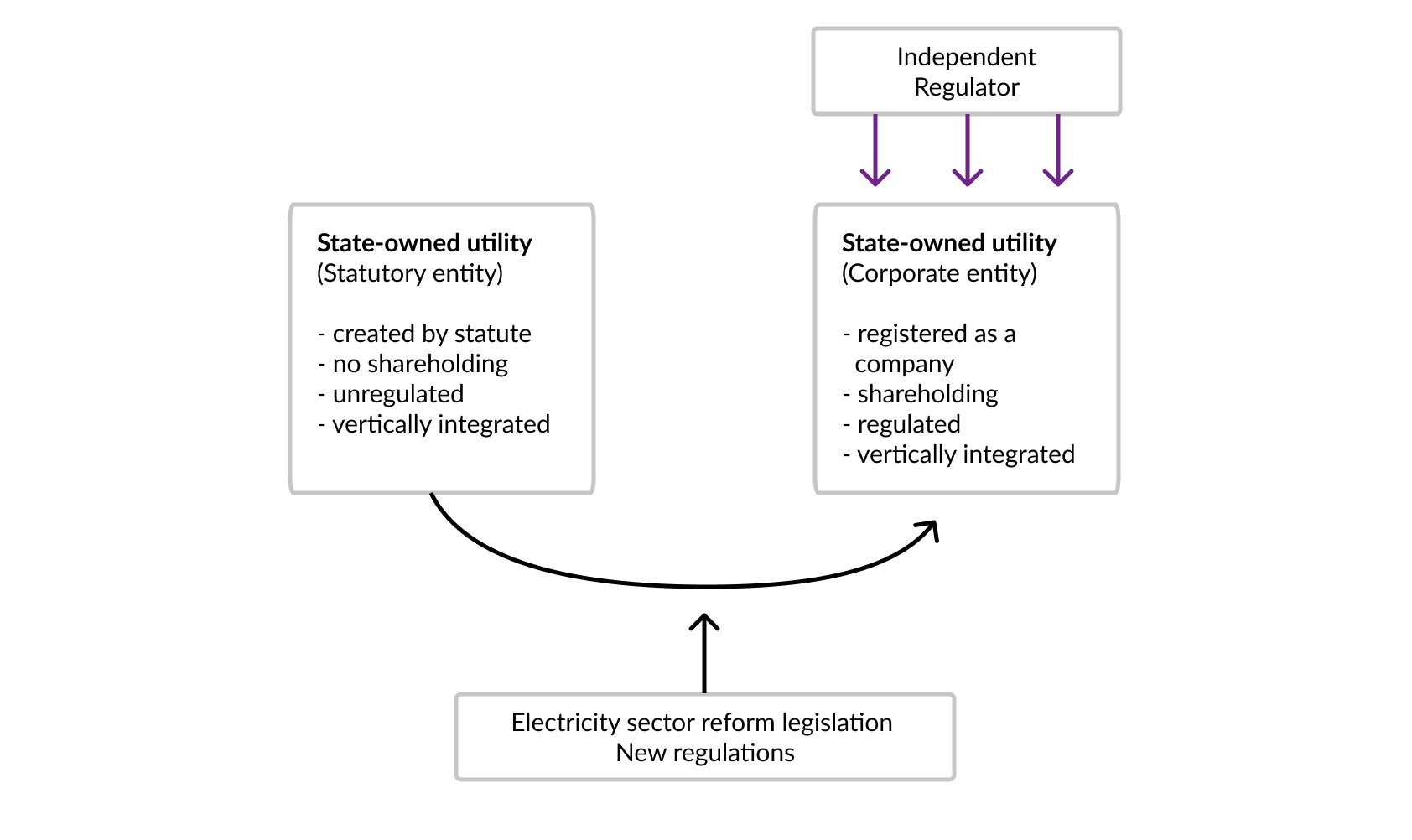
Privatisation can be implemented in at least three ways:
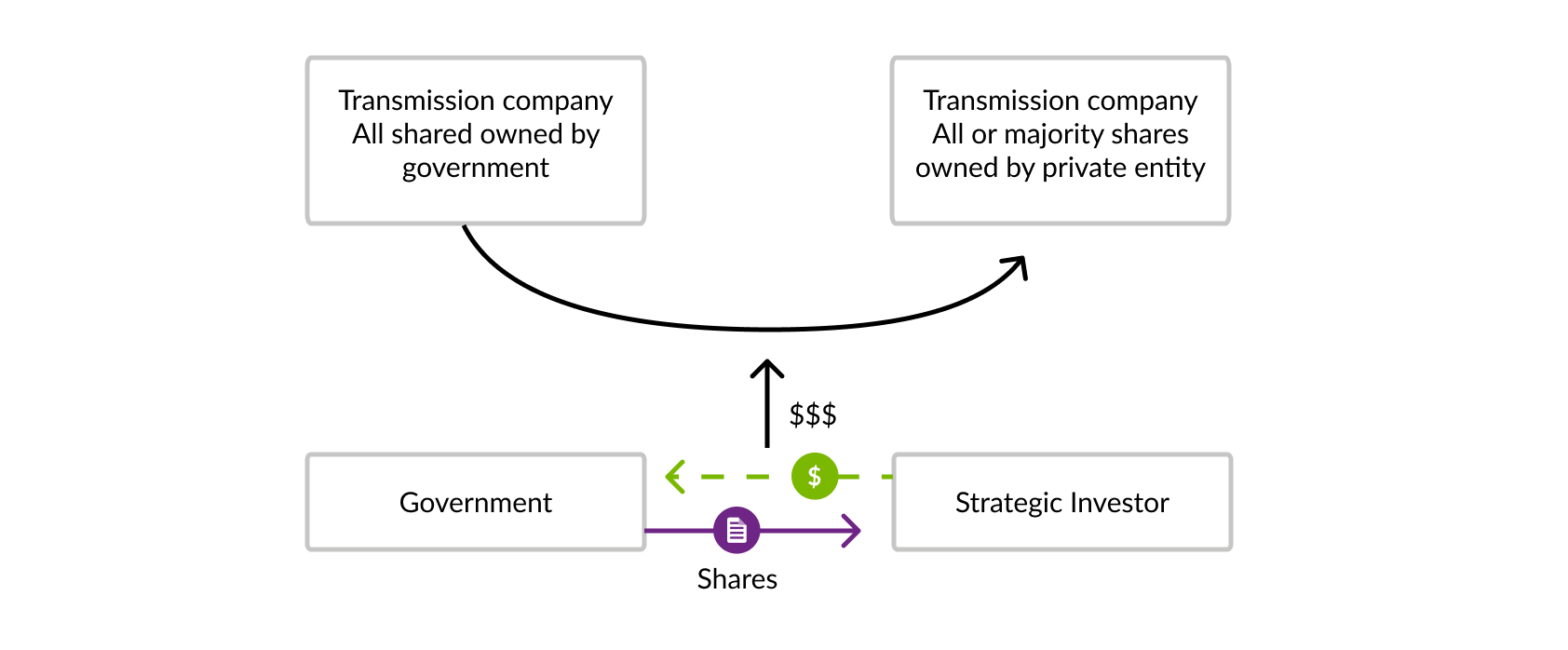
The government and the new owner may also enter into a government support agreement, which protects the new private sector owner from certain risks such as change-in-law, expropriation and foreign exchange.
One of the key decisions that governments need to take at an early stage is to be willing to divest from owning transmission infrastructure that are assets with national security implications. This will entail the loss of ownership in assets that are monopolistic in nature. This monopoly does provide governments with intense power to control the electricity supply of a country and provides for additional revenues in some instances.
A second challenge is a fear that the privatisation process will result in increased tariffs. A carefully managed privatisation effort will ensure that results from long-term financial models are clearly articulated to the public and key stakeholders. In some instances, there may be an initial tariff increase due to increased operations and maintenance activity and investments required to stabilise the transmission business. However, long-term benefits and comparative cost reductions need to be proven and stated. The usual intent of a privatisation process is to increase the efficiency and stability of the transmission business, which could ultimately lead to relative cost reductions. If this is not achieved, the re-nationalisation of the privatised transmission assets are likely to bring even more challenges to the country’s power sector.
Another challenge is that staff and management of public utilities in some instances fear the loss of jobs. However, some means are available to governments and unions that can be utilised to guarantee job security. If managed carefully and when widespread stakeholder buy-in is secured, this challenge can be minimised. However, this is a fundamental challenge and staff resistance may be at a level that may be too difficult to overcome.
Case Study — The Copperbelt Energy Corporation (“CEC”)
CEC’s business model has features of all three models — the privatisation, the industrial demand-driven model, and merchant line models — but especially, the industrial demand-driven model. CEC was established as part of the privatisation of a previously government-owned mining company. CEC’s transmission assets were built primarily for the defunct mining company’s electricity demand, and CEC currently sells power wheeled through its network to many mining customers in Zambia. Further, CEC currently buys or generates power in Zambia at a relatively lower cost and sells to mining companies in the Democratic Republic of Congo.
CEC is a private company established in the context of the privatisation of the Zambia Consolidated Copper Mines (ZCCM) in 1997. Before being privatised, ZCCM owned and operated electricity assets through its power division to address the needs of its mining operations in the Copperbelt region of the country. When privatised, ZCCM was divided into several companies and CEC took on the activities of ZCCM’s power division including the role of operating, maintaining, upgrading, and expanding the transmission asset to continue the supply of electricity to the mines. CEC was later listed on the Lusaka stock exchange in 2008 and became a full member of the Southern African Power Pool in 2009.
CEC currently owns a network of more than 1,000 kilometres of transmission lines at 220kV and 66kV, 43 high voltage substations and a transmission interconnection between Zambia and the DRC. The company purchases electricity from ZESCO, the Zambian national power utility, and sells this across its transmission network to many Zambian mining customers with a combined average demand of approx. 450 MW. CEC also operates 6 gas turbine generators for emergency power supply with a total installed capacity of 80MW.
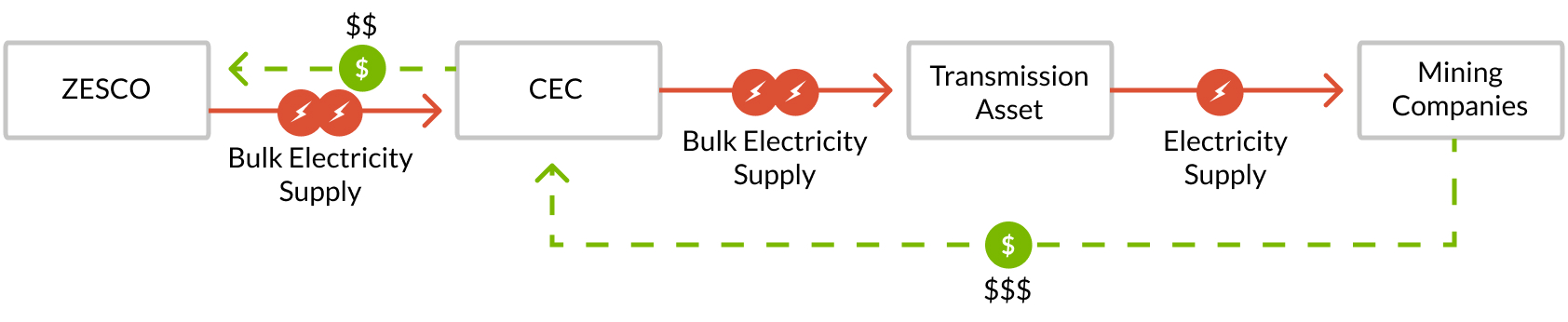
The business model of CEC is not solely focused on transmission line assets as the company diversified its activities in recent years and has also developed generation projects and conducts power trading activities. Nonetheless, CEC is a good example of an industrial-led funding model as it was set up to address specific needs of the mining industry in the Copperbelt region. Hence, the funding required for the acquisition, maintenance, upgrade, and expansion of the network was provided on the basis of the mining companies’ ability to pay for electricity and the strength of the commodity sector. Moreover, the characteristics of some of the world’s deepest copper mines required consistency of supply to guarantee the safety of the mines’ workers. The reliability standards of the network and the readily available emergency power supply were therefore specifically designed to respond to the specificities of the mining activities.
Sovereign support and additional credit enhancements, when needed, will be required for the IPT, network concession, and privatisation funding structures. As is the case for the financing of other types of infrastructure assets, the need for additional credit enhancements and sovereign support for the financing of transmission infrastructure will be largely defined by the type of financing procured, and the country’s and power sector’s economic viability. The sector’s solvency will be instrumental in defining lenders’ requirements for providing financing, including which credit enhancements are necessary and whether a sovereign guarantee will be requested.
Moreover, the lenders will have different considerations depending on whether the transmission project is corporate- or project-financed. Some of the key factors assessed by financiers in making this decision are:
Case Study — The Transener Transmission Network Concession: Argentina
In 1993, the national government of Argentina granted a whole-of-grid concession over the country’s existing high voltage system to Transener, a privately funded transmission company. Transener’s concession agreement provided for three forms of charges: connection charges, line availability charges, and variable network charges. The connection charges and line availability charges were mainly fixed charges unconnected to the use of the assets or the quantity or wholesale prices of electricity transmitted on Transener’s network. However, the revenues from the variable network charges were based on the use of the transmission assets. Specifically, these charges are connected to the quantity of electric power which is lost as heat in the transmission process and the wholesale price of that power.
To protect Transener from revenue losses arising from the volatility of the variable network charges, the government guaranteed Transener $55 million per year in variable network charges for the first five years of the concession. Any shortfall from the guaranteed amount would be covered by a corresponding surcharge on the line availability charges.
This case illustrates the importance for the government to ensure the stability of the revenues in private sector-led funding structures. While in the Transener case, the government did not undertake to cover the revenue shortfall directly, it provided initial support against the risk by a regulatory mechanism established in the concession agreement.
Under the current market conditions in SSA, it is unlikely that it will be feasible to structure the financing of a transmission infrastructure without some form of government support and/or other credit enhancements when one or more of these factors are perceived by the financiers as a significant risk.
Although there is a wide spectrum of potential government support instruments and credit enhancements, in the transmission infrastructure market in Sub-Saharan Africa, only a limited number of instruments/ products have been used to date. Nevertheless, stakeholders working towards a financeable structure should consider all options when searching for risk-mitigating measures.
Before issuing a sovereign guarantee, governments should carefully consider all available options and assess the magnitude of the payment obligations, the related contingent liabilities and the impact these obligations will have on the country’s overall debt sustainability. Nonetheless, providing government support in favour of transmission infrastructure financing can result in many potential benefits for the host government. In making decisions about the support needed from the government, all stakeholders should have an appreciation of the various factors the government must balance when weighing the benefits and challenges of granting credit enhancement.
The need for credit support from a host government may be required both to address continuing payment risks and/or to address the ability to satisfy termination payments. A sovereign guarantee can backstop routine payments and give direct protection for termination payments and other obligations affecting the transmission utility’s ability to repay the financiers.
For the IPT model, the need for government support should be anticipated since the model will use project finance to raise the debt necessary for the transmission project. For the whole-of-grid concession and the privatisation models, the government is also likely to be requested to provide support although the scope may vary significantly depending on the level of capital investment required to be made and the specificities of the transaction. Furthermore, for the privatisation model, more government support is typically expected at the early phase of the privatisation of the transmission assets but should reduce within a few years of operations by the private transmission utility.
Government support agreements can take various forms. An “implementation agreement”, a “government guarantee”, a “government support letter” or a “put call options agreement” are just some of the names of documents under which governments can provide support to a project. Broadly speaking, they aim to achieve the same end, namely providing some form of government support to a private sector investment and investors. The government support agreement will be an important risk allocation tool that is likely to be vital in terms of ensuring that the project is capable of obtaining finance.
In some cases, the government support can extend to guaranteeing the obligations of a state-owned transmission utility (e.g. in terms of payment obligations). In almost all cases, government support will extend to a government taking responsibility for certain “political” risks, often described as events of “political force majeure”. These risks include expropriation, war, civil disturbance, and they are typically seen as risks within the government’s control. Most government support agreements provide for a form of termination compensation payable if an ongoing political force majeure event occurs. Government support documents also typically confirm the wider regulatory and enabling environment and transaction or sector-specific promises made by the government to facilitate private sector investment (e.g. as to matters relating to the tax regime, investment protections, assistance with permits etc.).
Financiers are especially concerned about getting compensated if the project is terminated. Most government support agreements are usually structured such that upon termination, the government assumes ownership of the project at a purchase price, also known as a termination payment. This transfer of ownership can be executed either through a sale of the transmission assets to the government or through a sale of all the shares in the project company to a government-owned entity. The constrained nature of the termination payment compensation is important since this type of sovereign credit support is, in essence, a “last-resort” option rather than a guarantee of actions or payments that are in the regular course of business for a transmission infrastructure project.
Termination of the project agreements (the TSA or the concession agreement) and the corresponding compensation typically follow certain defined trigger events. These events may be as a result of government actions such as expropriation/nationalisation of the transmission assets or payment default. In the case of termination as a result of government actions, the project company typically terminates the project and transfers ownership to the government upon payment of the compensation. Termination may also be triggered by actions of the project company such as persistent failure to meet key performance indicators. In this case, the government may decide to terminate the project and assume ownership of the project.
In addition to defining the trigger events, the government support agreement must also carefully define the purchase price to be paid for the project assets or of the shares in a project company upon termination. The formula for the purchase price, also known as the termination payment, will be directly tied to which trigger event has led to the termination of the TSA or concession agreement.
For example, in the case of termination of the concession agreement due to payment default by the state-owned utility, the purchase price will likely include not only the value of the project assets and the outstanding project debt but also the expected return for shareholders in the project over a pre-agreed period. In the case of termination due to the project company’s default, the purchase price may be limited to just the outstanding project debt. The purchase price in the case of termination for force majeure will likely fall somewhere between these two extremes and may depend on who is directly impacted by the force majeure as between the transmission utility or government and the project company.
For a further dive into the various forms of government support agreements, please see chapter 6 titled “Sovereign Support” in the Understanding Power Project Financing handbook and the chapter titled "Default and Termination" in the Understanding Power Purchase Agreements handbook.
Direct Agreements
Direct agreements are agreements that give the lenders a right to "step into the shoes" of the project company with the key project contracts if the project company — or another contractual counterparty — defaults in some way. While the counterparties to the government support agreement will be the project company, the lenders will enter into a direct agreement with the government related to the government support agreement. This direct agreement will enable the lenders to step into the shoes of the project company and directly enforce the rights of the project company in the government support agreement in an event of default.
This type of agreement is also common in a project finance context for the IPT business model. It will enable lenders to take possession of the project they have financed if there is a material default by the developer. The lenders may then decide to select a new operator to avoid complete failure of the project.
Third-party financial institutions offer various credit enhancement and political risk mitigation products in the context of transmission infrastructure financing. These products can be used instead of, or together with sovereign support to provide another level of credit enhancement. They are particularly used where the credit of a sovereign itself is not strong enough to offer the level of assurance required by investors and lenders.
For a more comprehensive discussion on the various types and features of Credit Enhancements, please see chapter 7 titled “Third-Party Credit Support and Risk Mitigation” in the Understanding Power Project Financing handbook.
Transmission systems play a crucial role in moving electricity from power plants to the end users. The farther the plants are from load centres, the more important it will be to plan carefully the development of the transmission infrastructure. With a growing focus on cheaper and greener energy sources that are frequently located in less populated areas, it is becoming even more imperative to efficiently transmit electricity across the grid. In this chapter, we will discuss the following:
Depending on the jurisdiction, the responsibility of the transmission planning may shift from the transmission utility to the ministry, regulator or another governmental agency. It also can be the responsibility of the private sector, although this is rarely the case in SSA. Even in the case of a whole-of-grid concession, the planning function may be retained by the government and the execution of identified projects may be done partly or fully by the public sector and then handed over to the concessionaire.
The transmission planning process also allows the government to identify the transmission lines that will be built in the upcoming years and for which it will allocate significant resources. Thus, the planning process also enables the government to identify lines not considered a priority but that might be suitable for a merchant line or industrial demand-driven funding model (regulation allowing).
This chapter will discuss the various steps from the power system planning phase to the procurement of a transmission asset.
There are many reasons why a government or a key public sector institution (e.g., transmission system operator) should conduct power system planning. These include:
Without a plan, there is substantial uncertainty regarding the development of the power sector, and this increases the risks associated with new projects.
The typical process flow for developing a new transmission line is depicted below. This chapter will expand on each of these processes:

Integrated Resource Planning (IRP) is usually done by the Government. This is done at a national level to develop a plan to meet all the country’s national energy demands with available and planned supply. It is a planning and selection process for electricity infrastructure development, which assesses all options for providing adequate and reliable electricity service to end users at the least system cost.
Some of the options considered by an IRP include new generation capacity, energy efficiency measures, renewable energy resources, energy storage, and cogeneration. The IRP process considers the impact of any of these options on the efficiency and reliability of the electricity network. An IRP will provide a country with an energy plan for a long period, usually 20 years. Although the IRP has a strong focus on power generation requirements, it does account for high-level transmission costing to connect generation power plants and load to main collector substations.
One of the main objectives of the IRP is to identify the least-cost generation to meet the macro power demand over a defined period. To project the growth of the demand for various energy sources, the IRP will set macroeconomic assumptions such as GDP growth and country inflation targets. The demand needs are then balanced with the country’s potential energy sources and the cost associated with their conversion into electricity. Some power projects that are already being developed will be included in the IRP’s assumptions and used as inputs into the analysis. The shortfall between the anticipated supply and the projected growth will result in identifying opportunities for new generation projects.
The IRPs usually require continuous updates based on changing assumptions (especially demand forecasts and implementation schedule of projects) and government targets. The output from an IRP process serves to strengthen the level of knowledge of the sector stakeholders and simultaneously serves as an input to future IRP processes.
Not all countries in Sub-Saharan Africa produce IRPs. In some instances, they are not detailed. This often leads to the construction of adhoc generation plants. This unplanned approach can produce undesirable consequences such as stranded assets in some areas of the system or the overload of a part of the system. In addition, without a power sector development plan, it would be difficult to identify in advance the need for transmission system requirements. As depicted in the flowchart (Figure 9.1), the IRP is used as an input to the Transmission Development Plan which provides for a more focused study of transmission projects.
The TDP is developed by the transmission utility. In some instances, there may exist an independent system operator but this is not common in Africa.
The TDP utilises the IRP as an input. The TDP is needed to identify specific transmission projects which are required to ensure that the electricity generated reaches the end users and satisfies their needs. The TDP is crucial to the current and future viability of a country’s power sector.
The planning process, as depicted in Figure 9.2, identifies the gap between the capacity of the existing transmission system and the infrastructure needed to meet current and projected demand. This process takes into account several key factors including the historical demand, the quality of power supply, the economic growth and development goals, regulatory requirements, connections to new power plants, system losses, undesirable voltage profiles and new industrial customers with high demand. Regulatory requirements can include the need to meet the quality of supply or system reliability standards or technical loss limits set by the regulator. Regulations including the grid code may also impose obligations on the transmission utility to connect, for instance, renewable energy plants which are typically located in undeveloped parts of the country and away from load centres. All these factors serve as inputs into the analysis of options for transmission system development.

A wide range of public and private stakeholders with different interests may be involved in the transmission planning process, depending on the structure of the power system and the market operations. The sector’s stakeholders will typically include the Ministry of Energy, the economic planning ministry, power generators, utilities, industrial customers, regulators, the investment community, and the transmission utility(ies). While some of these stakeholders may play active roles in the process (e.g., regulator, utility, cities, etc.), others such as large industrials or building owners may only be consulted as part of the data collection activity or for an alignment of the different options available for resolving identified challenges in the transmission system. Notwithstanding differences in each stakeholder’s level of involvement, all stakeholders need to be aligned in the development of the TDP to ensure that it is a national and comprehensive plan.
The identification of projects for the TDP is underpinned by many critical studies. The analytical work is mainly done by planning experts. Some of these studies include a demand forecast; load flow studies of existing and future systems; a short circuit analysis; system stability studies; and resilience analysis.
For best results, the team of experts will be composed of different experts such as economists, environmental specialists and engineers experienced in planning, design, operations and maintenance. Existing and prospective power producers must be consulted during this phase of the planning process. The output of the analytical work is a list of projects required to satisfy the evolving needs of the power system, more specifically to ensure that generated electricity is transmitted to end users in the most efficient manner and satisfies the demand needs of end users.
The options assessment generally specifies the type of equipment to be built to improve the stability of the transmission system and the quality of the supply. The assessment will also cover high-level capital and lifetime cost estimates and the useful lives of these components on the network. Lifetime cost may include losses, operations and maintenance costs. The options may also already identify preliminary route surveys and locations and their preliminary environmental and social impact assessment. Detailed cost estimates, identification of actual route of transmission infrastructure, and substation sites are only required for the most viable options during project development (e.g., through the project-specific feasibility study).
At an early stage, satellite images and available topographical data may be used to identify one or a few feasible routes for further analysis and investigation. Routes that have little chance of success such as routes close to communities and nature reserves, can be avoided. When one or a few viable routes are selected, further investigation may warrant on-site activities such as “walking/driving/flying” the route to confirm initial findings. At this stage, environmental screening activities may also start and community consultations are essential. The main outcome of this phase will be the specification of a few routes from identified substations, which are low cost and have low or manageable environmental and social impacts. More detail on route identification, land acquisition and environmental and social impact studies is provided in chapter 10. Land acquisition.

The next phase of the transmission planning process is the selection of specific projects. In this context, the relative merits of the options and alternatives generated from the analytical work are evaluated and ranked. Considerations other than electrical parameters come into play, including critical factors such as the environmental and social impacts. The options and alternatives are therefore not only compared based on technical efficiency and cost but also according to their environmental, social and regulatory impacts. The set of viable, economical, and environmentally feasible projects selected at the end of this phase constitute the TDP.
The output of the TDP is a list of viable project alternatives for meeting the identified needs of the power system. Out of this list, the projects to be developed are selected. The case study below provides an example of a TDP.
Case Study — Eskom Transmission Development Plan
Eskom’s Transmission business in South Africa is recognised globally for its technical expertise and operations. Over the last 10 years, it has successfully constructed over 7800 km of new transmission lines (added to its existing ~30000 km of transmission lines defined as 132kV and above) and increased the transmission substation capacity by more than 37000 MVA. The transmission business follows a rigorous planning approach. This is depicted in the diagram below (courtesy of the published ESKOM TDP).

To achieve this, Eskom has to carry out many assessments such as conducting strategic Environmental Impact Assessments (EIAs) and strategic servitude acquisition, working closely with the government on the IRP development, independently determining its own national and regional forecast at the Main Transmission Substation (MTS) level, and merging planning data with operational data to ensure that reliability is improved. All of Eskom's planning is also designed to meet the South African Grid code and to ensure that the new generation is integrated. More than 10000 MW of new generation has been integrated into the grid over the last 10 year with a substantial increase expected for the next ten years. Eskom also develops a strategic long-term Transmission Plan that is updated every 2 to 3 years based on long term strategic assumptions over 20 years (instead of the 10-year planning horizon for the TDP which is updated annually).
The planning process for transmission infrastructure will provide the utility or a ministry with a list of projects for implementation. At this stage, a project can be identified for concept definition and initial design. A typical project will follow the following phases:
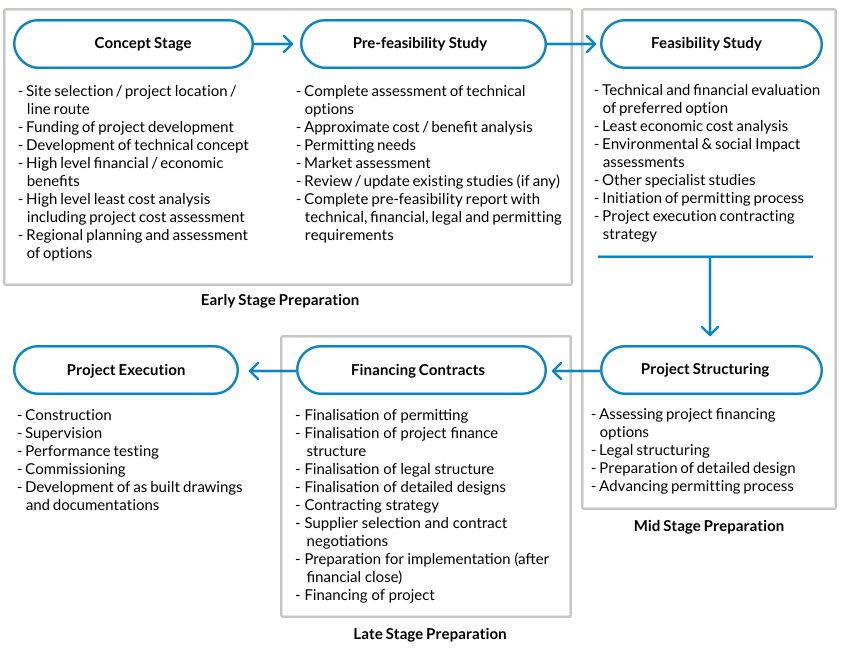
Each phase has clear outputs as defined in the diagram above.
It is important to note that in the practice, the transmission planning and project preparation phases will have some overlaps in terms of some of the outputs of the concept phase. However, a clearly defined project concept is a key requirement to attract project preparation funding and technical assistance funding for the further stages.
The pre-feasibility analysis will focus on confirming several assumptions of the TDP route identification process and high-level environment and social impact assessment (ESIA) to confirm (or adjust) the preliminary analyses or conclusions made in the context of the TDP. The pre-feasibility analysis is considered a high-risk phase of a transmission project. It is therefore important to keep costs as low as possible. The project will progress toward a full feasibility study if the outcome of the pre-feasibility is satisfactory.
The private sector is rarely involved at this stage of the project preparation process because of the significant uncertainty surrounding the project’s viability and business case. For this reason, the Government or transmission utility should always budget or seek funding to provide for the cost of the pre-feasibility studies for the projects identified.
The feasibility study will be conducted on the route selected by the pre-feasibility study and confirms or refines its conclusions through detailed analysis and technical designs. Examples of activities carried out at this stage may include power system analysis to establish the technical feasibility, estimated power flows and scenario simulation for losses under different operating conditions. Other activities include in-depth data gathering, site reconnaissance activities including visual inspection of the route and development of a digital terrain model, alternate route analysis, geotechnical and other advance studies, substation site selection and layout, risk assessment, stakeholder engagement and route selection workshops.
At the end of the feasibility study, the project should have complete initial design and cost estimates, a financial and an economic business case, an ESIA, recommendations of contract procurement packages, legal structure options and an approach for the financing of the capital works. All of these activities will set the scene for project structuring to affirm the bankability of the project.
At this stage, the inclusion of the private sector will be easier and can be considered. However, to attract greater interest, the government or utility can also consider conducting the feasibility study before approaching the private developers. If private participation does not gain traction at the feasibility stage, it should consider alternative public funding options.
Even when the private sector is invited to participate in the development of a transmission infrastructure project, the expectation is usually that the Government or the transmission utility will conduct most of the project preparation activities. However, not all SSA governments or SOEs may have the funds to conduct this exercise. For this reason, project preparation funds or facilities (PPF) have been designed to provide funding for the project preparation of transmission lines. Some of these donors/funds have specific objectives such as the introduction of the PPP model or to help promote regional integration, while others aim at encouraging projects that help meet climate change targets. Hence, PPFs are not homogenous. A non-exhaustive list of donors/funders can be found online at The Infrastructure Consortium for Africa.
Some of these fund sources also support capacity building, facilitate and support the enabling environment to support infrastructure investment by the public and private sectors, or a combination of both. It should be noted that multiple funds may be used for the same project. For example, a fund may be used to develop and conclude the ESIA study while another may fund the technical feasibility report.
Most of these donors/funders have standard application processes and documentation. At a minimum, the conceptual phase for the project should be well-conceived before applications are made. Some donors/funders will only fund projects that are ready for feasibility studies and expect the concept and pre-feasibility studies to be complete at a minimum. A high-level understanding of the sites for the substations (if required), line routes, the financial and economic benefits and the expected cost of the project should be understood and documented as a minimum. Linkages to possible private participation, “green” energy and regional integration should also be clearly articulated.
As stated above, the planning and early preparation work is commonly undertaken by the government or state-owned utility. It may be possible to start considering the inclusion of private sector participation at the concept stage of a project. However, in most instances, the high-risk nature of the project will deter most investors.
When the decision has been made to include the private sector, the government needs to consider the procurement approach. This is discussed in the following sections.
The applicable procurement framework is closely linked to the source of funding for that particular project. If the government or the transmission utility conducts the project preparation (pre-feasibility and feasibility studies) then the sovereign laws, guidelines, and regulations become applicable. If the feasibility studies are funded by grants from donors, then there will be a requirement to waive the local requirements for the procurement and adopt the donor’s requirements. This is often captured in a grant agreement between the government and the donor.
It should be further noted that funding for the capital works must be kept in mind. If funding is sought from DFIs for the capital works, a review of all procurement activities will be conducted. If the local procurement guidelines and regulations do not provide for competitive procurement then it is advisable to adopt AfDB or World Bank guidelines to avoid further challenges in raising finance.
For cross-border projects, choosing a local framework to govern the procurement can be complex. Since most project preparation for cross-border projects are donor-funded, most projects will adopt the donor’s requirements. If there is an instance where development activities are being funded by the government or the TSO, then it is advisable for the project to still adopt an international DFI’s guidelines to secure funding for the capital works at a later stage.
Having developed a TDP and completed project preparation activities, the government and the procuring entity need to identify a procurement approach. The government must decide earlier on which entity will manage procurement. Below we will briefly discuss different types of procurement that can be considered. The procurement approach, planning and structure are discussed in great detail in the Understanding Power Project Procurement handbook.
A procuring entity might use a variety of procurement processes. Broadly we use the categories described below as a framework for discussing the different processes.
A competitive tender (also called an auction or competitive bidding process) is a process initiated by a procuring entity to select the sponsors that will develop a project through a competitive process. A competitive tender requires investors to compete directly against each other, on the same terms, for the opportunity to develop a project (or projects). This procurement structure harnesses the power of competition to achieve the objectives of the procuring entity. Bids are therefore evaluated primarily on price, but may also include additional evaluation criteria.
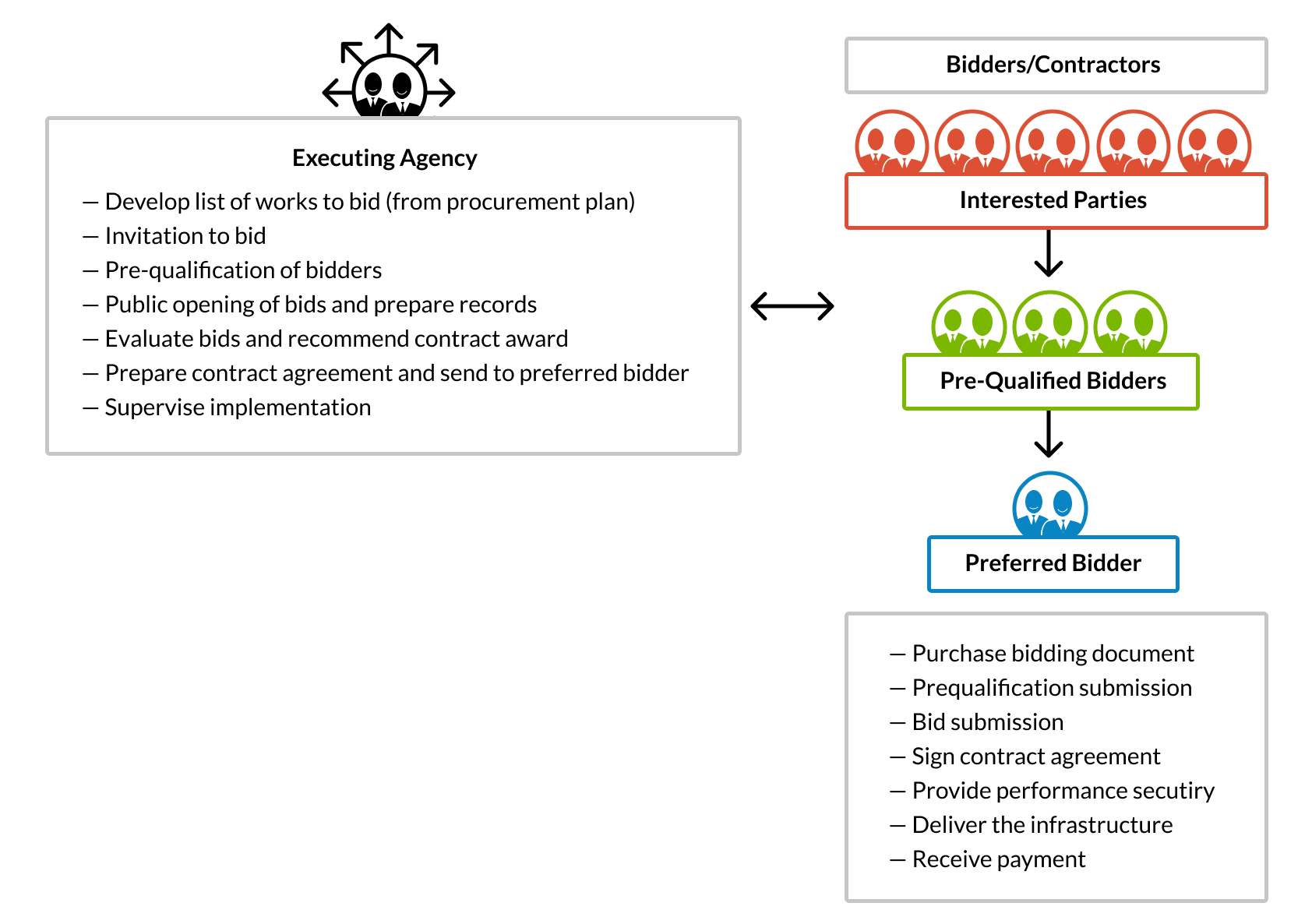
Negotiating a project with single or multiple developers without inviting other interested parties to engage in a procurement process is referred to as either a negotiated deal, a direct negotiation, or a sole-sourced power procurement. A direct negotiation may be initiated by the procuring entity or by the sponsors. In either case, the procuring entity must ensure that direct negotiations are permitted under applicable law while also considering the funder’s procurement requirements to ensure that the capital works gets funded.
A transmission line may be hundreds of kilometres long. The route may cross land that is owned by the national government, state or regional governments, public authorities, private landowners, or it could be tribal or community-owned land. In many cases, it will be a combination of all of these types of landownership. In addition to the transmission lines themselves, substations are likely to be located along the line. Before financing can be disbursed or construction can begin, rights-of-way, wayleaves or easements must be acquired along the length of the route and ownership interests over the land on which substations will be constructed must be acquired. These are all forms of “access right” or ownership interest, that enables the contractor to build along a pre-identified route and are usually granted by the relevant landowner (whether this be a governmental authority or private individual).
When it comes to substations, not only must the land on which it is built be secured, it also needs to be accessible by road to get construction materials to the site and for ongoing operations and maintenance. If they are not, additional rights-of-way or easements must be procured to provide access to the substations.
Acquiring these rights-of-way, easements, and ownership interests can be costly and time-consuming in any country. Fortunately, a set of good international practices have evolved for designing and siting transmission lines, engaging in consultations with stakeholders that may be affected by the project, acquiring interests in land through voluntary purchases and sales, and ultimately, exercising rights of expropriation (the right of eminent domain) in the event a landowner refuses to sell a right-of-way, easement, or ownership interest.
The land acquisition process can present one of the most significant impediments to implementing greenfield transmission infrastructure development. The key is careful, methodical and early planning to implement an efficient and expeditious land acquisition strategy. The stakeholder best placed to negotiate and finance land acquisition will depend on how that stakeholder is empowered to execute this activity, to implement a project on time and at the lowest cost. With varying land rights at stake, the matter is unlikely to be simple, and coordination with stakeholders at all levels (from individual landowners to communities, to the relevant lands ministry) will be fundamental to ensure a smooth and successful process.
During the project preparation phase, one of the key activities is the selection of the transmission line route to determine route optimisation. At this early stage, utilities will start investigating routing options for planning purposes. If there is a sufficiently strong case or an obvious need for a transmission line in the long term, then the utility may start pre-emptively acquiring strategic rights-of-way for the eventual transmission infrastructure.
Identifying strategic rights-of-way does not involve a significant cost outlay. At the start, it will be a desktop or satellite determination of potential line routes, identifying the nature of the landownership along that route, and proceeding to landowner engagement. Where it is possible to negotiate rights agreements with private landowners, this can significantly assist in transmission line development in later development phases. In some instances, it may be strategic to acquire the rights to prevent obstacles that may impede project development (e.g., to prevent settlements along routes that may be needed in future years).
The relationship with landowners is critical in transmission line development. With early-stage relationship-building activities, the party responsible for the land acquisition, be that the governmental authority or the private developer, will be able to manage the land acquisition risk methodically. Without strong planning capacity, it will be difficult for parties to proceed with strategic land acquisitions.
The acquisition of strategic rights does not provide an alternative to detailed route selection engineering. This activity will need to be undertaken as part of the project preparation activities and needs to be budgeted accordingly. The availability of strategic rights-of-way can however significantly reduce the time it takes to implement a transmission project.
Route identification can help avoid choosing routes that are close to communities and nature reserves or pass through difficult terrain. The objective of this screening analysis is to identify one or a few feasible routes for a more detailed analysis, with limited on-the-ground activity.
The next phase of the identification and selection investigation may warrant on-site activities such as “walking/driving/flying” the route to confirm initial findings. Environmental screening activities and community consultations may also start during this phase. The goal of this scoping phase is to specify a few routes which optimise technical feasibility, cost, and mitigate environmental and social impacts.
The environmental and social impact assessment (ESIA) is an important consideration that can ultimately determine available external financing options. Aside from routing considerations, on-site soil and geotechnical studies will be required, as well as ensuring the final detailed design meets national grid code requirements.
We have included a high-level depiction of the ESIA process in the diagram below (as per the IFC environmental and social performance standards):
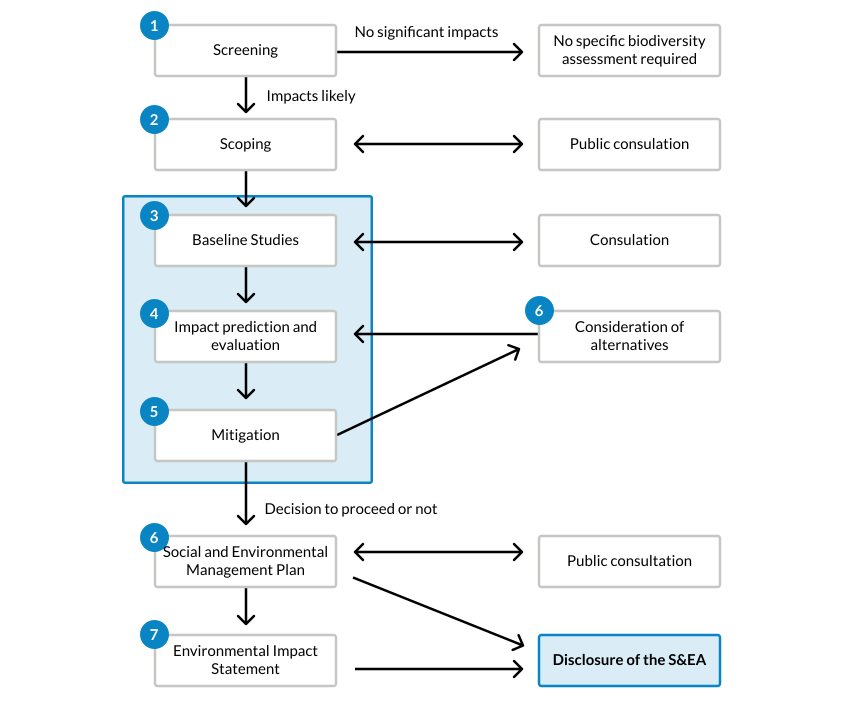
For transmission lines and land acquisition, the screening and scoping stages are critical. Screening is a quick high-level analysis to determine whether a full ESIA is required. If a full ESIA is required, scoping determines which impacts are likely to be significant and become the main focus of the ESIA.
In transmission projects, a full ESIA will most likely be required if seeking external financing support from a publicly backed financial institution. If significant physical or economic resettlement of communities is needed, then a Resettlement Action Plan (RAP) will be required. A deeper discussion of the ESIA and RAP processes is outside of the scope of this book, however, both elements are closely related to the land acquisition strategy and required for any transmission infrastructure development.
The ESIA process must start at the concept stage or sooner as part of the planning process. With an early start to the ESIA, the challenges faced by projects can be managed and addressed. Transmission line developments will be assessed against:
By initiating the ESIA process early, the utility or government can make informed decisions on the most optimal line route with due consideration of these challenges. Some of these may be avoided through strategic acquisitions as described above or can be avoided through alternative routes.
The responsibility for land acquisition will depend on the procurement strategy for a transmission project, which is explored further in other chapters. This responsibility is often best coordinated and executed by the government, especially when the transmission utility or other governmental body owns the transmission infrastructure. Depending on the terms of a transmission service or concession agreement, private sector developers can be allocated the responsibility for procuring land rights. For example, the renewable IPP programme in South Africa provides the option for the IPP developers, through a “self-build option” to acquire the land required for their IPP project’s transmission connection and undertake such transmission development themselves (see case study in chapter 3. Common Funding Structures in the African Market). Ultimately, while the acquisition of land can be done by either the government or by the private sector, it is wise to identify the actor who is best positioned to efficiently and expeditiously acquire or secure the land and rights of use, and to empower them with that responsibility. For example, some types of land will require governments to exercise a “right of eminent domain” to construct critical national infrastructure, a right only the government can exercise.
Project preparation activities will normally include all of the studies required to choose the line route options including the ESIA studies. These activities can be funded through project preparation funds that are available to governments and in some instances the private sector. If MDBs or bilateral donors are providing concessionary financing to construct the project asset, then land acquisition and ESIA related costs may be included as a project capital expenditure which they are willing to finance (for further discussion of project preparation funding, see chapter 9. Planning and Project Preparation).
Budgetary constraints faced by many utilities and governments can frustrate funding the acquisition of privately held land, especially to pre-emptively acquire strategic land for future transmission lines. Timing of land acquisition can greatly impact the negotiated price and therefore the cost of this activity. Most investors will only fund the transmission projects at the construction stage, and technical assistance grants are rarely available for capital works or the acquisition of capital assets. Moreover, acquisition of land during construction (or in general, after financial closure) increases the land-related risks. Any way to secure the land ahead of the financial closure is also desirable for all parties as delays can prevent a project from being implemented, potentially resulting in cost overruns and an increase in the overall cost of the transmission line.
To the extent that the land acquisition is moved to the private sector, the private sector may be able to fund the acquisition out of development costs but are less likely to exercise the same leverage or bargaining power than the government (local or national). The appetite they will have to do this will depend upon how certain they are about having the rights to execute the rest of the transaction (i.e., have they been awarded a tender or concession to develop the project). In any event, the private sector will need to work closely with the government at both a local and national level to ensure adequate compensation is being paid to affected peoples and landowners.
For many transmission projects, where the land in question is owned by a community or by the government itself, the land acquisition risk is best managed by the public utility or relevant ministry within the government. This is not always the case and provided that they are granted the right authorisations, private sector sponsors can take on the responsibility for acquiring land, sometimes engaging a consultant to advise and manage the process. It is important to note that ESIA and RAP studies can often only be completed once land parcels have been acquired, which adds to the lead time of preparing these types of projects.
In projects anchored by a dedicated large industrial consumer, the connection charge may be sufficient to allow for the payment for the acquisition of the land rights.
For some IPP projects, the risk for the transmission connection to the grid can be passed on to the IPP (e.g., generation-linked transmission project discussed in chapter 3. Common Funding Structures in the African Market). The IPP will need to acquire the land rights and conduct all the associated studies to ensure that the power generation project can evacuate the power. It should be noted that these are usually shorter transmission lines that simply allow for the connection to the existing grid.
In an IPT or whole-of-grid concession/privatisation, the private developer may be responsible for the grid expansion within the defined concessioned area under a transmission service or concession agreement. This could include land right acquisition for the projects. Governments do however face the risk that if the landowners and the concessionaire cannot reach an agreement, this might significantly delay investment into the sector and this will hamper macroeconomic growth.
Governments in some jurisdictions may exercise their right to acquire land via expropriation if needed for projects that are strategically beneficial to the country.
These rights are sometimes called rights to “eminent domain” or “compulsory purchase” rights. All of these describe the power of a state, federal, or national government to take private or community property for the public good or public use, on a limited basis. This power can be delegated to government subdivisions (or even to private companies) if legislatively permissible.
When this right is exercised, it is expected that the government will pay a fair market value for the right. Typically the land value includes the value of any agricultural assets or use of the land as well as the price of having to move any dwellings or other fixtures, but this will be dependent on each country’s laws — and — if funding is being provided by a DFI or MDB or donor agency, is likely to need to meet the international standard of adequate economic compensation.
The purpose of this section is to identify the most common risks associated with private transmission projects/investments. The risks summarised here are universal and should be considered regardless of the business model which may be selected for each specific project. How each risk is mitigated, however, may differ based on the business model (see chapters 5, 6, and 7 for the discussion of risk mitigation for each business model). Understanding the detailed risk allocation will be an important part of the assessment of a project for a government, transmission utility, or transmission investor. Such understanding will also inform the policy case and the commercial case and impact the availability or cost of financing for a project.
Identifying and allocating risks is a key part of the development stage of private sector financing of any asset or project. How risks are allocated between the parties will depend on the appetite that the party has for risk. However, as a rule of thumb, risks are best allocated to the party that is best placed to manage those risks. Risk allocation is agreed upon in documentation between the parties. Where one party is not able to fully take on risk, there may be mitigants that can be put in place to minimise the impact of any risks occurring.
Project development often requires a significant investment of time and money before proposing a project for direct negotiation or entering a bid in a competitive procurement. From the point of project identification onwards, there is a time commitment and funding required to carry out all the activities which take place prior to financial close. These include a pre-feasibility study, a review of relevant laws and regulations, and conceptualising the financing scheme. As the project matures, more substantial investments are made in feasibility studies, social and environmental impacts assessments, land acquisition/lease and a more detailed review of laws and regulations. The time and substantial costs associated with these development activities — and the risk of a project not achieving commercial or financial close — represents a significant risk to investors. As a result, before opening the transmission to private participation, governments/regulators should be careful to ensure that they have fully committed to an open and transparent investment solicitation process. Any ambiguity or uncertainty will deter investors from taking on the risk of developing a project proposal that will never receive fair consideration.
To differentiate amongst the common risks, they have been grouped into six categories: financial, land, technical, social and environmental, political and regulatory, and dispute resolution. A diagrammatic summary of what falls into these categories is set out below.
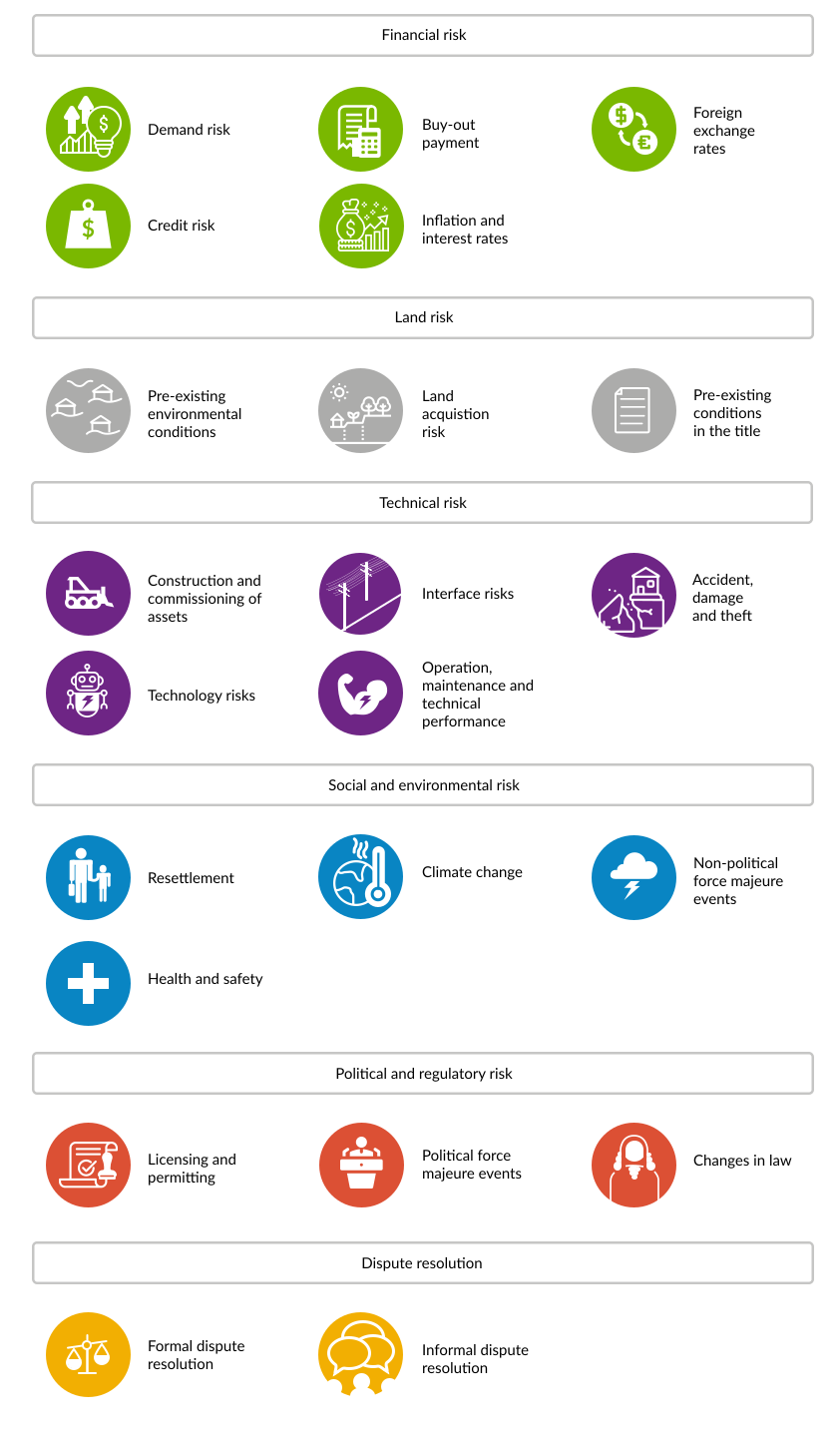
The financial risks detailed below arise from private participation in transmission infrastructure.
A substantial risk for any transmission project is demand risk. Demand risk is the risk that there will not be enough demand for electricity from end users in a prescribed period to enable the private investor to recover the capital costs of building the transmission infrastructure. The risk is characterised as an under-utilisation of the transmission assets such that, over time, the transmission assets do not generate enough revenue to cover their construction and operating costs.
Private investors are very unlikely to accept any exposure to demand risk: such exposure arises when the payment terms of a project are linked to the use of the relevant transmission infrastructure (often termed a “utilisation factor”). For example, the main private transmission business models discussed in this book — independent power transmission projects (see chapter 5) and concessions (see chapter 6) — allocate demand risk to the transmission utility, the host government, or electricity consumers.
Regardless of who bears this risk, the best way to mitigate it is to ensure that the project includes assets that are essential and necessary for the country’s requirements, as demonstrated by comprehensive planning and feasibility studies. Hence, the focus for a private investor is on how to build this asset as efficiently as possible and on time, and to use the most efficient operating model.
The ability of existing utilities to make payments to private transmission companies under long-term contracts is referred to as “credit risk”. This type of risk is significant in the African market since few utilities on the continent generate enough cash themselves to recover their operational and capital expenditure costs. This is due to a combination of high costs and low revenues. In extreme cases, utilities may become functionally or legally insolvent. As a result, utility credit risk is one of the most important risks which need to be managed.
When evaluating credit risk, transmission investors will assess the financial condition of the utility, the extent to which the end-user tariffs reflect the cost of electricity across the entire value chain, the utility company’s revenue collection rate, and its ability to pay all stakeholders.
The capacity of the government to make a termination payment, even if the likelihood of terminating the project is highly unlikely, will also be part of the overall credit risk assessment, and mitigating this risk will be necessary to access financing for the private transmission project.
The formulation of termination compensation and buy-out prices are discussed in more detail in the chapters on independent power transmission projects and concessions (see chapters 5 and 6).
The multi-decade duration of most transmission investments exposes investors to long-term economic risks arising from changes in inflation and interest rates.
The costs of operating and maintaining transmission infrastructure will vary over time and will be subject to inflation throughout a long-term project. If a private investor takes responsibility for operating or maintaining transmission infrastructure, then understanding the treatment of inflation regarding these costs is an important risk that is often reflected in the investment agreement.
Similarly, private investment in transmission infrastructure will usually involve a large debt component that will be repaid during the long life of the project. Lenders terms may include either fixed or floating interest rates, and a lender may provide financing for the duration of the project (most common in project financing for IPTs) or up until a date in the future when the company investing in the transmission project may need to refinance (which is typically the case for a transmission concession). As with inflation, the risk that interest rates may increase over time must be allocated within the investment agreement. In some cases, these risks may be partly or fully mitigated by hedging instruments.
While debt service and payment obligations for a transmission investor are usually denominated in a reserve currency such as US dollars or Euros, the transmission utility almost always charges its consumers in local currency. The result is a currency mismatch – the transmission utility pays for the transmission infrastructure in a reserve currency but earns its revenues in the local currency. This mismatch is significant and strains the overall risk profile of an investment.
Different business models for transmission investment deal with this risk differently. However, the majority of investors, including international lenders, with a mandate presently suitable for the sector in Sub-Saharan Africa will be unable to take currency risk. Even where this risk is mitigated by a pass-through to the utility or government, an investor will need to consider the impact of foreign exchange risk as part of the overall credit risk assessment described earlier in this chapter.
Transmission infrastructure, especially transmission lines, can cover several hundreds of kilometres, adding to the complexity of securing financing. Unlike power generation assets that are location-specific, acquiring the rights-of-way requires considerable political, community, social, economic, and environmental considerations for each community or geographic terrain along the transmission line route. Resettlement and the security of the infrastructure — from both a public safety perspective and against vandalism or theft — increases the risk of delays in, and escalates the costs of, developing and delivering transmission infrastructure.
Please see chapter 10. Land Acquisition for further details on the land acquisition process.
Transmission projects involve many technical risks. Identifying these and apportioning them between a host government or transmission utility and a private investor is an important part of agreeing to the terms of any project. Private investors will then seek to mitigate and pass through many of these risks by contracting with EPC contractors and/or O&M providers, or through insuring against these risks where suitable. In many cases, transferring some of these risks to a private investor is a key benefit for a host government or transmission utility and may form part of the rationale for introducing private investment.
Most transmission projects will involve new infrastructure, including new or upgraded infrastructure forming the basis of the project. Transferring construction risk to the private sector is likely to be a key feature and benefit of most projects. This will generally involve a private investor taking responsibility for cost overruns resulting from construction.
Changes in the construction scope of work required may occur at different stages of the project and may have significant impacts on the budget, schedule, and overall viability of the project. Changes may involve the specification of certain components, the designed redundancy, and interfaces with the existing or future components of the power grid. Yet, the most disruptive scope change is the change in the routing of the transmission line. This may be needed because of numerous reasons including issues with land acquisition and challenging geology.
The existence of a grid code helps to set the design specification. A thorough feasibility study should help determine the required scope and design specifications, as is described in chapter 9. Planning and Project Preparation. The parties to a transmission project will generally agree to the scope of projects before the signing of the contract. Most transmission investors will seek to mitigate construction risks with an EPC contract to transfer risk to a construction company if it is better placed to manage them.
Private transmission projects may be as simple as a single transmission line or may include multiple lines. They may include new substations or the expansion or refurbishment of existing ones. They may link to new or existing power generation projects. All of these related infrastructure assets may be held in either private or public hands. When conceiving a new transmission infrastructure project, these related or ancillary projects — and their ownership — must be taken into consideration during the planning period of the transmission project as the interface between the various assets may affect the scope of the new transmission project. For example, a privately financed line that is dependent on, and will be connected to, a remote generation project will need to carefully assess the timing of the construction of that generation project to ensure that delays on the generation project do not adversely impact the timing of payment of wheeling or use-of-service charges of the transmission line. A level of coordination and interface management will be required for projects that connect to one another.
New technology risk is not common for transmission projects, as the technology is relatively standard. However, soon new technologies will be developed including smart grid capabilities and battery storage. IPTs will not usually take on new technology risk as they are difficult to finance without a proven track record. However, whole-of-grid concessions and privatisation models do allow private sector operators to experiment with new technology within their wider business. Encouraging innovation and improvements is a possible benefit of network concession models. Technology risks are reduced or eliminated by ensuring that the specific technology has demonstrated good performance and reliability in other projects of scale and similar operating conditions. Risks associated with new technologies can also be mitigated through appropriate supplier guarantees.
Operating risks, especially availability and technical performance, need to be assessed. Any private transmission financing business model which passes responsibility for operating or maintaining assets to the private sector will likely include key performance indicators (KPIs) for which the private investor will be responsible. Failure to meet KPIs will generally result in financial penalties or revenue reductions for the project company. Maintenance risks involve improper or inadequate maintenance. In most private-sector business models this risk will be transferred to the investor. The investor will then either employ its own staff to maintain the assets or seek to transfer the responsibility and the risk by hiring a contractor (either an independent maintenance company or even the transmission utility) to carry out this function.
Accidents, damage and theft are risks throughout the lifecycle of a project including construction, operation and maintenance, and need to be dealt with. Responsibility for accidents will typically reside with the party responsible for operations and maintenance. Damage and theft will typically be the responsibility of the private sector asset owner, though this can be mitigated through insurance products and adequate insurance will typically be a requirement of lenders to the sector.
The potential for transmission projects to impact surrounding communities and environments is significant and gives rise to a number of risks that must be allocated amongst the public and private parties in any transmission investment. In general, a comprehensive social and environmental impact assessment will need to be prepared in connection with the construction of new facilities or the rehabilitation of existing facilities. It is often advisable to begin this assessment at an early stage, as part of pre-feasibility and feasibility studies, so that serious social and environmental issues are identified early on. In many cases, changes to the design of the project may mitigate these issues. For example, alterations to the line route to mitigate social and environmental impacts are common.
Social and environmental risks are typically grouped into construction-related risks and operations-related risks. Some of the risks mentioned below are present in only one of these two periods. Others are in both.
Occupational, health, and safety risks that may arise during project construction, operation, maintenance, and decommissioning should also be assessed and allocated. Accidents could happen and adequate precautions need to be taken to avoid them. Electrocution is probably the most common injury but could be avoided with proper system design and precautions. Electromagnetic interference (radio noise) is possible and may require that transmission line rights-of-way and conductor bundles be designed to ensure radio reception at the outside limits remains normal.
If resettlement of persons is required to build and operate the transmission project, a very thorough assessment is needed to ensure that it is handled properly. Resettlement relates not only to landowners but also to users of the land, particularly for agricultural or other purposes. Lenders, especially development finance institutions, have specific requirements on how social and environmental issues (including resettlement) should be handled. One such example is the “Environmental, Health, and Safety Guidelines for Electric Power Transmission and Distribution” of the World Bank Group.
Finally, it should be mentioned that assessment of greenhouse gases as a result of the transmission project is becoming more and more common. Certainly, energy losses in the transmission line could be linked to greenhouse gases. However, investments in transmission reduce losses. Transmission is a key enabling infrastructure for renewables and green power sources and as a result, investments in transmission may contribute substantially to the reduction of emissions of greenhouse gases.
A party to a contract may be affected by an event or circumstance or combination of events or circumstances (including the effects thereof) that is beyond the reasonable control of that party and that materially and adversely affects the performance by that party of its obligations under to a project agreement. Such events are known as force majeure events. In civil law countries, the nature and consequences of force majeure events are generally specified by law. It may or may not be possible for parties to agree to change the events that constitute force majeure events or the consequences of force majeure events by contract. English law does not recognise the concept of force majeure as a matter of law. As a result, the parties to a contract governed by English law (and the laws of virtually all common law countries) must agree on the events and circumstances that constitute force majeure events and the consequences of those events.
Force majeure events may include:
If a party is prevented from performing by such an event, uses reasonable efforts to overcome the effects of the event and continue performing its obligations, and notifies the other party of the event and its effects, then the time the affected party must perform will be extended. If the force majeure continues for a prolonged period, the parties may have the ability to terminate the affected project agreements.
As discussed in chapter 12. Regulatory Framework, private transmission projects will need to obtain many approvals, licenses, permits, and other consents from various public authorities to be able to perform their obligations and exercise their rights. The project company faces the risk that a license will not be issued, may be revoked or that when the license period lapses, the license will not be renewed. The project company would also be concerned about any changes to the terms and conditions of the license or changes in law more generally.
Political risks are generally mitigated under government support agreements by way of termination compensation payments. The formulation of termination compensation and buy-out prices are discussed in more detail in the chapters on independent power transmission projects and concessions (see chapter 5 and 6).
A government support agreement (see chapter 8. Government Support and Credit Enhancement for more detail) will typically provide that the host government will, where necessary, take appropriate action to ensure that its public authorities issue the licenses, permits, and consents the project company is required to obtain. The form of material licenses — such as a transmission license — may be attached to the government support agreement so that the project company will have visibility of the terms and conditions that will be attached to that license upon the execution of the government support agreement. The issuance of key licenses will usually also constitute a condition precedent to the effectiveness of the project agreements or to the obligation of the project company to perform its obligations, such as constructing facilities or taking control over operations and maintenance. It is important to note the failure to approve and issue permits or other regulatory approvals may eventually trigger an event of default under the relevant IPT, concession, or similar agreement.
The transmission utility and the host government will likely require the project company to contractually commit to comply in all material respects with the laws of the host country. The project company should in turn be able to commit to doing so, at least by reference to applicable laws at the outset of the project based on legal due diligence and advice. The project company (and by extension its lenders) will, however, find it difficult to give an unqualified commitment to comply with laws to the extent that laws may change over time. This risk arising from the impact of a changing legal environment over the life of the project is referred to as a change in law risk.
The scope of change in law risk has evolved to include (a) the introduction of a new law, (b) modification of existing law, and/or (c) changes in the interpretation of the law by any court, tribunal, governmental entity or other authority which has applicable jurisdiction or regulatory oversight concerning the project or the project company. “Law” in this context is often defined as covering a comprehensive range of legislative, statutory and regulatory instruments, orders, guidelines, and so on.
A change in law may impact the project company in many ways:
The general principle behind the allocation of change in the law risk is that the project company should be left in no better or worse position than if the relevant change in law had not occurred. This protection is often subject to limits, such as the need for a “material” impact on the project economics or exclusions for changes in law related to human rights or environmental protection.
To the extent the project company is temporarily unable to perform an obligation as a result of a change in law, this will not constitute a project company default and any time limits imposed on the project company will be extended accordingly. In addition, if the project company incurs an increase in costs or decrease in revenue as a result of a change in law, this will entitle the project company to receive either (a) direct compensation to pay for or reimburse the project company for such cost or revenue shortfall, or (b) an appropriate tariff increase. Conversely, if the project company benefits from a change in law, then an appropriate downward adjustment in the tariff will typically apply. If a change in law renders performance under the project agreement impossible, the project company will generally be entitled to trigger the termination payment provided for in the agreement.
A party to a contract may be affected by an event or circumstance or combination of events or circumstances (including the effects thereof) that is beyond the reasonable control of that party, and is to some extent within the control of the host country, and materially and adversely affects the performance by that party of its obligations under a project agreement. Such an event may be known as a political force majeure event. It may also be known as material adverse government action or by some other name.
These events may include:
Prolonged political force majeure events may lead to government events of default, which would typically entitle the project company to terminate the project agreements and claim any termination compensation that is payable upon their termination.
Unfortunately, disputes do sometimes arise, even in the context of well-structured transactions that have been implemented by parties that were well advised by legal, technical, financial, and other specialist advisors. The contracts that are discussed in this handbook are all long-term contracts and the parties to them cannot always anticipate the circumstances that may arise over a period that may sometimes exceed 30 years.
When a dispute arises, all parties will have an interest in resolving the dispute as quickly, efficiently, and amicably as they can. The purpose of dispute resolution mechanisms is to ensure that disputes are resolved quickly so that the parties can put the dispute behind them and continue to perform their obligations and enjoy their rights under the contracts they have entered into.
Disputes arise for a variety of reasons. They may relate to technical or financial issues, measurements of the availability of a transmission line, or measurements of KPIs to name just a few. Disputes may also relate to the interpretation of contracts, laws, regulations, or licenses, or the interpretation of rights or obligations that arise out of the intersection between contracts, laws, regulations, and licenses.
The best thing parties can do when disputes arise is to talk to each other. Ongoing dialogue among the parties after the project agreements have been executed can help to resolve most disputes. If the project level team is not able to resolve a dispute, discussions between senior management of the parties to the dispute may be helpful. Most project agreements impose an obligation on the parties to attempt to amicably resolve issues in good faith through dialogue before they use more formal dispute resolution processes.
Many project agreements provide that a party may refer defined categories of disputes to a technical expert. They may also provide that any dispute may be referred to a technical expert if the parties agree after the dispute has arisen, regardless of whether the dispute falls within the defined categories of disputes that can be referred to a technical expert by right.
Some project agreements provide that a technical expert appointed by the parties will render a non-binding recommendation to the parties. Although the recommendation is non-binding, it may assist the parties in crystallising the issues and reaching an amicable resolution. Other project agreements provide that a technical expert may issue a decision and that the decision will be binding on the parties unless a party effectively appeals the decisions by referring the dispute to arbitration within a defined period after the decision has been issued. Finally, in rare instances and in relation to narrower categories of disputes, a project agreement may provide that a decision issued by a technical expert is final and binding.
It is worth noting that the legal frameworks that support the validity and binding nature of arbitration are well developed. In contrast, the legal frameworks related to the determination of disputes by technical experts is less well developed and that a decision may not be final and binding even if a project agreement indicates that it will be if applicable law does not provide that such decisions are final and binding. Care is necessary in the context of cross-border projects because the laws of multiple countries must be considered.
Expert determination is less suited to the resolution of disputes that arise out of complex factual matters that require extensive evidence in the form of documents or evidence from witnesses. Expert determination is also less suited to purely legal disputes, in part because most clauses that permit a party to refer a dispute to a technical expert do not envision the referral of a dispute to barristers, solicitors, or attorneys.
If the transaction involves the appointment of an independent engineer, the independent engineer may issue recommendations or opinions that can help the parties resolve disputes. The list of issues that can be submitted to an independent engineer can be agreed upon during the negotiation of the project agreements. An independent engineer is mandated in a separate agreement among the independent engineer and the parties to the project agreement in relation to which the engineer is being appointed. If the parties intend for an independent engineer to play a role in resolving disagreements as they arise, it is advisable to appoint an independent engineer at the outset of the project. This avoids delays and disagreement as to the identity of the independent engineer after a disagreement arises. It also means that the independent engineer will have more background knowledge about the project and may be able to issue well-informed recommendations and opinions more quickly as a result.
Arbitration is used to resolve disputes that cannot be resolved through informal processes or processes that involve a technical expert or independent engineer. Unless the project agreements include a provision that requires the parties to resolve disputes by binding arbitration, the dispute would be submitted to courts that have jurisdiction over the dispute. This is not an ideal outcome in the context of international transactions because arbitral awards are much more easily recognised and enforced by courts than decisions issued by other courts.
The parties to a contract may choose from various sets of arbitration rules to resolve disputes. Those rules include rules issued by the International Centre for the Settlement of Investment Disputes (ICSID), the International Chamber of Commerce (the ICC), the United Nations Commission on International Trade Law (UNCITRAL), and the London Court of International Arbitration (the LCIA). Other arbitration rules also exist, including under OHADA law. Each set of rules addresses issues such as the qualifications of arbitrators, the number of arbitrators, the method of appointing arbitrators, the confidentiality of the proceedings, the fees and costs of the arbitrators, and many procedural issues.
The project agreements should select the seat of the arbitration. The seat sounds like it is where the arbitration will physically take place, but it is important that the seat not be confused with the venue of the arbitration (which is where the arbitration will take place). The seat is important because the law of the seat will (either favourably or unfavourably) fill in gaps not catered for by the arbitral rules, will impact on the role of the courts regarding the independence of the arbitrators, and might even override certain arbitration rules.
The law of the seat can even influence the ultimate enforceability of any award. Prudent contracting parties would undertake some due diligence of the chosen seat.
Parties often prefer arbitration to litigation due to the enforceability of an arbitral award. An arbitral award may be enforced in a country that is a party to the New York Convention (the Convention on the Recognition and Enforcement of Foreign Arbitral Awards) and has implemented the convention by passing its own internal laws regarding the enforceability of foreign arbitral awards in a manner that is consistent with the convention.
Regulatory frameworks are fundamental to the effective operations of the electricity sector in any country. A predictable regulatory framework is of particular importance to private funding structures since the existing framework forms the assumptions upon which the investment is made at the outset of the project and ongoing regulation represents a risk over the life of the project.
The elements that define a well-constructed and transparent framework include autonomy, consistency, and predictability. With these elements legislated and demonstrated in practice, it will be easier to attract funding of private business models and stimulate transmission infrastructure investment. Improving the regulatory framework for transmission projects will also benefit the market more broadly by incentivising efficiency and bringing down costs for consumers.
In addition to the general need for a well-developed regulatory framework, the introduction of private investment in the transmission sector will also require targeted changes to existing regulations to address barriers that may otherwise make private investment impossible.
In this chapter we will discuss the following:
Regulation by Contract
For certain private investments where the transmission project will operate largely on an independent basis (e.g., whole-of-network concessions and IPT models), it may be possible to finance a project even if the regulatory framework is not fully developed. Both the economic and technical regulations described in this chapter can be defined directly in the project agreements, which is referred to as Regulation by Contract. This does not foreclose the possibility of developing a regulatory framework as that legislative process may continue in parallel with the implementation of the project. There are many cases in the power sector where one or two projects have led the way and provided useful lessons learned that are translated into long-term regulations. It is important to note, however, that the use of Regulation by Contract should be limited as a widespread use would result in a market with widely divergent regulation of different projects. Any plan for wide-scale investment from the private sector will require an independent and stable regulatory framework that governs all market actors on equal terms.
The independence of the regulator is a primary concern for transmission project investors given the significant possibility for political influence in the energy sector. As a regulated asset that supports the broader public benefit of energy access, there is often an incentive for political actors to artificially lower transmission and other energy costs to generate goodwill with consumers (particularly ahead of elections). In its basic ideal form, an independent regulator will not be subject to any political influences or special interest groups and will be autonomous in its governance of the energy sector. Some of the characteristics of an independent regulator are:
As a general rule, legislative frameworks that govern electricity sectors establish the regulator as a separate legal and independent entity outside the ministry that is responsible for energy. Although the government may establish policy objectives for the sector, the independent regulator is responsible for ensuring efficiency, transparency, and fairness in the management of the electricity sector and benefits from the discretion that is required to achieve those objectives and to balance the interests of investors and consumers. Among other things, the concepts of regulatory independence and discretion mean that a regulator is permitted by law to modify its tariff guidelines at any time, yet with a reform procedure that involves broad consultation with all participants, particularly sector stakeholders.
A transparent regulatory framework can create credibility for the regulator and the regulatory decisions it makes. Even when service providers are all public entities, stakeholders including the government, consumers, and utilities are more likely to express confidence in the regulator if its decisions are guided by clear rules, procedures, and methodologies and if stakeholders participate in the decision-making process.
Transparency makes it easier to attract private investment in financing through any of the available business models discussed in this handbook. This is because private investors are more likely to choose legal and regulatory frameworks in which their rights and obligations have been clearly defined and the decisions of the regulator are predictable.
Measures to achieve and enhance transparency in the regulatory framework include clarity of the rules and procedures of the regulator and the rights and obligations of regulated entities, the autonomy of the regulator, regulator accountability to stakeholders, predictability of regulatory decisions, broad stakeholder participation in the regulatory process, and open access to information about the process.
Regulatory transparency can be enhanced when the roles and objectives of the regulator are spelt out in primary legislation and other instruments such as contracts. The rights and obligations of the regulated entities also need to be clearly stated so that expectations are clear to all stakeholders. This feature of the regulatory framework is particularly important to private developers and their financiers.
Good regulatory governance requires that the regulator is protected by law and in practice from interference from political actors, policymakers, and special interest groups. This may be achieved through various measures that ensure that regulators are not funded through government budgets or by the utilities, and balanced stakeholder representation on the board of the regulators.
To avoid abuse or the perception of abuse of its autonomy, a good regulatory framework should create the framework for stakeholders to challenge the decisions of the regulator, and most importantly, to obtain redress when the decisions are not per the rules and procedures.
In a good regulatory framework, the decisions of the regulator will be predictable. This means that regulatory decisions are made under established rules, methodologies, and processes. It calls for clearly spelling out in regulatory documents - including licenses and contracts- the factors that feed into the decisions of the regulator. These factors may include definitions of parameters such as the rate base, price adjustment formulas, and timetables of events.
Broad stakeholder participation in the regulatory process enhances transparency and the legitimacy of the regulatory framework and bolsters consumer confidence that the regulatory system will protect them from unreasonably high prices or poor quality of service. Typical stakeholders will include regulated entities, non-regulated ones, consumers, policymakers, and other public authorities. These stakeholders should be encouraged to participate actively in the regulatory decision-making process, to provide regulators with as much information as possible about their views and about the impact that a regulatory decision would have on them.
Open access simply means that the laws, rules, processes, methodologies, and consultation papers that inform the decisions of the regulator and the decisions themselves are readily and openly available to stakeholders and the general public. This is one way to enhance the transparency of the regulatory framework and foster stakeholder participation and stakeholder confidence in the regulator and regulatory decisions.
Economic regulation is needed in areas where no functional competition is possible. Electricity networks are a prime example of this lack of constitution since they typically constitute a natural monopoly and require regulation to limit monopoly pricing and to set incentives for efficient performance.
Economic regulation typically involves ensuring the financial sustainability of the utility through tariffs that are cost-reflective and incentives for the efficient cost of operations. It also allows for utilities to have returns that allow for future investments and still balances the requirements for affordability to ensure access for all. The necessity for economic regulation that balances the need to limit monopoly effects with the financial sustainability of the utility applies equally to both public and private transmission companies.
Some of the methods used for economic regulation by regulators include:
Rate of return (ROR) regulation: At the basic level this method allows the regulated entity to recover its justifiable prudent cost and is allowed a return on the regulated assets (or rate base). Under this method of regulation, regulators evaluate the firm's rate base, cost of capital, operating expenses, and overall depreciation to estimate the total revenue needed for the firm to fully cover its expenses. It makes room for clawbacks and claims for over- and under-recovery of cost, typically through clearing accounts. It should be noted that in some jurisdictions the term cost of service regulation, or COSR, is used. The most commonly used term in Africa, however, is RoR.
Incentive-based regulation: This method determines the revenue requirement for the transmission utility using a future period called a control period. The control period is a long interval between tariff reviews, usually 4 or 5 years, within which the revenue requirement is frozen. In the control period, tariffs are allowed to increase at a rate that comprises the difference between the country’s annual consumer price index (CPI) or inflation rate and a productivity factor. The goal of this method is to ensure that at the end of the control period, the transmission utility’s allowed revenues equate to its costs, and efficiency gains are passed on to the consumers in the next control period.
This model can take either of two approaches: the price cap and the revenue cap approaches.
Price cap regulation: Sometimes referred to as CPI-X, this method attempts to adjust the utilities’ prices according to the price cap index that reflects the overall rate of inflation in the economy, the ability of the operator to gain efficiencies relative to the inflation in the utilities input prices, relative to the average in the economy.
Revenue cap regulation: This method allows the utility to change its prices as long as its revenue remains below the cap set.
The effective application of these methods will lead to a predictable methodology for calculating the economic return for transmission projects and make it easier for potential investors to assess the commercial viability of any given project.
Efficient regulation will be required to determine the price (cost) of transmission through a transmission tariff that will be ultimately borne by the electricity end user. The transmission tariff will be designed using principles that enable fair allocation of the cost of transmission between generation and consumption, reduce the investor’s risk of cost recovery, incentivise network users to make the best decisions on the location of new generation and load, and reduce system operating costs.
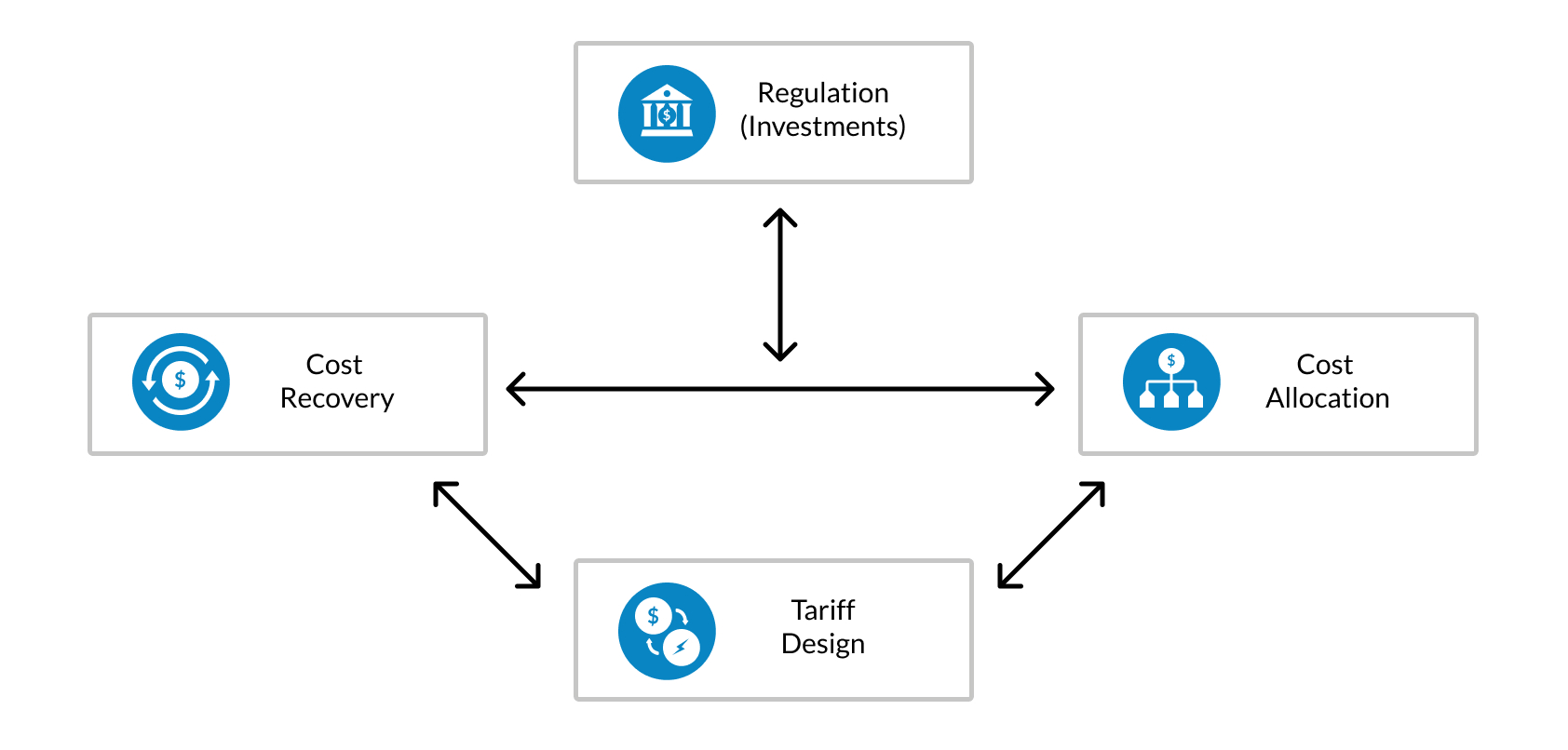
When the transmission costs are clear and fairly allocated, it becomes easier to attract financing through any of the available business models discussed in this handbook.
To attract financing for transmission, governments will have to consider how their respective electricity market structures affect the transparency of their transmission costs. The regulatory tariff models and pricing methodology used in Sub-Saharan Africa to calculate the upstream costs of transmission depend largely on the structure of the electricity market. Thus, vertically integrated electricity markets with little or no unbundling or competition differ in their approach to transmission pricing from unbundled markets with a partial or full competition. This impact of the market structure on transmission pricing affects the extent of regulation for and transparency in the cost of transmission.
In vertically integrated monopolies with no market competition, the costs associated with transmission are often unclear. While it may be possible to determine the fixed costs of new transmission lines, the variable costs of operating and maintaining the grid may not be easily separated from the operation and maintenance costs for associated generation plants and the distribution system. Corporate and administrative costs also remain bundled.
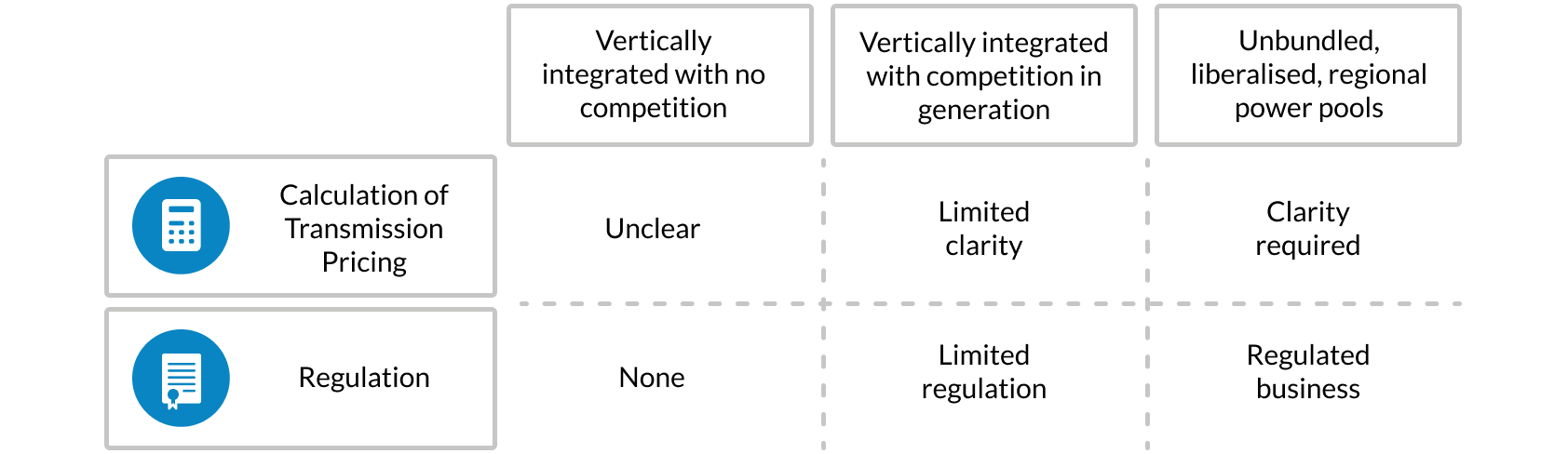
Further, limited regulation of transmission pricing is seen in most countries that have introduced competition in generation while retaining a vertically integrated monopoly structure. The regulator ensures that the connection charges for a new generator — typically an IPP — cover the costs of constructing, operating, and maintaining the network facilities that are strictly required to connect the IPP to the monopoly’s network. However, the costs related to the use of the system by both the generators and the utility are not clear. Thus, proper cost allocation may not be feasible under current tariff structures in markets with vertically integrated utilities and new regulations may be needed to establish a predictable methodology for transmission pricing.
Transmission pricing is clearer in some countries that have undergone full legal unbundling: separation of generation, transmission, and distribution functions into different legal entities. The laws in such countries also establish independent regulators that create regulatory frameworks to allocate the benefits and costs of using the transmission network among the various participants in the market and recover the costs of investment. Yet, the degree of transmission cost transparency in such markets depends on the extent of the regulator’s independence and its ability to design and implement cost-reflective tariffs.
Nonetheless, all countries regardless of market structure can regulate and achieve transparency in transmission costs. Costs of transmission in vertically integrated monopolies can be regulated and be transparent without a full legal unbundling exercise. This is possible if the existing monopoly utility is required to maintain separate accounts for the various services it renders (generation, transmission, distribution) which are then monitored by an independent regulator. This introduces transparency and predictability without the need to fully unbundle the legacy utility in a market.
Case Study — Mauritius
The legal and regulatory framework established by the Mauritius Electricity Act, 2005 (as amended, 2020) contemplates the existence of an independent regulator (the Utility Regulatory Authority) and a requirement that a licensee who provides more than one electricity service should keep separate accounts and publish separate financial statements for each electricity service. Hence, the vertically integrated utility will keep separate accounts for generation, transmission, and distribution. Such practice — known as accounting unbundling — can enable a vertically integrated utility to avoid cross-subsidisation of costs among its respective businesses, determine the true cost of transmission, and publicly disclose such costs. The regulator is also better equipped to properly allocate transmission costs to other network users such as IPPs and bulk purchasers.
An electricity regulator also performs in some markets the function of a market regulator in addition to the economic regulations. This includes for the transmission business the development of the grid codes that govern the technical specifications and performance requirements. Adherence to this is usually specified in the licence.
A regulator also plays an important role in monitoring compliance to licensing conditions and other legislation. To do this effectively, the regulator will need to be appropriately resourced and have the necessary legislative powers to impose sanctions for infringements.
As electricity markets become more liberalised, the functions of the regulator will need to be reinforced. With a multitude of stakeholders and consultants being a foundation of regulatory processes, the regulator’s ability and resources to undertake these activities need continual focus. A regulator without the resources can quickly lose its independence, even if in some instances this is not total independence.
Another function that a regulator performs is to issue licenses. Some of these licenses, permits, and consents apply to virtually any type of business. A business license may be required by the localities in which a business owns property, operates, or has an office, for example. Planning, location, and construction permits are likely to be required to construct transmission facilities, substations, offices, and other facilities. At the other end of the spectrum, some licenses, permits, and consents are specific to the power sector, and to transmission in particular. A transmission license is a good example of a license that is specific to the transmission sector.
The transmission license typically authorises the holder to own, construct, and operate physical installations for transporting electricity from a production point to a consumption point, either within the country or outside the country. In many African countries, cross-border transactions will not fall under the remit of the local countries’ regulator and may be regarded as an unregulated business.
The system operation license authorises the holder to engage in activities that ensure the reliability of the entire network. Thus, the system operation licensee will manage electricity flows on the network, and undertake non-discriminatory generation scheduling, commitment and dispatch, transmission congestion management, transmission outage coordination, system planning for long-term capacity, and procurement and scheduling of ancillary services. The system operator does not own or operate physical transmission facilities and has no financial interest in the electricity flow on the transmission lines.
This section will discuss the regulatory framework required to attract private investments in transmission. While the bulk of private investment in power infrastructure is directed to generation projects, governments and regulators are increasingly moving towards the introduction of private participation into other segments of the power market, such as transmission and distribution. Even with private participation, the need to maintain the stability and accessibility of power markets remains. Regardless of the mix of public and private participation in the power market, a regulatory framework that establishes market rules, prohibits and provides protection is an important focus for governments and regulators.
Since electricity transmission infrastructure has traditionally been managed as a public asset, the regulatory framework must often be adjusted to specifically authorise private participants to undertake grid activities. Grid activities include planning for transmission projects, construction of new transmission infrastructure, maintenance planning, and system operation. Some jurisdictions divide these activities into two licenses which may be held by the same entity — a transmission license and a system operation license.
If a country’s legal and regulatory framework contemplates that only the state-owned utility will perform the activities listed above as strictly “transmission license” activities, it will be difficult to attract private investments into the transmission segment of the electricity supply chain. The business models discussed in this book are only possible if the electricity laws and regulations are drafted to allow private entities to hold “transmission licenses''. These licensees can coexist with state-owned utilities who may also provide transmission and/or system operator functions. However, the licensing regime must ensure that private entities which undertake strictly transmission activities allow non-discriminatory connection to the installations they own and operate. The licensing framework should also clearly establish the steps for obtaining a transmission license and the costs involved.
One significant change in the regulatory framework for transmission systems that must be anticipated with the introduction of private investment is the need for investors to obtain a secured interest in any transmission assets that are covered by a license, concession, or any other business model. This may be a significant departure from existing frameworks that assume transmission assets are to be held by a public entity on behalf of the state. The form of secured interest that investors require may vary significantly, based upon both the project structure and the type of financing. In general, however, the regulatory framework should anticipate the need to grant interests to private parties in the physical assets (land, equipment, etc), legal assets (operating license, sales/marketing agreements, etc), and financial assets (tariff payments, receivables, etc). Without this security, the investor will be unable to demonstrate to their shareholders or lenders the financial security necessary to fully fund the project's development and the cost recovery potential.
As discussed later in this book within the context of financing, privately financed transmission projects often require that the investor borrow funds in either local currency or reserve currency. The local currency is the currency of the jurisdiction in which the project is to be constructed and operated, and reserve currency is a currency held in significant quantities as part of governments’ or institutions’ foreign exchange reserves. Reserve currencies, such as U.S. dollars and Euros, are commonly used in power and infrastructure transactions. As a result, any regulatory framework that intends to attract private investment in transmission infrastructure must also authorise the payment of transmission tariffs in either local or reserve currencies (or possibly a combination of both) to ensure that the private financing terms of the project are compatible with the publicly regulated payment structure. For additional detail on currency risk in private projects, see chapter 11. Common Risks.
With the introduction of private participation in the transmission segment of a domestic power market, it is often necessary for the regulatory framework to accommodate the need for alternative forms of dispute resolution to quickly and fairly resolve any issues that arise at the contract or operational level. For example, as new technologies and operational standards are introduced by private parties, the regulatory framework may authorise the appointment of independent engineers to help reconcile any conflicts between legacy and modern systems. Similarly, if a major dispute were to arise between public and private parties, it would be expected that a neutral dispute resolution system, such as commercial arbitration, could be utilised to resolve the dispute, an option that would need to be specifically authorised in the regulatory framework (public entities may also be required to waive their sovereign immunity protections to enable the enforcement of any arbitration awards). For additional detail on dispute resolution, see chapter 11. Common Risks.
As explained in this chapter 12. Regulatory Framework, one of the primary functions of an independent regulator is to establish the pricing that the transmission utilities, be they private or public, can charge to generate revenue. This revenue will then cover the transmission utility’s costs, namely, the network investment costs (including a specified return on the capital deployed), operation and maintenance costs, ancillary service charges, and administrative costs.
This section of the book presents a summary of the most common methodologies utilised by independent regulators to establish transmission pricing. While any application of a pricing model will require careful study, economic modelling, and significant consultation with all market stakeholders, this section should provide a helpful overview of the diversity of pricing strategies available to regulators.
This section is especially relevant for the whole-of-grid concession funding structure as the pricing of the transmission charge by the regulator will be critical for the successful implementation of the business model. Note, however, that the level of technicality of this subject matter is high and goes slightly beyond the original intent of this book.
The basis for determining the transmission utility’s allowed revenues depends on the tariff model adopted by the regulator. As detailed in this chapter, there is a range of tariff models that may be deployed by the regulator. However, before investigating each model, it is important to note that any uncertainty in the process adopted for tariff making is itself considered a risk for private investors.
A key feature of the revenue models for private transmission projects is the periodic regulatory review of the tariffs. At the outset of a project, the tariff will be established, based upon the allocation of existing assets to the private operator (in a privatisation or concession model). However, over the life of the project, as the need for additional investments in the transmission network/segment are identified, the regulated tariff will need to be reviewed. Additionally, between reviews, the existing regulated tariff may be allowed to increase by an escalation factor that reflects inflation or other changes in economic growth. The investment agreement may also include key performance targets for the private transmission project, which may also be adjusted over time as the assumptions underlying those performance targets evolve with appropriate rewards or penalties attached to the performance targets.
Given the significant need to treat tariff setting as an ongoing exercise rather than a one-time event, it is critically important for the regulator to communicate to the market how it plans to engage in this process and invite feedback to build trust in that process. Some areas of concern include: the model applied in the valuation of the transmission assets, the establishment of a reasonable return on invested capital, and the characterisation of the nature of new assets that are included in the regulated asset base.
In general, the process for transmission tariff design is divided into three phases:
The methods for establishing the allowed costs have been briefly described in the main chapter ‘Regulatory Framework’. These include the cost of service model and the performance-based regulation model. However, the various considerations and calculations in these models are not discussed in detail in this book.
After determining the transmission utility’s costs or revenue requirement, the regulator allocates these costs among network users through transmission charges. Transmission charges can be broadly divided into two categories:
Connection charges are designed to recover the transmission utility’s costs for constructing and maintaining the connections and associated transformers required by individual generators and wholesale buyers. Regulators typically take various approaches to recover the connection costs. These approaches depend on whether new facilities are needed to connect the network user and the extent to which the new connection facilities will benefit other users of the transmission network.
If new facilities are not needed, then there is typically no network charge. However, if new facilities are needed, whether the connection charge will be separated from the TUOS charge depends on whether the connection costs are shallow or deep.
Shallow connection costs cover the cost of new facilities dedicated to connecting a network user to the grid. The connection charge allowed by the regulator will cover the cost of the meter, any transmission substation, and the cost of the usually short line between the network users and the transmission utility’s network. The regulator may decide to levy those charges to be paid upfront or to spread the payments as monthly costs over time. Such costs may also be shared among all users connected to that specific node in the transmission network.
Deep connection costs cover facilities that benefit existing network users or future network users. For instance, system upgrades or reinforcements may be necessary because the network is congested at a certain connection point. New lines and associated transformers may also be needed when there is a long distance between the new IPP, distribution company, or industrial consumer and the preferable network connection point. In this case, the new facilities may be deemed part of the transmission network instead of a connection. Regulators typically include deep connection costs as part of the TUOS charge.
Since the TUOS charge covers the cost of network investments other than shallow connection costs, operation and maintenance of the network, and the corporate and administrative costs of running the transmission business, the TUOS is the main transmission charge which the regulator must determine how to allocate among network users.
In allocating the cost of the network, the regulator aims to ensure that the method used is simple and transparent, non-discriminatory, fair, enables recovery of the cost from both present and future users of the network, and sends proper location signals to users in the network. There are various approaches used globally by regulators or suggested by academics for transmission cost allocation, and no approach is foolproof. Some of the common approaches used are postage stamp, wheeling, and distance-based methods.

Then, removing any particular transaction, the regulator repeats the above process and calculates the resulting total MW-km amount. The difference between the second sum and the first sum is the amount of MW-km flow on the line allocated to the transaction removed. The transmission charge is then calculated as:

In some liberalised or wholesale electricity markets, the cost allocation methods described above are used to determine fixed charges that supplement other charges known as variable network charges. The variable network charges are implicit charges derived from the differences in marginal prices among different nodes in the electricity network. Such differences exist in a market system as a result of losses in the transmission system. Nodal prices are used to send signals to network users on more efficient locations to site new generation or load.
When electricity is transmitted from one point (node) to another, some of the electrical power is lost as heat. The amount of power lost depends on the distance of the generator to the load (the farther the distance the more power is lost), the resistance of the transmission lines, the environmental conditions, and the amount of power flowing through a line at any particular point among other factors.
Using a model that calculates the impact of each user on the transmission losses, each generator’s marginal costs, the demand level at each node, and active transmission constraints, the regulator assigns loss factors or node factors to various nodes in the system. These factors are used to determine the electricity prices at each node. The loss factor estimates the losses associated with injecting or receiving an additional unit of electricity at any particular node. It is also used to calculate the marginal cost of meeting electricity demand at any node. For instance, if the loss factor at a particular bulk supply node is 5% and a generator has a contract to deliver 100 MW to that node within an hour, the generator must supply 105 MW to meet its delivery contract to the node and the associated losses. Thus, if there is a bulk supply connected to the generator’s node, the marginal cost of meeting demand at the generator’s node will be less than the marginal cost of meeting demand at the other bulk supply node — there will be fewer or insignificant losses at the generator’s node.
The differences between the prices of electricity between nodes are allocated to the transmission utility as variable network charges. Because these charges are variable and depend on a lot of contingencies, they may be insufficient to recover the investment and operation costs of the transmission utility. Hence, the regulator uses the cost allocation methods previously described to determine supplementary charges for the transmission utility.
In countries that do not use wholesale electricity prices, and electricity generation prices are not determined by market forces, the regulator may use transmission loss or congestion factors as an alternative to achieve the same locational signal objective associated with the use of nodal prices. With this practice, the generator bears the cost of the extra units of electricity needed to cover the transmission losses related to its generation. This practice is used with the fixed cost allocation methods (supplementary charges) discussed previously.
After determining the method for allocating the costs among network users as fixed or supplementary charges, the regulator finally determines the format of the tariff. The regulator’s decision on tariff structure may affect the private investment decisions and deserves careful consideration. The regulator may decide to design the transmission tariff as a lump sum, a volumetric energy charge ($/MWh), a volumetric capacity charge ($/MW), or an hourly availability charge ($/hour of t-line availability). As a lump sum charge, the regulator designs the TUOS cost allocated to a user as a one-off charge to be paid by the user annually. The regulator may also divide this lump sum into fixed monthly charges.
As an energy charge, the recovery of cost by the transmission utility depends on the actual energy generated or consumed by the network user. This may expose the transmission utility to losses since it has no control over the behaviour of other network users. For instance, with the increase in behind-the-meter installations, an energy charge for transmission means that network users whose demand may have justified transmission investments will avoid payments for such transmission infrastructure in their end-use tariffs. This may affect the transmission utility’s ability to pay costs associated with private investments in the transmission network. There may also be fairness issues associated with the other tariff formats which are structured as capacity charges or availability charges. Some network users may feel that they are paying more than other users if their electricity production or consumption rates are considered.
Some regulators balance these considerations by using a mix of energy charges and capacity or availability charges. The suitable tariff format or a mix of formats adopted by the regulator depends on the nature of the market, the business models for private investment in transmission allowed in the market, and the regulatory goals. Nonetheless, the tariff format should ensure that the transmission utility recovers its cost without compromising on principles of fairness, non-discrimination, and transparency.
This handbook has largely focused on the funding of domestic transmission infrastructure. Another important topic is the features of cross-border transmission infrastructure development and the complexity of funding such regional projects.
Most of the risk allocation factors described in this handbook apply to cross-border interconnection. Although they have significant benefits, cross-border projects can also present additional implementation challenges when jointly undertaken by host governments and/or utilities. They may be constrained by varying policy, legislation, governance requirements, funding restrictions, restrictions or conditions to project company foreign or local shareholding, borrowing restrictions, and the like. Private sector participation is sometimes a viable option for reducing or mitigating such risks.
A cross-border project is transmission infrastructure that spans two or more neighbouring countries, creating a transmission interconnection between the electricity networks of the respective countries. Cross-border projects can provide transmission services to domestic transmission consumers and dedicated transmission capacity to power generation projects, but importantly enable the regional development of transmission infrastructure. Where cross-border transmission lines exist, countries with constrained funding and unstable or underdeveloped transmission infrastructure can lean on neighbouring countries to trade in electricity conveyed over that cross-border transmission infrastructure. Cross-border interconnectors aim to provide countries with an increased supply of electricity to meet growing demand where the generation capacity in a neighbouring country is strong. Other advantages include assisting a national grid in saving costs from having reserve capacity and stabilising the national grid.
Cross-border projects are not new to the African continent. There are many successful interconnector projects. These include:
|
The CLSG transmission line in West Africa, which involves the construction of a 1,303 km transmission line allowing power exports from Côte d’Ivoire to Liberia, Sierra Leone, and Guinea |
|
|
The 2,000 km 225kV connections that serve connecting points in Mali, Mauritania, and Senegal |
|
|
The 225kV Ghana - Cote d’Ivoire interconnection |
|
|
The 161kV Togo - Benin interconnection |
|
|
The MOTRACO transmission project (case study below), a project with multiple interconnectors across the SADC region set up to facilitate power trading in the SAAP. |
The benefits of undertaking a cross-border transmission project interconnecting neighbouring countries are numerous, some of which are:
Despite the benefits, there are many challenges and constraints to developing cross-border transmission infrastructure, in particular the raising of funding and facilitation of private sector participation. We have identified a few of these hurdles below.
Transmission interconnection projects can be constructed and developed individually by each respective country, or undertaken jointly by all the countries acquiring the transmission asset. This has been the typical approach taken by some cross-border projects on the African continent. The asset itself is therefore owned individually by each country in respect of those portions within the respective country, or jointly by all countries over which the asset is developed. The joint development aspect and joint fundraising is a nuance that creates complexity with cross-border transmission projects.
The starting point for cross-border transactions is an Inter-Governmental Memorandum of Understanding. This sets the governance model for development. This will usually define whether a JV or project implementing unit is created for the project preparation work. It should be noted that there is considerable funding available to fund preparation studies for regional integration projects from multilateral donors.
Challenges in raising funding for cross-border projects can arise for many reasons, relevant to one or more of the countries, being the limited ability of the utility or government:
Project finance fundraising is therefore challenging unless the transmission utility or host government agrees to pay a regular availability fee or subsidise the tariff where demand across the line and commensurate revenues is not sufficient to meet the repayment of the debt. In short, project finance funders would not likely take the “demand risk” as detailed in chapter 11. Common Risks.
Where host governments undertake regional transmission development to meet particular government objectives, for example, to enter into regional electricity power trading, or to become an active participant within a power pool, host governments can consider any form of subsidy or guarantee offered by it as being a critical upfront cost to achieve such goals. Once the goal is achieved and the transmission network improves, the initial funding challenge is progressively lessened as electrification rates increase and demand risk reduces. However, the initial challenge of how the infrastructure is funded remains.
Development Finance Institutions (DFI) provide the government with excellent sources of capital for funding cross-border transmission lines. Provided the business case and the project preparation is well-conceived, DFIs with an agenda to promote regional trade are aggressively pursuing these types of projects. One example of these is the funding for the Ethiopia-Kenya interconnector and the latest funding for the Temane interconnector in Mozambique, which has a business case motivated by regional trade.
As described earlier in this handbook, each country has a unique regulatory framework governing the transmission sector, including the national electricity legislation, the licensing regime, and the grid code. In most instances, there also exists a PPP or other procurement regime for the competitive, open, and transparent process to award a concession, or an IPT, or any other private-sector party to undertake the development and operation of transmission infrastructure.
Where there are two or more countries, a multiplicity of legal and regulatory regimes may govern the development of the interconnection infrastructure, which may create delays at the development stage. For example, if three countries are entering into a joint development agreement to construct interconnection facilities across a region, that JV company will likely want to appoint a single EPC contractor for the construction of the entire transmission corridor. The granting of rights to the JV company, where that company is incorporated, how it is run and how it is empowered, will all need to be agreed upon. This may lead to complex negotiations to take account of regulatory differences across countries for matters from the procuring the EPC contractor to the staffing of the JV company itself. Negotiating and agreeing to all of these details is typically not a quick process.
It should be noted that for instance the cross-border interconnections are regarded as an unregulated business in terms of the local regulations. An example of this is the South African treatment of these interconnectors and the trade that takes place. However, these interconnectors will remain subject to other legislation such as ESIA and tax legislation.
Power pools in Africa have generally developed their own grid codes, operational standards, and have standardised cross-border electricity trading agreements, and transmission use of system and connection agreements. There is often a regional regulator who provides a monitoring and oversight role in respect of compliance with the suite of codes, standards and agreements developed by the power pool.
Whilst a domestic regulator’s legal authority and mandate emanate from domestic law, regional regulators typically have a mandate through contract, for example where power pool members agree contractually to abide by the membership rules of the power pool, including decisions by the regional regulator. However, in countries where there may be political or economic barriers where domestic policy decisions favour domestic generation over imports, the domestic law may well trump the regional rules. It is therefore imperative for the success of a cross-border project that the relevant policymakers fully support the project, see chapter 9. Planning and project preparation.
Case Study — The MOTRACO transmission project: an interesting hybrid model
The Mozambique Transmission Company (MOTRACO) was founded in 1998 as a joint venture between the government utilities of Mozambique (Electricidade de Moçambique — EDM), South Africa (Eskom) and Eswatini (Swaziland Electricity Board, now Eswatini Electricity Company — EEC). MOTRACO is a joint venture company that has as its aim the efficient provision of electricity to businesses in all three countries. It should be noted that government support in the form of assisting with transmission licensing and regulation in the three countries at a time when only state utilities had transmission licenses was critical to ensure MOTRACO could become an IPT company (although state-owned).
The “anchor” customer was the Mozal aluminium smelter plant, 20 km outside Maputo. The aluminium plant had significant electricity demands and was willing to pay MOTRACO a wheeling charge for the reliable energy it received. The aluminium plant paid the cost of electricity purchased from ESKOM. The fixed portion of the wheeling charges relating to the energy transmission covered debt service and operational expenditure of MOTRACO. The management, maintenance, and control of the MOTRACO network were outsourced to Eskom.
EDM and EEC also have independent wheeling contracts with MOTRACO. This allows the utilities to participate in SAPP and trade power in both directions (i.e. import power from the market when supply is constrained and export to the market when surpluses are available).
The initial phase of the investment, worth US$ 93 million, was completed in mid-2000. MIGA issued guarantees to Eskom to cover loan guarantees to the European Investment Bank and the Japan Bank of International Cooperation for their investments in MOTRACO to cover the investment against the risks of expropriation, war and civil disturbance. The French development agency AFD provided additional financing for later stages.
The deal has subsequently grown to link to the wider Southern African Power Pool. The transmission interconnection benefited both Mozambique and Eswatini by improving the quality of electricity distributed to the population in those countries.
Of note was the fact that there was an “anchor” customer, thereby reducing “demand risk” (see Chapter 11. Common Risks for a further explanation of demand risk). It further benefited from a guarantee from Eskom. At the time of granting this guarantee, Eskom had a stand-alone investment-grade credit rating. The MIGA cover was taken to protect the Eskom balance sheet against political risk.
The project provided the industrial company Mozal with a reliable supply of electricity to meet its increased production and industrialisation of Mozambique post-civil war, at the same time as strengthening the energy supply networks of Eswatini and Mozambique. For EEC and EDM, the transmission infrastructure helped lower the cost of energy and increase its availability, as well as to increase the reliability and security of interconnected systems in the region. By becoming active trading partners in the SAPP, both countries benefited from low-cost power purchase in the SAPP market.
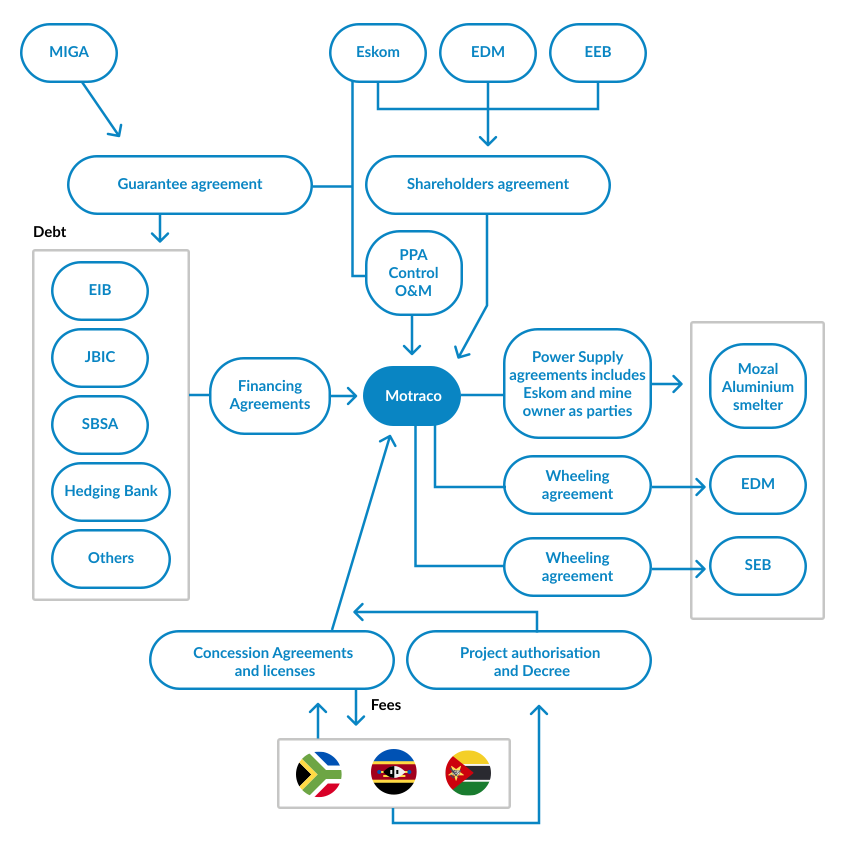
Many successful cross-border projects have occurred outside Africa as well.
Several cross-border lines exist across varying European Union countries (including more than 80 cross-border interconnections between the EU and neighbouring countries). The further development of cross-border transmission infrastructure is designed to meet the EU's external policy objectives, including energy transition (and the integration of renewable energy), security of supply as well as regional and local socio-economic welfare, economic cooperation, peace and solidarity. There are many political and economic reasons for a country to cooperate with neighbouring countries and benefit from existing and future interconnectors.
Some other international cross-border transmission projects include:



|
Paraguay-Brazil (Itaipu 12,600 MW Hydro) and Paraguay-Argentina (Yacyreta 3,100 MW Hydro); Paraguay surrendered operating control of the hydro plants to Brazil and Argentina, respectively. |

|
Uruguay and Argentina agreed to share the energy generated from the Salto Grande hydro plant (1,890 MW), with Uruguay consuming 50% of the energy and Argentina consuming 50% of the energy. |
|
|
The CIEN lines built by ENDESA connecting Argentina and Brazil (back-to-back interconnection) includes one line (1000 MW) with a firm contract and another (also 1000 MW), which is a merchant. |

|
Salta cross-border interconnection between Argentina and Chile built by AES (private company) to supply power to copper mines (in the north part of Chile). Salta thermal plant (640 MW) in Argentina is dedicated to supplying the mines in Chile. |






|
The SIEPAC (230kV line) synchronously interconnects six countries in Central America and allows up to 300 MW of trade within a regional electricity market. |


|
Two back-to-back (one 220kV and the other 400/500kV) interconnections between Georgia and Turkey; the latter is a merchant line. |
Private sector participation in cross-border projects has similar benefits to private funding of domestic transmission projects. These benefits include an increased mix of financing options and proper risk allocation and cost recovery methods. However, private participation in cross-border projects has its own complexities. Nonetheless, provided that the private sector developer(s) is empowered by the various governments, it can overcome some of the hurdles specific to the government-funded cross-border projects.
In this section, we will summarise some of the possible private-sector structures that could apply to cross-border projects.
The concept of an independent transmission project, as described in chapter 5. Independent Power Transmission (IPT) Projects above, can also apply to cross-border transmission infrastructure. In the earlier discussion, it was assumed a single local government or country defines the structure. For a cross-border project, the complexity of resolving the requirements for private participation extends to multiple governments. An example of this will be land acquisition. This will need to be agreed upon with multiple governments and the leasing structure for the rights-of-way will need to ensure that the long term titles are valid across all jurisdictions.
In short, all of the considerations that are required for a single-country project that need to be addressed and resolved are multiplied in cross-border transactions (e.g. how is political risk allocated between two countries if the event starts in one country but spills across to another).
The key risk to be addressed to allow IPT financing to take place is that of payment risk. An analysis will be required of the various users of the infrastructure. The tariff applicable to all jurisdictions would need to be considered. The payment risk for the transmission use of system charges or the capacity charges will also need to be addressed and this will get especially complex in default scenarios. One of the ways this can be resolved is for all of the government utilities to adopt joint and several liabilities with a defaulting utility. This may be possible although it will require complex inter-government negotiations.
As seen from the MOTRACO example above, a public sector project can be done with an “anchor” industrial offtaker. This addresses one of the key risks as regards demand and payment risk. However, the need for an umbrella guarantee from one of the parties may still be required, depending on the creditworthiness of the other offtakers and the reliability of the industrial user.
Whilst this is not necessarily a privately funded model, the existence of a private-sector party in the overall structure will allow for different types of lenders to fund the cross-border infrastructure. Whereas previously only concessional funding may have been available from donors, the existence of an industrial offtaker allows the entry of commercial banks and DFIs, who can provide loans at commercial rates. The advantage of a model that is more linked to an industrial offtaker is the reduction in the impact on the respective governments’ balance sheets.
In some instances where there is an operating regional market such as the SAPP, it may be possible to consider merchant transmission lines. We refer the reader to the earlier discussion on challenges in implementing a merchant transmission line in chapter 7. Other Private Funding Structures. These can work across borders. If, for example, country A has abundant resources that enable it to generate plentiful and cheap electricity but neighbouring country B has no such resources and is reliant on importing fuel to burn for expensive electricity, it is conceivable that a private sector developer could develop, finance and build a transmission line that is used to connect one country’s grid to a particular plant (or simply to the other country’s grid). The project company in this instance would earn revenues from “wheeling” or use-of-system charges payable by country B. Similar cross-border merchant lines have been delivered in the US and Australia, for example (across state borders).
An interesting example of a cross-border project done by a private company is the Zambia-DRC interconnector developed by CEC in Zambia. As a private whole-of-the-grid in the Copperbelt region licensee, CEC was able to develop and implement the cross-border transmission line. The line is used by SAPP members to trade power between SNEL in the DRC and other members. CEC benefits from wheeling charges as well as trading of energy across the line.
AfDB — African Development Bank
BOO — Build Own Operate
BOOT — Build Own Operate Transfer
BOT — Build Operate Transfer
CAPEX — Capital Expenditure
COD — Commercial Operation Date
DFI — Development Finance Institutions
EPC — Engineering, Procurement and Construction
ECA — Export Credit Agencies
EIA — Environmental Impact Assessment
ESIA — Environmental and Social Impact Assessment
GSA — Government Service/Support Agreement
IFC — International Finance Corporation
IPP — Independent Power Producer
IRP — Integrated Resource Plan
IPT — Independent Power Transmission
KPI — Key Performance Indicators
kWh – Kilowatt Hour
MWh – Megawatt Hour
MDB — Multilateral Development Banks
MoF — Ministry of Finance
MTS — Main Transmission Substation
OECD — Organisation for Economic Co-operation and Development
OEM — Original Equipment Manufacturer
O&M — Operating and Maintenance
OPEX — Operating Expense
PCOA – Put and Call Option Agreement
PCG — Partial Credit Guarantee
PRG — Partial Risk Guarantee
PPA — Power Purchase Agreement
PRI — Political Risk Insurance
PPF — Project Preparation Funds or Facilities
PPP — Public-Private Partnerships
RAB — Regulated Asset Base
RfP — Request for Proposal
RfQ — Request for Qualification
ROR — Rate of Return
SAPP — Southern African Power Pool
SADC — Southern African Development Community
SPV — Special Purpose Vehicle
SSA — Sub-Saharan Africa
TDP — Transmission Development Plan
TSA — Transmission Service Agreement
TSO — Transmission System Operator
Annual Revenue Requirement — the total revenue to be collected in a given year through the transmission of electricity over the transmission infrastructure, including associated technical losses, to compensate the transmission operating company for all expenditure incurred in the same year and provide the basis for sound economic operation of the infrastructure.
Balance Sheet Financing — the financing of a project which is provided in full by a sponsor.
Bankable — a project or contract is said to be “bankable” if it comprises a level of risk allocation which would be generally acceptable to lenders.
Baseload Power or Capacity — generating capacity within a national or regional grid network that the offtaker or grid operator intends to dispatch or utilise continuously.
Concession — a right to develop, construct, operate and maintain an infrastructure project and to earn the revenues generated by the project.
Concession Agreement — an agreement that grants a concession over a transmission system or a part of a transmission system.
Concessionaire — the holder of a concession.
Corporate Finance — used to distinguish Project Finance (see below). Corporate finance implies that a borrower utilises its existing balance sheet strength and operational cash flows to borrow. Lenders assess the creditworthiness of the corporate entity itself. This includes an assessment of its current indebtedness, its capital structure and the business plan of the corporate entity.
Commercial Operation Date (COD) — a key milestone date defined in the agreement when the transmission infrastructure commences commercial operation after all testing and commissioning have been completed.
Deemed Energy Payments — payments made concerning deemed generation.
Deemed Generation/Energy — the electricity that a power plant would have been able to generate, but for the occurrence of an event or circumstance for which the offtaker bears the risk.
Developer — see Sponsor.
Development Finance Institutions (DFI) — financial institutions with a mandate to finance projects that achieve development outcomes. Examples include the World Bank, AfDB, OPIC, FMO, DEG, CDC, DBSA and Proparco.
Engineering, Procurement and Construction (EPC) contract — one or more contracts to be entered into between the EPC contractor and the project company for the purpose of setting out terms and conditions for the design, engineering, procurement of materials and equipment, the construction and commissioning of the power plant.
EPC + F — in addition to the Engineering, Procurement and Construction (EPC) definition, the EPC+F is a project financing mechanism in which the EPC contractor also arranges financing for the project, through tie-ups with financing institutions. It is useful when EPC contractors have better access to low-cost financing, including EXIM financing.
Environmental and Social Impact Assessment (ESIA) — a process of evaluating the environmental and social impacts of a proposed project, evaluating alternatives and designing appropriate mitigation, management and monitoring measures.
Equity — money invested by the sponsors in the project that is not borrowed by the project company. The term "equity" may sometimes be used to include shareholder subordinated debt (which is finance made available to the project company by the sponsors or shareholders of the project company, which is subordinated to debt made available by the lenders).
Export Credit Agencies (ECA) — public agencies and entities that provide government-backed loans, guarantees and insurance to corporations from their home country that seek to do business overseas in developing markets.
Force Majeure Event — an event beyond the control of the affected party that prevents it from performing one or more of its obligations under the relevant contract. Events constituting force majeure are generally further classified into political force majeure events and non-political force majeure events, with different financial and contractual consequences to the contracting parties. Natural force majeure events fall within the latter category.
Financial Close — occurs when all conditions precedent in a signed loan agreement have been met or waivered, making the funds available for drawdown.
Finance documents — the agreements required to finance the relevant transmission infrastructure project under which the project company borrows (and then owes financial obligations to) a series of lending institutions — be they banks or development finance institutions or export credit agencies. The facility agreement is typically one of the main finance documents which is an agreement that sets out the terms and conditions on which the lenders make a loan available to the project company.
Government Support Agreement — an agreement entered into by a host country and a project company established to undertake an infrastructure project or hold a concession to provide certain identified types of support to the project company in respect of the project or concession.
Government Concession and Support Agreement — an agreement between the host government and the project company, under which the host government agrees to certain undertakings concerning the project. This agreement typically goes beyond the customary provisions of an Implementation Agreement and may include an explicit guarantee of the performance obligations of a governmental entity, such as an offtaker or fuel supplier.
Grid — a system of high tension cables by which electrical power is distributed throughout a region.
Host Country — the country in which a project, concession, or part thereof is located.
Independent Power Producer (IPP) — a special purpose company established for the sole purpose of developing, financing, constructing, owning, operating and maintaining a power plant.
Institutional Lender — a regulated financial institution engaged in lending.
Integrated Resource Plan (IRP) — is an electricity infrastructure development plan based on least-cost electricity supply and demand balance, taking into account several considerations such as the security of supply, ability to reduce/shift the demand and the impact on the environment.
Interconnection — the linkage of transmission or distribution lines between the offtaker (utility) and the power plant, enabling evacuation of the energy generated.
Investor — see Sponsor.
Independent Power Transmission (IPT) — the construction and financing by a private sector investor of a single transmission line or a package of transmission lines and/or associated transmission infrastructure including substations. These are independently owned but typically connected with the wider electricity network.
Joint Venture (JV) — a joint venture is a commercial enterprise undertaken jointly by two or more parties that otherwise retain their distinct identities. These can be conducted either by way of incorporating a special purpose vehicle (called the JV company) or by way of contract alone (in which case it is called an “unincorporated” joint venture).
Key Performance Indicators (KPIs) — set of performance indicators used to evaluate the performance of a project or system.
Kilowatt Hour (kWh) — a measurement of energy that is equal to 1,000 watts of electricity being generated or consumed continuously for one hour.
Kilovolt (kV) — a unit of potential equal to 1,000 volts.
Lenders — the providers of loan financing to the project company.
Megawatt (MW) — a measurement of power meaning 1,000,000 watts.
Multilateral Development Banks (MDBs) — an institution, formed, owned and controlled by its member countries, that provides financing and advisory development services. Examples include the World Bank (IBRD and IDA), AfDB, and MIGA.
New York Convention — the Convention on the Recognition and Enforcement of Foreign Arbitral Awards (also known as the New York Convention) allows for the enforcement by a contracting state of arbitration awards issued by another contracting state, subject to limited defences.
Non-Recourse Financing — financing that will be repaid solely through the cash flow proceeds of a project, structured as a special-purpose vehicle. The obligations of the shareholders in the special-purpose vehicle are usually limited to their obligation to contribute capital and, in some cases, to provide other limited and well-defined support to the special-purpose vehicle.
Offtaker — the party to a PPA whose obligation is to purchase the capacity made available and the electricity generated by the power plant, subject to the terms and conditions of the PPA. Also referred to as the Buyer.
Operating and Maintenance (O&M) Agreement — the agreement between the project company and a plant facilities operator under which the operator operates and maintains the power plant and associated facilities.
Partial Credit Guarantee (PCG) — a guarantee that covers interest and principal defaults, up to a pre-agreed amount — expressed either as a fixed sum or as a percentage of the credit balance. See Chapter 2 on Funding Options and Constraints.
Partial Risk Guarantee (PRG) — a guarantee specifically structured to address targeted risks and can be time-bound or event-bound. See Chapter 2 on Funding Options and Constraints.
Power Purchase Agreement (PPA) — a medium-to-long-term contract that governs the production, sale and purchase of electrical capacity and energy. Also referred to as an "offtake" agreement.
Political Risk Insurance (PRI) — offers coverage to mitigate and manage risks arising from the adverse action, or inactions, of governments that go against contractual obligations. PRI can be provided by both public and private insurers.
Privatisation — also called divestiture, in the context of this handbook, relates to where full ownership of the transmission infrastructure is transferred to a private-sector party. Privatisation may occur on a single transmission corridor, by region or even in respect of the entire transmission system operation in a country.
Project Company — a special purpose company established to undertake an infrastructure project. Also referred to as a Special Purpose Vehicle (SPV), a corporate entity established specifically to pursue a specific project and is prohibited from undertaking any activity beyond the project in question. For this handbook, the term Project Company is used.
Project Documents — key project and finance documents that would typically be required in transmission projects.
Project Finance — see Non-Recourse Financing.
Project Preparation Funds or Facilities (PPF) — donors/funds designed to provide funding for the project preparation of transmission lines. Some have specific objectives such as the introduction of the PPP model or to help promote regional integration while others aim at encouraging projects that help meet climate change targets.
Public-Private Partnerships (PPP) — arrangements between the public and private sectors whereby a service or piece of infrastructure that is ordinarily provided by the public sector is provided by the private sector, with clear agreement on the allocation of associated risks and responsibilities.
Regulated or Regulatory Asset Base — this is a system of long-term tariff design aimed primarily at encouraging investment in the expansion and modernisation of infrastructure. It looks at the overall value of regulated assets (e.g. a national transmission grid) and uses that to create a methodology for paying a private operator to run the relevant assets.
Regulation by Contract — regulation by contract is a form of governing private contracts with utilities that uses no separate regulatory agency, where the public sector owner of the asset monitors the performance of the (private) operator and sets the relevant tariff and revenue arrangements. A contract typically defines the relationship between the asset owner and the service provider.
Regulator — the authority that is responsible for ensuring efficiency, transparency, and fairness in the management of the electricity sector. An independent regulator is generally established by the legal framework that governs the electricity sector as a legal entity that is separate from the government and is governed by a board of commissioners with fixed terms who can only be removed for cause, as defined in the legislation that established the regulator. Regulators issue, modify, and enforce licenses (including transmission licenses) and establish and implement price controls for network businesses and, in some cases, generation businesses.
Request for Proposal (RfP) — a solicited invitation from the procuring entity to potential bidders to submit a proposal to develop a power project.
Request for Qualification (RfQ) — a solicited invitation from the procuring entity to invite potential bidders to provide qualification credentials for the development of a power plant.
Reverse Auction — a process where there is a single buyer and many suppliers. The buyer indicates its requirements, and suppliers progressively bid downwards. The lowest bidder wins the right to supply. This is opposite to a regular auction that involves a single seller and many buyers.
Sponsor — a commercial entity active in developing and investing in power projects. Typically, it is a shareholder of the project company. Also known as the investor or developer.
TransCo — a state-owned utility that owns a transmission network.
Transmission Development Plan (TDP) — a consultative process to identify viable, economical, and environmentally feasible projects. The process evaluates and compares options and alternatives based not only on technical efficiency and cost, but also on their environmental, social, regulatory, and political impacts.
Transmission Service Agreement (TSA) — an agreement concluded between the relevant IPT and the grid operator that entitles the IPT, as a network user, to use the grid and transmission systems of the relevant country.
Transmission System Operator (TSO) — entity entrusted with transporting energy on a national or regional level, either directly or through instructions issued to others who operate as agents of the TSO.
Wayleaves — rights-of-way granted by a landowner, generally in exchange for payment and typically for purposes such as the erection of transmission lines, telecommunications infrastructure or for the laying of pipelines.
Search
Please fill the input to search