10
Land Acquisition
Introduction
A transmission line may be hundreds of kilometres long. The route may cross land that is owned by the national government, state or regional governments, public authorities, private landowners, or it could be tribal or community-owned land. In many cases, it will be a combination of all of these types of landownership. In addition to the transmission lines themselves, substations are likely to be located along the line. Before financing can be disbursed or construction can begin, rights-of-way, wayleaves or easements must be acquired along the length of the route and ownership interests over the land on which substations will be constructed must be acquired. These are all forms of “access right” or ownership interest, that enables the contractor to build along a pre-identified route and are usually granted by the relevant landowner (whether this be a governmental authority or private individual).
When it comes to substations, not only must the land on which it is built be secured, it also needs to be accessible by road to get construction materials to the site and for ongoing operations and maintenance. If they are not, additional rights-of-way or easements must be procured to provide access to the substations.
Acquiring these rights-of-way, easements, and ownership interests can be costly and time-consuming in any country. Fortunately, a set of good international practices have evolved for designing and siting transmission lines, engaging in consultations with stakeholders that may be affected by the project, acquiring interests in land through voluntary purchases and sales, and ultimately, exercising rights of expropriation (the right of eminent domain) in the event a landowner refuses to sell a right-of-way, easement, or ownership interest.
The land acquisition process can present one of the most significant impediments to implementing greenfield transmission infrastructure development. The key is careful, methodical and early planning to implement an efficient and expeditious land acquisition strategy. The stakeholder best placed to negotiate and finance land acquisition will depend on how that stakeholder is empowered to execute this activity, to implement a project on time and at the lowest cost. With varying land rights at stake, the matter is unlikely to be simple, and coordination with stakeholders at all levels (from individual landowners to communities, to the relevant lands ministry) will be fundamental to ensure a smooth and successful process.
Planning for Rights-of-way
During the project preparation phase, one of the key activities is the selection of the transmission line route to determine route optimisation. At this early stage, utilities will start investigating routing options for planning purposes. If there is a sufficiently strong case or an obvious need for a transmission line in the long term, then the utility may start pre-emptively acquiring strategic rights-of-way for the eventual transmission infrastructure.
Identifying strategic rights-of-way does not involve a significant cost outlay. At the start, it will be a desktop or satellite determination of potential line routes, identifying the nature of the landownership along that route, and proceeding to landowner engagement. Where it is possible to negotiate rights agreements with private landowners, this can significantly assist in transmission line development in later development phases. In some instances, it may be strategic to acquire the rights to prevent obstacles that may impede project development (e.g., to prevent settlements along routes that may be needed in future years).
The relationship with landowners is critical in transmission line development. With early-stage relationship-building activities, the party responsible for the land acquisition, be that the governmental authority or the private developer, will be able to manage the land acquisition risk methodically. Without strong planning capacity, it will be difficult for parties to proceed with strategic land acquisitions.
The acquisition of strategic rights does not provide an alternative to detailed route selection engineering. This activity will need to be undertaken as part of the project preparation activities and needs to be budgeted accordingly. The availability of strategic rights-of-way can however significantly reduce the time it takes to implement a transmission project.
Phases for Route Identification
Route identification can help avoid choosing routes that are close to communities and nature reserves or pass through difficult terrain. The objective of this screening analysis is to identify one or a few feasible routes for a more detailed analysis, with limited on-the-ground activity.
The next phase of the identification and selection investigation may warrant on-site activities such as “walking/driving/flying” the route to confirm initial findings. Environmental screening activities and community consultations may also start during this phase. The goal of this scoping phase is to specify a few routes which optimise technical feasibility, cost, and mitigate environmental and social impacts.
The environmental and social impact assessment (ESIA) is an important consideration that can ultimately determine available external financing options. Aside from routing considerations, on-site soil and geotechnical studies will be required, as well as ensuring the final detailed design meets national grid code requirements.
Environmental and Social Impact Assessment (ESIA)
We have included a high-level depiction of the ESIA process in the diagram below (as per the IFC environmental and social performance standards):
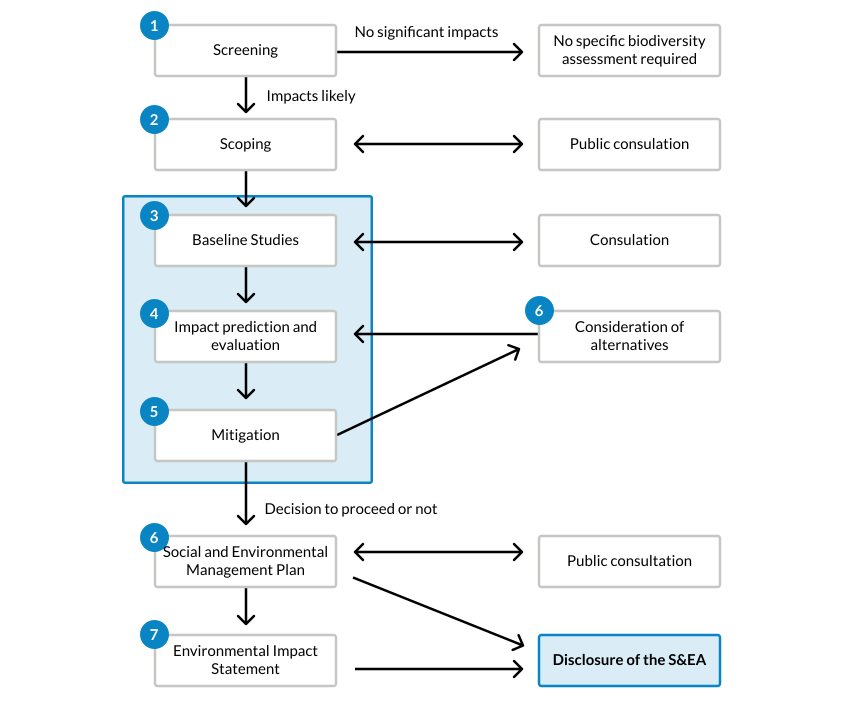
For transmission lines and land acquisition, the screening and scoping stages are critical. Screening is a quick high-level analysis to determine whether a full ESIA is required. If a full ESIA is required, scoping determines which impacts are likely to be significant and become the main focus of the ESIA.
In transmission projects, a full ESIA will most likely be required if seeking external financing support from a publicly backed financial institution. If significant physical or economic resettlement of communities is needed, then a Resettlement Action Plan (RAP) will be required. A deeper discussion of the ESIA and RAP processes is outside of the scope of this book, however, both elements are closely related to the land acquisition strategy and required for any transmission infrastructure development.
The ESIA process must start at the concept stage or sooner as part of the planning process. With an early start to the ESIA, the challenges faced by projects can be managed and addressed. Transmission line developments will be assessed against:
- The process to prepare ESIA has been performed to the appropriate level, with a plan to finance and implement identified mitigation plans, including managing biodiversity;
- Stakeholder consultation, including time and process allocated for stakeholder engagement;
- The process to prepare, finalise, and obtain agreement on the RAP, including evaluating the adequacy of economic compensation and/or physical relocation for identified affected individuals and/or households; and
- Availability of sufficient budget required for resettlement planning and implementation.
By initiating the ESIA process early, the utility or government can make informed decisions on the most optimal line route with due consideration of these challenges. Some of these may be avoided through strategic acquisitions as described above or can be avoided through alternative routes.
Acquisition of Land for Rights-of-way
The responsibility for land acquisition will depend on the procurement strategy for a transmission project, which is explored further in other chapters. This responsibility is often best coordinated and executed by the government, especially when the transmission utility or other governmental body owns the transmission infrastructure. Depending on the terms of a transmission service or concession agreement, private sector developers can be allocated the responsibility for procuring land rights. For example, the renewable IPP programme in South Africa provides the option for the IPP developers, through a “self-build option” to acquire the land required for their IPP project’s transmission connection and undertake such transmission development themselves (see case study in chapter 3. Common Funding Structures in the African Market). Ultimately, while the acquisition of land can be done by either the government or by the private sector, it is wise to identify the actor who is best positioned to efficiently and expeditiously acquire or secure the land and rights of use, and to empower them with that responsibility. For example, some types of land will require governments to exercise a “right of eminent domain” to construct critical national infrastructure, a right only the government can exercise.
Project preparation activities will normally include all of the studies required to choose the line route options including the ESIA studies. These activities can be funded through project preparation funds that are available to governments and in some instances the private sector. If MDBs or bilateral donors are providing concessionary financing to construct the project asset, then land acquisition and ESIA related costs may be included as a project capital expenditure which they are willing to finance (for further discussion of project preparation funding, see chapter 9. Planning and Project Preparation).
Budgetary constraints faced by many utilities and governments can frustrate funding the acquisition of privately held land, especially to pre-emptively acquire strategic land for future transmission lines. Timing of land acquisition can greatly impact the negotiated price and therefore the cost of this activity. Most investors will only fund the transmission projects at the construction stage, and technical assistance grants are rarely available for capital works or the acquisition of capital assets. Moreover, acquisition of land during construction (or in general, after financial closure) increases the land-related risks. Any way to secure the land ahead of the financial closure is also desirable for all parties as delays can prevent a project from being implemented, potentially resulting in cost overruns and an increase in the overall cost of the transmission line.
To the extent that the land acquisition is moved to the private sector, the private sector may be able to fund the acquisition out of development costs but are less likely to exercise the same leverage or bargaining power than the government (local or national). The appetite they will have to do this will depend upon how certain they are about having the rights to execute the rest of the transaction (i.e., have they been awarded a tender or concession to develop the project). In any event, the private sector will need to work closely with the government at both a local and national level to ensure adequate compensation is being paid to affected peoples and landowners.
Role of the Private Sector
For many transmission projects, where the land in question is owned by a community or by the government itself, the land acquisition risk is best managed by the public utility or relevant ministry within the government. This is not always the case and provided that they are granted the right authorisations, private sector sponsors can take on the responsibility for acquiring land, sometimes engaging a consultant to advise and manage the process. It is important to note that ESIA and RAP studies can often only be completed once land parcels have been acquired, which adds to the lead time of preparing these types of projects.
In projects anchored by a dedicated large industrial consumer, the connection charge may be sufficient to allow for the payment for the acquisition of the land rights.
For some IPP projects, the risk for the transmission connection to the grid can be passed on to the IPP (e.g., generation-linked transmission project discussed in chapter 3. Common Funding Structures in the African Market). The IPP will need to acquire the land rights and conduct all the associated studies to ensure that the power generation project can evacuate the power. It should be noted that these are usually shorter transmission lines that simply allow for the connection to the existing grid.
In an IPT or whole-of-grid concession/privatisation, the private developer may be responsible for the grid expansion within the defined concessioned area under a transmission service or concession agreement. This could include land right acquisition for the projects. Governments do however face the risk that if the landowners and the concessionaire cannot reach an agreement, this might significantly delay investment into the sector and this will hamper macroeconomic growth.
Expropriation and Eminent Domain
Governments in some jurisdictions may exercise their right to acquire land via expropriation if needed for projects that are strategically beneficial to the country.
These rights are sometimes called rights to “eminent domain” or “compulsory purchase” rights. All of these describe the power of a state, federal, or national government to take private or community property for the public good or public use, on a limited basis. This power can be delegated to government subdivisions (or even to private companies) if legislatively permissible.
When this right is exercised, it is expected that the government will pay a fair market value for the right. Typically the land value includes the value of any agricultural assets or use of the land as well as the price of having to move any dwellings or other fixtures, but this will be dependent on each country’s laws — and — if funding is being provided by a DFI or MDB or donor agency, is likely to need to meet the international standard of adequate economic compensation.
Summary of Key Points
- Transmission lines can be hundreds of kilometres long and may cross land that is owned by the national government, state or regional governments, public authorities, private landowners, or it could be tribal or community-owned land.
- During the project preparation phase, one of the key activities is the selection of the optimum transmission line route.
- Route identification can help avoid choosing routes that are close to communities and nature reserves or passing through difficult terrain. The objective of this screening analysis is to identify one or a few feasible routes for a more detailed analysis, with limited on-the-ground activity.
- For transmission lines and land acquisition, the screening and scoping stages are critical. Screening is a quick high-level analysis to determine whether a full ESIA is required. If a full ESIA is required, scoping determines which impacts are likely to be significant and become the main focus of the ESIA.
- The responsibility for land acquisition will depend on the procurement strategy for a transmission project. But it is wise that the organisation which is in the best position to arrange land acquisition is made responsible for it.
- For many transmission projects, where the land in question is owned by a community or by the government itself, the land acquisition risk is best managed by the public utility or relevant ministry within the government. Provided that they are granted the right authorisations, private sector sponsors can also take on the responsibility for acquiring land.
- It is important to note that ESIA and RAP studies can often only be completed once land parcels have been acquired, which adds to the lead time of preparing these types of projects.
- Governments in some jurisdictions may exercise their right to acquire land via expropriation if needed for projects that are strategically beneficial to the country.