11
Common Risks
Introduction
The purpose of this section is to identify the most common risks associated with private transmission projects/investments. The risks summarised here are universal and should be considered regardless of the business model which may be selected for each specific project. How each risk is mitigated, however, may differ based on the business model (see chapters 5, 6, and 7 for the discussion of risk mitigation for each business model). Understanding the detailed risk allocation will be an important part of the assessment of a project for a government, transmission utility, or transmission investor. Such understanding will also inform the policy case and the commercial case and impact the availability or cost of financing for a project.
Identifying and allocating risks is a key part of the development stage of private sector financing of any asset or project. How risks are allocated between the parties will depend on the appetite that the party has for risk. However, as a rule of thumb, risks are best allocated to the party that is best placed to manage those risks. Risk allocation is agreed upon in documentation between the parties. Where one party is not able to fully take on risk, there may be mitigants that can be put in place to minimise the impact of any risks occurring.
Project development often requires a significant investment of time and money before proposing a project for direct negotiation or entering a bid in a competitive procurement. From the point of project identification onwards, there is a time commitment and funding required to carry out all the activities which take place prior to financial close. These include a pre-feasibility study, a review of relevant laws and regulations, and conceptualising the financing scheme. As the project matures, more substantial investments are made in feasibility studies, social and environmental impacts assessments, land acquisition/lease and a more detailed review of laws and regulations. The time and substantial costs associated with these development activities — and the risk of a project not achieving commercial or financial close — represents a significant risk to investors. As a result, before opening the transmission to private participation, governments/regulators should be careful to ensure that they have fully committed to an open and transparent investment solicitation process. Any ambiguity or uncertainty will deter investors from taking on the risk of developing a project proposal that will never receive fair consideration.
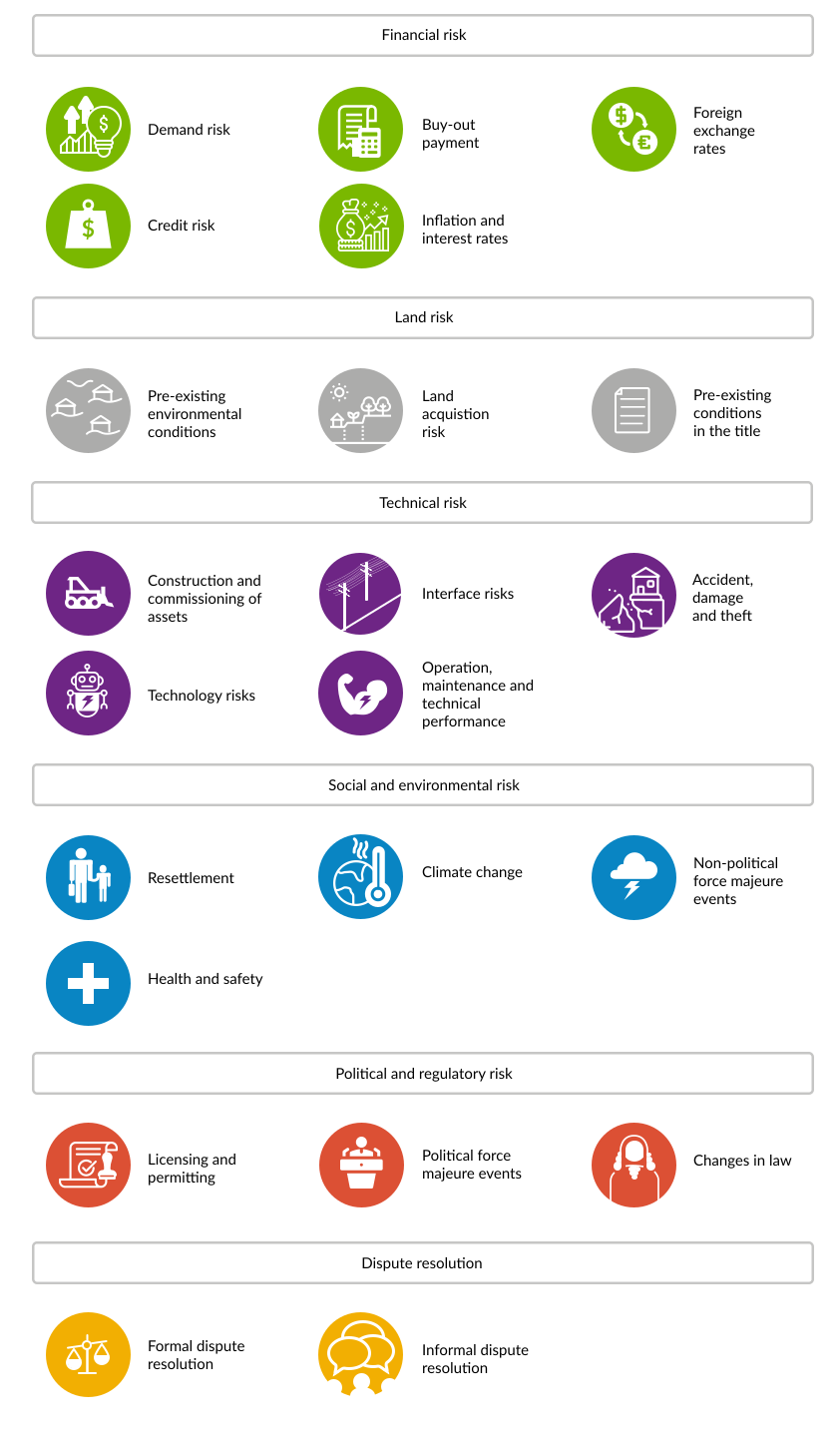
To differentiate amongst the common risks, they have been grouped into six categories: financial, land, technical, social and environmental, political and regulatory, and dispute resolution. A diagrammatic summary of what falls into these categories is set out below.
Financial Risks
The financial risks detailed below arise from private participation in transmission infrastructure.
Demand risk
A substantial risk for any transmission project is demand risk. Demand risk is the risk that there will not be enough demand for electricity from end users in a prescribed period to enable the private investor to recover the capital costs of building the transmission infrastructure. The risk is characterised as an under-utilisation of the transmission assets such that, over time, the transmission assets do not generate enough revenue to cover their construction and operating costs.
Private investors are very unlikely to accept any exposure to demand risk: such exposure arises when the payment terms of a project are linked to the use of the relevant transmission infrastructure (often termed a “utilisation factor”). For example, the main private transmission business models discussed in this book — independent power transmission projects (see chapter 5) and concessions (see chapter 6) — allocate demand risk to the transmission utility, the host government, or electricity consumers.
Regardless of who bears this risk, the best way to mitigate it is to ensure that the project includes assets that are essential and necessary for the country’s requirements, as demonstrated by comprehensive planning and feasibility studies. Hence, the focus for a private investor is on how to build this asset as efficiently as possible and on time, and to use the most efficient operating model.
Credit risk
The ability of existing utilities to make payments to private transmission companies under long-term contracts is referred to as “credit risk”. This type of risk is significant in the African market since few utilities on the continent generate enough cash themselves to recover their operational and capital expenditure costs. This is due to a combination of high costs and low revenues. In extreme cases, utilities may become functionally or legally insolvent. As a result, utility credit risk is one of the most important risks which need to be managed.
When evaluating credit risk, transmission investors will assess the financial condition of the utility, the extent to which the end-user tariffs reflect the cost of electricity across the entire value chain, the utility company’s revenue collection rate, and its ability to pay all stakeholders.
The capacity of the government to make a termination payment, even if the likelihood of terminating the project is highly unlikely, will also be part of the overall credit risk assessment, and mitigating this risk will be necessary to access financing for the private transmission project.
The formulation of termination compensation and buy-out prices are discussed in more detail in the chapters on independent power transmission projects and concessions (see chapters 5 and 6).
Inflation and interest rates
The multi-decade duration of most transmission investments exposes investors to long-term economic risks arising from changes in inflation and interest rates.
The costs of operating and maintaining transmission infrastructure will vary over time and will be subject to inflation throughout a long-term project. If a private investor takes responsibility for operating or maintaining transmission infrastructure, then understanding the treatment of inflation regarding these costs is an important risk that is often reflected in the investment agreement.
Similarly, private investment in transmission infrastructure will usually involve a large debt component that will be repaid during the long life of the project. Lenders terms may include either fixed or floating interest rates, and a lender may provide financing for the duration of the project (most common in project financing for IPTs) or up until a date in the future when the company investing in the transmission project may need to refinance (which is typically the case for a transmission concession). As with inflation, the risk that interest rates may increase over time must be allocated within the investment agreement. In some cases, these risks may be partly or fully mitigated by hedging instruments.
Foreign exchange rates
While debt service and payment obligations for a transmission investor are usually denominated in a reserve currency such as US dollars or Euros, the transmission utility almost always charges its consumers in local currency. The result is a currency mismatch – the transmission utility pays for the transmission infrastructure in a reserve currency but earns its revenues in the local currency. This mismatch is significant and strains the overall risk profile of an investment.
Different business models for transmission investment deal with this risk differently. However, the majority of investors, including international lenders, with a mandate presently suitable for the sector in Sub-Saharan Africa will be unable to take currency risk. Even where this risk is mitigated by a pass-through to the utility or government, an investor will need to consider the impact of foreign exchange risk as part of the overall credit risk assessment described earlier in this chapter.
Land
Transmission infrastructure, especially transmission lines, can cover several hundreds of kilometres, adding to the complexity of securing financing. Unlike power generation assets that are location-specific, acquiring the rights-of-way requires considerable political, community, social, economic, and environmental considerations for each community or geographic terrain along the transmission line route. Resettlement and the security of the infrastructure — from both a public safety perspective and against vandalism or theft — increases the risk of delays in, and escalates the costs of, developing and delivering transmission infrastructure.
Please see chapter 10. Land Acquisition for further details on the land acquisition process.
Technical Risk
Transmission projects involve many technical risks. Identifying these and apportioning them between a host government or transmission utility and a private investor is an important part of agreeing to the terms of any project. Private investors will then seek to mitigate and pass through many of these risks by contracting with EPC contractors and/or O&M providers, or through insuring against these risks where suitable. In many cases, transferring some of these risks to a private investor is a key benefit for a host government or transmission utility and may form part of the rationale for introducing private investment.
Construction and commissioning of assets
Most transmission projects will involve new infrastructure, including new or upgraded infrastructure forming the basis of the project. Transferring construction risk to the private sector is likely to be a key feature and benefit of most projects. This will generally involve a private investor taking responsibility for cost overruns resulting from construction.
Changes in the construction scope of work required may occur at different stages of the project and may have significant impacts on the budget, schedule, and overall viability of the project. Changes may involve the specification of certain components, the designed redundancy, and interfaces with the existing or future components of the power grid. Yet, the most disruptive scope change is the change in the routing of the transmission line. This may be needed because of numerous reasons including issues with land acquisition and challenging geology.
The existence of a grid code helps to set the design specification. A thorough feasibility study should help determine the required scope and design specifications, as is described in chapter 9. Planning and Project Preparation. The parties to a transmission project will generally agree to the scope of projects before the signing of the contract. Most transmission investors will seek to mitigate construction risks with an EPC contract to transfer risk to a construction company if it is better placed to manage them.
Interface Risks
Private transmission projects may be as simple as a single transmission line or may include multiple lines. They may include new substations or the expansion or refurbishment of existing ones. They may link to new or existing power generation projects. All of these related infrastructure assets may be held in either private or public hands. When conceiving a new transmission infrastructure project, these related or ancillary projects — and their ownership — must be taken into consideration during the planning period of the transmission project as the interface between the various assets may affect the scope of the new transmission project. For example, a privately financed line that is dependent on, and will be connected to, a remote generation project will need to carefully assess the timing of the construction of that generation project to ensure that delays on the generation project do not adversely impact the timing of payment of wheeling or use-of-service charges of the transmission line. A level of coordination and interface management will be required for projects that connect to one another.
Technology Risks
New technology risk is not common for transmission projects, as the technology is relatively standard. However, soon new technologies will be developed including smart grid capabilities and battery storage. IPTs will not usually take on new technology risk as they are difficult to finance without a proven track record. However, whole-of-grid concessions and privatisation models do allow private sector operators to experiment with new technology within their wider business. Encouraging innovation and improvements is a possible benefit of network concession models. Technology risks are reduced or eliminated by ensuring that the specific technology has demonstrated good performance and reliability in other projects of scale and similar operating conditions. Risks associated with new technologies can also be mitigated through appropriate supplier guarantees.
Operation, maintenance, and technical performance
Operating risks, especially availability and technical performance, need to be assessed. Any private transmission financing business model which passes responsibility for operating or maintaining assets to the private sector will likely include key performance indicators (KPIs) for which the private investor will be responsible. Failure to meet KPIs will generally result in financial penalties or revenue reductions for the project company. Maintenance risks involve improper or inadequate maintenance. In most private-sector business models this risk will be transferred to the investor. The investor will then either employ its own staff to maintain the assets or seek to transfer the responsibility and the risk by hiring a contractor (either an independent maintenance company or even the transmission utility) to carry out this function.
Accidents, damage, and theft
Accidents, damage and theft are risks throughout the lifecycle of a project including construction, operation and maintenance, and need to be dealt with. Responsibility for accidents will typically reside with the party responsible for operations and maintenance. Damage and theft will typically be the responsibility of the private sector asset owner, though this can be mitigated through insurance products and adequate insurance will typically be a requirement of lenders to the sector.
Social and Environmental Risks
The potential for transmission projects to impact surrounding communities and environments is significant and gives rise to a number of risks that must be allocated amongst the public and private parties in any transmission investment. In general, a comprehensive social and environmental impact assessment will need to be prepared in connection with the construction of new facilities or the rehabilitation of existing facilities. It is often advisable to begin this assessment at an early stage, as part of pre-feasibility and feasibility studies, so that serious social and environmental issues are identified early on. In many cases, changes to the design of the project may mitigate these issues. For example, alterations to the line route to mitigate social and environmental impacts are common.
Social and environmental risks are typically grouped into construction-related risks and operations-related risks. Some of the risks mentioned below are present in only one of these two periods. Others are in both.
Health and safety
Occupational, health, and safety risks that may arise during project construction, operation, maintenance, and decommissioning should also be assessed and allocated. Accidents could happen and adequate precautions need to be taken to avoid them. Electrocution is probably the most common injury but could be avoided with proper system design and precautions. Electromagnetic interference (radio noise) is possible and may require that transmission line rights-of-way and conductor bundles be designed to ensure radio reception at the outside limits remains normal.
Resettlement
If resettlement of persons is required to build and operate the transmission project, a very thorough assessment is needed to ensure that it is handled properly. Resettlement relates not only to landowners but also to users of the land, particularly for agricultural or other purposes. Lenders, especially development finance institutions, have specific requirements on how social and environmental issues (including resettlement) should be handled. One such example is the “Environmental, Health, and Safety Guidelines for Electric Power Transmission and Distribution” of the World Bank Group.
Climate change
Finally, it should be mentioned that assessment of greenhouse gases as a result of the transmission project is becoming more and more common. Certainly, energy losses in the transmission line could be linked to greenhouse gases. However, investments in transmission reduce losses. Transmission is a key enabling infrastructure for renewables and green power sources and as a result, investments in transmission may contribute substantially to the reduction of emissions of greenhouse gases.
Non-political force majeure events
A party to a contract may be affected by an event or circumstance or combination of events or circumstances (including the effects thereof) that is beyond the reasonable control of that party and that materially and adversely affects the performance by that party of its obligations under to a project agreement. Such events are known as force majeure events. In civil law countries, the nature and consequences of force majeure events are generally specified by law. It may or may not be possible for parties to agree to change the events that constitute force majeure events or the consequences of force majeure events by contract. English law does not recognise the concept of force majeure as a matter of law. As a result, the parties to a contract governed by English law (and the laws of virtually all common law countries) must agree on the events and circumstances that constitute force majeure events and the consequences of those events.
Force majeure events may include:
- lightning fire, earthquake, tsunami, flood, storm, cyclone, typhoon, or tornado;
- fire, explosion, mudslide, or chemical contamination;
- epidemic or plague; and
- events that are analogous to political force majeure events but that occur outside of the host country and do not directly involve the host country.
If a party is prevented from performing by such an event, uses reasonable efforts to overcome the effects of the event and continue performing its obligations, and notifies the other party of the event and its effects, then the time the affected party must perform will be extended. If the force majeure continues for a prolonged period, the parties may have the ability to terminate the affected project agreements.
Political and Regulatory Risks
As discussed in chapter 12. Regulatory Framework, private transmission projects will need to obtain many approvals, licenses, permits, and other consents from various public authorities to be able to perform their obligations and exercise their rights. The project company faces the risk that a license will not be issued, may be revoked or that when the license period lapses, the license will not be renewed. The project company would also be concerned about any changes to the terms and conditions of the license or changes in law more generally.
Political risks are generally mitigated under government support agreements by way of termination compensation payments. The formulation of termination compensation and buy-out prices are discussed in more detail in the chapters on independent power transmission projects and concessions (see chapter 5 and 6).
Licensing and permitting
A government support agreement (see chapter 8. Government Support and Credit Enhancement for more detail) will typically provide that the host government will, where necessary, take appropriate action to ensure that its public authorities issue the licenses, permits, and consents the project company is required to obtain. The form of material licenses — such as a transmission license — may be attached to the government support agreement so that the project company will have visibility of the terms and conditions that will be attached to that license upon the execution of the government support agreement. The issuance of key licenses will usually also constitute a condition precedent to the effectiveness of the project agreements or to the obligation of the project company to perform its obligations, such as constructing facilities or taking control over operations and maintenance. It is important to note the failure to approve and issue permits or other regulatory approvals may eventually trigger an event of default under the relevant IPT, concession, or similar agreement.
Change in law
The transmission utility and the host government will likely require the project company to contractually commit to comply in all material respects with the laws of the host country. The project company should in turn be able to commit to doing so, at least by reference to applicable laws at the outset of the project based on legal due diligence and advice. The project company (and by extension its lenders) will, however, find it difficult to give an unqualified commitment to comply with laws to the extent that laws may change over time. This risk arising from the impact of a changing legal environment over the life of the project is referred to as a change in law risk.
The scope of change in law risk has evolved to include (a) the introduction of a new law, (b) modification of existing law, and/or (c) changes in the interpretation of the law by any court, tribunal, governmental entity or other authority which has applicable jurisdiction or regulatory oversight concerning the project or the project company. “Law” in this context is often defined as covering a comprehensive range of legislative, statutory and regulatory instruments, orders, guidelines, and so on.
A change in law may impact the project company in many ways:
- It may adversely affect the performance of a particular obligation under the project agreement or render performance impossible.
- It may adversely affect the project company’s revenue stream by requiring the project company to incur a one-off capital cost or cause an ongoing increase in the project company’s operating costs (in each case, for the project company to comply with the relevant change in law). Conversely, it may lead to a reduction in the project company’s operating or forecast capital expenditure.
The general principle behind the allocation of change in the law risk is that the project company should be left in no better or worse position than if the relevant change in law had not occurred. This protection is often subject to limits, such as the need for a “material” impact on the project economics or exclusions for changes in law related to human rights or environmental protection.
To the extent the project company is temporarily unable to perform an obligation as a result of a change in law, this will not constitute a project company default and any time limits imposed on the project company will be extended accordingly. In addition, if the project company incurs an increase in costs or decrease in revenue as a result of a change in law, this will entitle the project company to receive either (a) direct compensation to pay for or reimburse the project company for such cost or revenue shortfall, or (b) an appropriate tariff increase. Conversely, if the project company benefits from a change in law, then an appropriate downward adjustment in the tariff will typically apply. If a change in law renders performance under the project agreement impossible, the project company will generally be entitled to trigger the termination payment provided for in the agreement.
Political force majeure events
A party to a contract may be affected by an event or circumstance or combination of events or circumstances (including the effects thereof) that is beyond the reasonable control of that party, and is to some extent within the control of the host country, and materially and adversely affects the performance by that party of its obligations under a project agreement. Such an event may be known as a political force majeure event. It may also be known as material adverse government action or by some other name.
These events may include:
- any act of war (whether declared or undeclared), invasion, armed conflict or act of a foreign enemy, blockade, embargo, revolution, riot, insurrection, civil commotion, or act of terrorism;
- unless the project company is otherwise effectively compensated, any failure by the regulator to allow or approve an adjustment to the annual revenue requirement that the project company is authorised to recover per the terms or provisions of the applicable licenses and the tariff methodology guidelines;
- the failure of a public authority to issue or renew licenses or the modification of the terms of a license;
- any strike, work-to-rule, or go-slow which is not primarily motivated by a desire to influence the actions of the project company to preserve or improve conditions of employment, and is part of a general strike or industry-wide strike, work-to-rule, or go-slow; and
- changes in law, including adverse changes in the tariff methodology.
Prolonged political force majeure events may lead to government events of default, which would typically entitle the project company to terminate the project agreements and claim any termination compensation that is payable upon their termination.
Dispute Resolution
Unfortunately, disputes do sometimes arise, even in the context of well-structured transactions that have been implemented by parties that were well advised by legal, technical, financial, and other specialist advisors. The contracts that are discussed in this handbook are all long-term contracts and the parties to them cannot always anticipate the circumstances that may arise over a period that may sometimes exceed 30 years.
When a dispute arises, all parties will have an interest in resolving the dispute as quickly, efficiently, and amicably as they can. The purpose of dispute resolution mechanisms is to ensure that disputes are resolved quickly so that the parties can put the dispute behind them and continue to perform their obligations and enjoy their rights under the contracts they have entered into.
Disputes arise for a variety of reasons. They may relate to technical or financial issues, measurements of the availability of a transmission line, or measurements of KPIs to name just a few. Disputes may also relate to the interpretation of contracts, laws, regulations, or licenses, or the interpretation of rights or obligations that arise out of the intersection between contracts, laws, regulations, and licenses.
Informal dispute resolution
The best thing parties can do when disputes arise is to talk to each other. Ongoing dialogue among the parties after the project agreements have been executed can help to resolve most disputes. If the project level team is not able to resolve a dispute, discussions between senior management of the parties to the dispute may be helpful. Most project agreements impose an obligation on the parties to attempt to amicably resolve issues in good faith through dialogue before they use more formal dispute resolution processes.
Formal dispute resolution
Referral to technical experts
Many project agreements provide that a party may refer defined categories of disputes to a technical expert. They may also provide that any dispute may be referred to a technical expert if the parties agree after the dispute has arisen, regardless of whether the dispute falls within the defined categories of disputes that can be referred to a technical expert by right.
Some project agreements provide that a technical expert appointed by the parties will render a non-binding recommendation to the parties. Although the recommendation is non-binding, it may assist the parties in crystallising the issues and reaching an amicable resolution. Other project agreements provide that a technical expert may issue a decision and that the decision will be binding on the parties unless a party effectively appeals the decisions by referring the dispute to arbitration within a defined period after the decision has been issued. Finally, in rare instances and in relation to narrower categories of disputes, a project agreement may provide that a decision issued by a technical expert is final and binding.
It is worth noting that the legal frameworks that support the validity and binding nature of arbitration are well developed. In contrast, the legal frameworks related to the determination of disputes by technical experts is less well developed and that a decision may not be final and binding even if a project agreement indicates that it will be if applicable law does not provide that such decisions are final and binding. Care is necessary in the context of cross-border projects because the laws of multiple countries must be considered.
Expert determination is less suited to the resolution of disputes that arise out of complex factual matters that require extensive evidence in the form of documents or evidence from witnesses. Expert determination is also less suited to purely legal disputes, in part because most clauses that permit a party to refer a dispute to a technical expert do not envision the referral of a dispute to barristers, solicitors, or attorneys.
Independent engineers
If the transaction involves the appointment of an independent engineer, the independent engineer may issue recommendations or opinions that can help the parties resolve disputes. The list of issues that can be submitted to an independent engineer can be agreed upon during the negotiation of the project agreements. An independent engineer is mandated in a separate agreement among the independent engineer and the parties to the project agreement in relation to which the engineer is being appointed. If the parties intend for an independent engineer to play a role in resolving disagreements as they arise, it is advisable to appoint an independent engineer at the outset of the project. This avoids delays and disagreement as to the identity of the independent engineer after a disagreement arises. It also means that the independent engineer will have more background knowledge about the project and may be able to issue well-informed recommendations and opinions more quickly as a result.
Arbitration
Arbitration is used to resolve disputes that cannot be resolved through informal processes or processes that involve a technical expert or independent engineer. Unless the project agreements include a provision that requires the parties to resolve disputes by binding arbitration, the dispute would be submitted to courts that have jurisdiction over the dispute. This is not an ideal outcome in the context of international transactions because arbitral awards are much more easily recognised and enforced by courts than decisions issued by other courts.
The parties to a contract may choose from various sets of arbitration rules to resolve disputes. Those rules include rules issued by the International Centre for the Settlement of Investment Disputes (ICSID), the International Chamber of Commerce (the ICC), the United Nations Commission on International Trade Law (UNCITRAL), and the London Court of International Arbitration (the LCIA). Other arbitration rules also exist, including under OHADA law. Each set of rules addresses issues such as the qualifications of arbitrators, the number of arbitrators, the method of appointing arbitrators, the confidentiality of the proceedings, the fees and costs of the arbitrators, and many procedural issues.
The seat of arbitration
The project agreements should select the seat of the arbitration. The seat sounds like it is where the arbitration will physically take place, but it is important that the seat not be confused with the venue of the arbitration (which is where the arbitration will take place). The seat is important because the law of the seat will (either favourably or unfavourably) fill in gaps not catered for by the arbitral rules, will impact on the role of the courts regarding the independence of the arbitrators, and might even override certain arbitration rules.
The law of the seat can even influence the ultimate enforceability of any award. Prudent contracting parties would undertake some due diligence of the chosen seat.
Enforceability of an arbitral award
Parties often prefer arbitration to litigation due to the enforceability of an arbitral award. An arbitral award may be enforced in a country that is a party to the New York Convention (the Convention on the Recognition and Enforcement of Foreign Arbitral Awards) and has implemented the convention by passing its own internal laws regarding the enforceability of foreign arbitral awards in a manner that is consistent with the convention.
Summary of Key Points
- Identifying and allocating risks is a key part of the development stage of a private sector financing of any asset or project.
- The majority of risks identified in this chapter are universal to all types of investment in any country.
- There are certain specific risks associated with the development, construction, financing, and operation of transmission assets.
- How risks are allocated between the parties will depend on the appetite that party has for risk, but as a rule of thumb, risks are best allocated to the party that is best placed to manage those risks.
- Risk allocation is agreed upon in documentation between the parties. Where one party is not able to fully take on risk, there may be mitigants that can be put in place to minimise the impact of any risks occurring.
- Understanding the detailed risk allocation will be an important part of the assessment of a project for a government, transmission utility, and transmission investor. Such understanding will also inform the policy case and the commercial case, and impact the availability or cost of financing for a project.
- More detailed analysis on the allocation of risks in IPTs and whole-of-grid concession models are found in those respective chapters.