13
Cross-border Interconnection Projects
Introduction
This handbook has largely focused on the funding of domestic transmission infrastructure. Another important topic is the features of cross-border transmission infrastructure development and the complexity of funding such regional projects.
Most of the risk allocation factors described in this handbook apply to cross-border interconnection. Although they have significant benefits, cross-border projects can also present additional implementation challenges when jointly undertaken by host governments and/or utilities. They may be constrained by varying policy, legislation, governance requirements, funding restrictions, restrictions or conditions to project company foreign or local shareholding, borrowing restrictions, and the like. Private sector participation is sometimes a viable option for reducing or mitigating such risks.
What Are Cross-border Interconnection Projects?
A cross-border project is transmission infrastructure that spans two or more neighbouring countries, creating a transmission interconnection between the electricity networks of the respective countries. Cross-border projects can provide transmission services to domestic transmission consumers and dedicated transmission capacity to power generation projects, but importantly enable the regional development of transmission infrastructure. Where cross-border transmission lines exist, countries with constrained funding and unstable or underdeveloped transmission infrastructure can lean on neighbouring countries to trade in electricity conveyed over that cross-border transmission infrastructure. Cross-border interconnectors aim to provide countries with an increased supply of electricity to meet growing demand where the generation capacity in a neighbouring country is strong. Other advantages include assisting a national grid in saving costs from having reserve capacity and stabilising the national grid.
Cross-border projects are not new to the African continent. There are many successful interconnector projects. These include:
|
The CLSG transmission line in West Africa, which involves the construction of a 1,303 km transmission line allowing power exports from Côte d’Ivoire to Liberia, Sierra Leone, and Guinea |
|
|
The 2,000 km 225kV connections that serve connecting points in Mali, Mauritania, and Senegal |
|
|
The 225kV Ghana - Cote d’Ivoire interconnection |
|
|
The 161kV Togo - Benin interconnection |
|
|
The MOTRACO transmission project (case study below), a project with multiple interconnectors across the SADC region set up to facilitate power trading in the SAAP. |
Benefits of Cross-border Projects
The benefits of undertaking a cross-border transmission project interconnecting neighbouring countries are numerous, some of which are:
- interconnecting neighbouring countries’ power systems;
- increasing regional supply across a regional network;
- increasing grid stability;
- improving system control;
- creating reliable and accessible power supply; and
- facilitating electricity trading amongst members of power pools.
Hurdles to the Development of Cross-border Projects
Despite the benefits, there are many challenges and constraints to developing cross-border transmission infrastructure, in particular the raising of funding and facilitation of private sector participation. We have identified a few of these hurdles below.
Joint development and joint ownership models
Transmission interconnection projects can be constructed and developed individually by each respective country, or undertaken jointly by all the countries acquiring the transmission asset. This has been the typical approach taken by some cross-border projects on the African continent. The asset itself is therefore owned individually by each country in respect of those portions within the respective country, or jointly by all countries over which the asset is developed. The joint development aspect and joint fundraising is a nuance that creates complexity with cross-border transmission projects.
The starting point for cross-border transactions is an Inter-Governmental Memorandum of Understanding. This sets the governance model for development. This will usually define whether a JV or project implementing unit is created for the project preparation work. It should be noted that there is considerable funding available to fund preparation studies for regional integration projects from multilateral donors.
Funding constraints
Challenges in raising funding for cross-border projects can arise for many reasons, relevant to one or more of the countries, being the limited ability of the utility or government:
- to borrow due to existing financial constraints;
- to provide the appropriate collateral for the funding; and
- to "guarantee" to any funder any consistent revenue flows from the use of transmission infrastructure.
Project finance fundraising is therefore challenging unless the transmission utility or host government agrees to pay a regular availability fee or subsidise the tariff where demand across the line and commensurate revenues is not sufficient to meet the repayment of the debt. In short, project finance funders would not likely take the “demand risk” as detailed in chapter 11. Common Risks.
Where host governments undertake regional transmission development to meet particular government objectives, for example, to enter into regional electricity power trading, or to become an active participant within a power pool, host governments can consider any form of subsidy or guarantee offered by it as being a critical upfront cost to achieve such goals. Once the goal is achieved and the transmission network improves, the initial funding challenge is progressively lessened as electrification rates increase and demand risk reduces. However, the initial challenge of how the infrastructure is funded remains.
Development Finance Institutions (DFI) provide the government with excellent sources of capital for funding cross-border transmission lines. Provided the business case and the project preparation is well-conceived, DFIs with an agenda to promote regional trade are aggressively pursuing these types of projects. One example of these is the funding for the Ethiopia-Kenya interconnector and the latest funding for the Temane interconnector in Mozambique, which has a business case motivated by regional trade.
Varying Domestic Regulatory Frameworks
As described earlier in this handbook, each country has a unique regulatory framework governing the transmission sector, including the national electricity legislation, the licensing regime, and the grid code. In most instances, there also exists a PPP or other procurement regime for the competitive, open, and transparent process to award a concession, or an IPT, or any other private-sector party to undertake the development and operation of transmission infrastructure.
Where there are two or more countries, a multiplicity of legal and regulatory regimes may govern the development of the interconnection infrastructure, which may create delays at the development stage. For example, if three countries are entering into a joint development agreement to construct interconnection facilities across a region, that JV company will likely want to appoint a single EPC contractor for the construction of the entire transmission corridor. The granting of rights to the JV company, where that company is incorporated, how it is run and how it is empowered, will all need to be agreed upon. This may lead to complex negotiations to take account of regulatory differences across countries for matters from the procuring the EPC contractor to the staffing of the JV company itself. Negotiating and agreeing to all of these details is typically not a quick process.
It should be noted that for instance the cross-border interconnections are regarded as an unregulated business in terms of the local regulations. An example of this is the South African treatment of these interconnectors and the trade that takes place. However, these interconnectors will remain subject to other legislation such as ESIA and tax legislation.
Competing electricity regulators
Power pools in Africa have generally developed their own grid codes, operational standards, and have standardised cross-border electricity trading agreements, and transmission use of system and connection agreements. There is often a regional regulator who provides a monitoring and oversight role in respect of compliance with the suite of codes, standards and agreements developed by the power pool.
Whilst a domestic regulator’s legal authority and mandate emanate from domestic law, regional regulators typically have a mandate through contract, for example where power pool members agree contractually to abide by the membership rules of the power pool, including decisions by the regional regulator. However, in countries where there may be political or economic barriers where domestic policy decisions favour domestic generation over imports, the domestic law may well trump the regional rules. It is therefore imperative for the success of a cross-border project that the relevant policymakers fully support the project, see chapter 9. Planning and project preparation.
Case Study — The MOTRACO transmission project: an interesting hybrid model
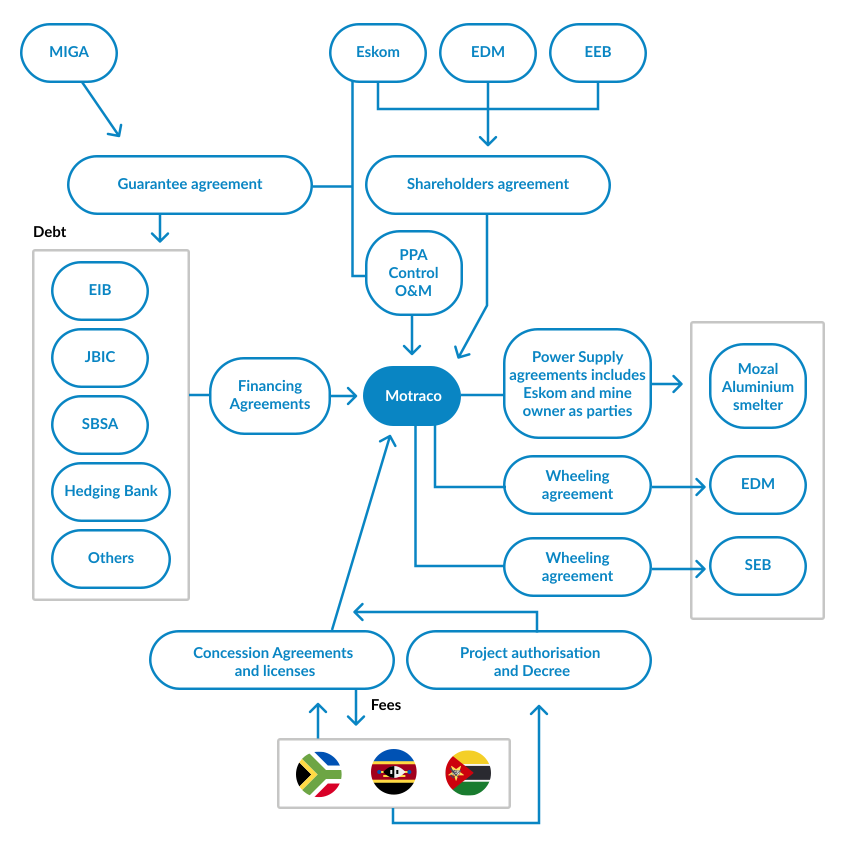
The Mozambique Transmission Company (MOTRACO) was founded in 1998 as a joint venture between the government utilities of Mozambique (Electricidade de Moçambique — EDM), South Africa (Eskom) and Eswatini (Swaziland Electricity Board, now Eswatini Electricity Company — EEC). MOTRACO is a joint venture company that has as its aim the efficient provision of electricity to businesses in all three countries. It should be noted that government support in the form of assisting with transmission licensing and regulation in the three countries at a time when only state utilities had transmission licenses was critical to ensure MOTRACO could become an IPT company (although state-owned).
The “anchor” customer was the Mozal aluminium smelter plant, 20 km outside Maputo. The aluminium plant had significant electricity demands and was willing to pay MOTRACO a wheeling charge for the reliable energy it received. The aluminium plant paid the cost of electricity purchased from ESKOM. The fixed portion of the wheeling charges relating to the energy transmission covered debt service and operational expenditure of MOTRACO. The management, maintenance, and control of the MOTRACO network were outsourced to Eskom.
EDM and EEC also have independent wheeling contracts with MOTRACO. This allows the utilities to participate in SAPP and trade power in both directions (i.e. import power from the market when supply is constrained and export to the market when surpluses are available).
The initial phase of the investment, worth US$ 93 million, was completed in mid-2000. MIGA issued guarantees to Eskom to cover loan guarantees to the European Investment Bank and the Japan Bank of International Cooperation for their investments in MOTRACO to cover the investment against the risks of expropriation, war and civil disturbance. The French development agency AFD provided additional financing for later stages.
The deal has subsequently grown to link to the wider Southern African Power Pool. The transmission interconnection benefited both Mozambique and Eswatini by improving the quality of electricity distributed to the population in those countries.
Of note was the fact that there was an “anchor” customer, thereby reducing “demand risk” (see Chapter 11. Common Risks for a further explanation of demand risk). It further benefited from a guarantee from Eskom. At the time of granting this guarantee, Eskom had a stand-alone investment-grade credit rating. The MIGA cover was taken to protect the Eskom balance sheet against political risk.
The project provided the industrial company Mozal with a reliable supply of electricity to meet its increased production and industrialisation of Mozambique post-civil war, at the same time as strengthening the energy supply networks of Eswatini and Mozambique. For EEC and EDM, the transmission infrastructure helped lower the cost of energy and increase its availability, as well as to increase the reliability and security of interconnected systems in the region. By becoming active trading partners in the SAPP, both countries benefited from low-cost power purchase in the SAPP market.
Other examples of successful cross-border projects
Many successful cross-border projects have occurred outside Africa as well.
Several cross-border lines exist across varying European Union countries (including more than 80 cross-border interconnections between the EU and neighbouring countries). The further development of cross-border transmission infrastructure is designed to meet the EU's external policy objectives, including energy transition (and the integration of renewable energy), security of supply as well as regional and local socio-economic welfare, economic cooperation, peace and solidarity. There are many political and economic reasons for a country to cooperate with neighbouring countries and benefit from existing and future interconnectors.
Some other international cross-border transmission projects include:



|
Paraguay-Brazil (Itaipu 12,600 MW Hydro) and Paraguay-Argentina (Yacyreta 3,100 MW Hydro); Paraguay surrendered operating control of the hydro plants to Brazil and Argentina, respectively. |

|
Uruguay and Argentina agreed to share the energy generated from the Salto Grande hydro plant (1,890 MW), with Uruguay consuming 50% of the energy and Argentina consuming 50% of the energy. |
|
|
The CIEN lines built by ENDESA connecting Argentina and Brazil (back-to-back interconnection) includes one line (1000 MW) with a firm contract and another (also 1000 MW), which is a merchant. |

|
Salta cross-border interconnection between Argentina and Chile built by AES (private company) to supply power to copper mines (in the north part of Chile). Salta thermal plant (640 MW) in Argentina is dedicated to supplying the mines in Chile. |






|
The SIEPAC (230kV line) synchronously interconnects six countries in Central America and allows up to 300 MW of trade within a regional electricity market. |


|
Two back-to-back (one 220kV and the other 400/500kV) interconnections between Georgia and Turkey; the latter is a merchant line. |
Private Sector Participation in Cross-border Projects
Private sector participation in cross-border projects has similar benefits to private funding of domestic transmission projects. These benefits include an increased mix of financing options and proper risk allocation and cost recovery methods. However, private participation in cross-border projects has its own complexities. Nonetheless, provided that the private sector developer(s) is empowered by the various governments, it can overcome some of the hurdles specific to the government-funded cross-border projects.
In this section, we will summarise some of the possible private-sector structures that could apply to cross-border projects.
IPT Models
The concept of an independent transmission project, as described in chapter 5. Independent Power Transmission (IPT) Projects above, can also apply to cross-border transmission infrastructure. In the earlier discussion, it was assumed a single local government or country defines the structure. For a cross-border project, the complexity of resolving the requirements for private participation extends to multiple governments. An example of this will be land acquisition. This will need to be agreed upon with multiple governments and the leasing structure for the rights-of-way will need to ensure that the long term titles are valid across all jurisdictions.
In short, all of the considerations that are required for a single-country project that need to be addressed and resolved are multiplied in cross-border transactions (e.g. how is political risk allocated between two countries if the event starts in one country but spills across to another).
The key risk to be addressed to allow IPT financing to take place is that of payment risk. An analysis will be required of the various users of the infrastructure. The tariff applicable to all jurisdictions would need to be considered. The payment risk for the transmission use of system charges or the capacity charges will also need to be addressed and this will get especially complex in default scenarios. One of the ways this can be resolved is for all of the government utilities to adopt joint and several liabilities with a defaulting utility. This may be possible although it will require complex inter-government negotiations.
Industrial demand-driven model
As seen from the MOTRACO example above, a public sector project can be done with an “anchor” industrial offtaker. This addresses one of the key risks as regards demand and payment risk. However, the need for an umbrella guarantee from one of the parties may still be required, depending on the creditworthiness of the other offtakers and the reliability of the industrial user.
Whilst this is not necessarily a privately funded model, the existence of a private-sector party in the overall structure will allow for different types of lenders to fund the cross-border infrastructure. Whereas previously only concessional funding may have been available from donors, the existence of an industrial offtaker allows the entry of commercial banks and DFIs, who can provide loans at commercial rates. The advantage of a model that is more linked to an industrial offtaker is the reduction in the impact on the respective governments’ balance sheets.
Merchant power lines
In some instances where there is an operating regional market such as the SAPP, it may be possible to consider merchant transmission lines. We refer the reader to the earlier discussion on challenges in implementing a merchant transmission line in chapter 7. Other Private Funding Structures. These can work across borders. If, for example, country A has abundant resources that enable it to generate plentiful and cheap electricity but neighbouring country B has no such resources and is reliant on importing fuel to burn for expensive electricity, it is conceivable that a private sector developer could develop, finance and build a transmission line that is used to connect one country’s grid to a particular plant (or simply to the other country’s grid). The project company in this instance would earn revenues from “wheeling” or use-of-system charges payable by country B. Similar cross-border merchant lines have been delivered in the US and Australia, for example (across state borders).
Private sector example
An interesting example of a cross-border project done by a private company is the Zambia-DRC interconnector developed by CEC in Zambia. As a private whole-of-the-grid in the Copperbelt region licensee, CEC was able to develop and implement the cross-border transmission line. The line is used by SAPP members to trade power between SNEL in the DRC and other members. CEC benefits from wheeling charges as well as trading of energy across the line.
Summary of Key Points
- Cross-border projects are transmission infrastructure projects that span over two or more neighbouring countries, creating a transmission interconnection between the electricity networks of the respective countries.
- Cross-border projects are not new to the African continent. There are many successful interconnector projects both in Africa and globally.
- The benefits of undertaking a cross-border transmission project interconnecting neighbouring countries are numerous, including grid stability, system control, and trade benefits.
- Despite the benefits, there are also many challenges and constraints to developing cross-border transmission infrastructure, in particular the raising of funding and facilitation of private sector participation.
- The joint development aspect and joint fundraising of multiple countries is a nuance that creates complexity with cross-border transmission projects.
- Challenges in raising funding for cross-border projects can arise due to existing utility or government financial constraints.
- Project finance fundraising is challenging for cross-border projects as project finance funders would not be likely to take the “demand risk”.
- Development Finance Institutions provide the government with excellent sources of capital for funding cross-border transmission lines, provided the business case and the project preparation are well-conceived.
- Where there are two or more countries, a multiplicity of legal and regulatory regimes may govern the development and procurement of the interconnection infrastructure, which may create complexity and delays at the development stage of the project.
- Whilst a domestic regulator’s legal authority and mandate emanate from domestic law, regional regulators typically have a mandate through contract, for example, where power pool members agree contractually to abide by the membership rules of the power pool, including decisions by the regional regulator.
- When considering the complexity and cost of a regional cross-border interconnection project to host governments and utilities, it would appear to be an area of transmission development that may be well suited to private sector involvement.
- Possible private-sector structures that could apply to cross-border projects are:
- IPT models;
- industrial offtake model; and
- merchant power lines.